
How to Configure Cranes for New Energy Equipment Manufacturing
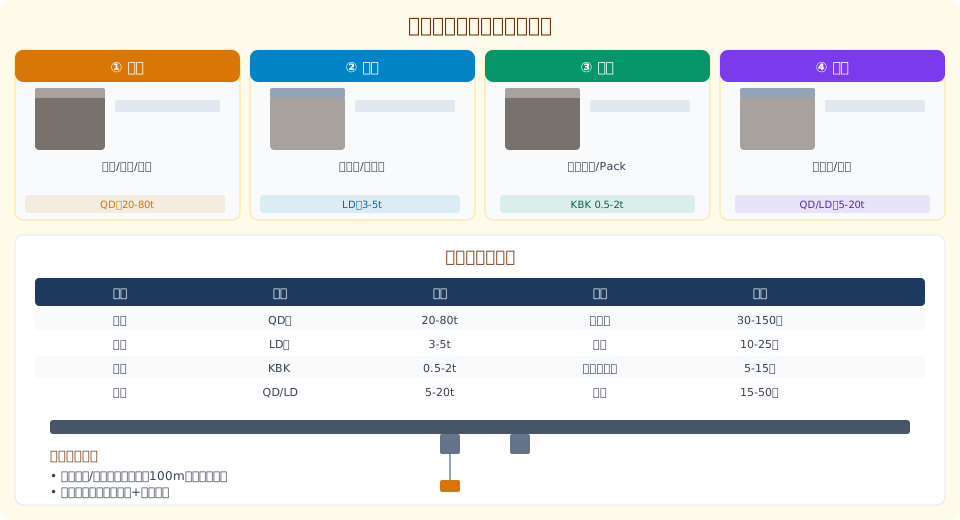
Cranes for new energy equipment manufacturing are configured across four sectors: wind, solar, storage, and hydrogen. For wind blade and nacelle handling, QD Type double-girder cranes in the 20–80t range handle large components; solar laminating machines use LD Type clean-room cranes (3–5t); battery storage assembly lines rely on KBK workstation cranes (0.5–2t) with anti-static protection; and hydrogen electrolytic cell production calls for QD/LD Type explosion-proof cranes (5–20t). Whole-plant solutions range from approximately $22,200 to $222,500.
Wind Power Manufacturing: Large-Scale Hoisting for Blades and Nacelles
Wind turbine blades range from 30 to 100 m in length and weigh 5–20t. Nacelle assemblies tip the scales at 20–80t. The recommended solution is a QD Type double-girder crane rated for 20–80t. Blade molds (fiberglass or carbon fiber) are oversized—35 to 110 m long—with a dead weight of 10–30t. Kelude's wind power division deploys wide-span QD Type cranes (24–36 m span) fitted with dedicated long-size spreader beams for blade handling, featuring adjustable suspension point spacing from 5 to 20 m.
Wind power tower sections are manufactured in segments (each 15–30 m long, 20–60t), requiring QD Type cranes for plate bending, longitudinal seam welding, and flange tack-up. Gearboxes and generators are assembled inside the nacelle, which moves along the assembly line under continuous crane coverage.
Solar Equipment Manufacturing: Clean-Room Solutions for Laminator Assembly Lines
Solar laminating machines are the core equipment on module production lines, with upper and lower frames weighing 3–5t. The recommended solution is an LD Type clean-room crane rated for 3–5t. Solar workshops maintain a Class 10,000 clean-room environment, so cranes are fitted with stainless steel hooks, food-grade lubrication, and sealed electrical enclosures. Kelude's solar equipment cranes meet the industry's clean-room specifications.
Energy Storage Manufacturing: Anti-Static KBK Systems for Battery Module Assembly
Individual battery modules on energy storage assembly and pack lines weigh 10–50 kg. Fully automatic assembly lines use KBK 0.5–2t workstation cranes for complete coverage. Lithium-ion batteries are electrostatic discharge (ESD) sensitive, so the KBK system requires full-line ESD grounding with a grounding resistance of ≤1Ω. Kelude's storage division KBK systems use conductive nylon sheaves with copper braided grounding straps.
Hydrogen Equipment Manufacturing: Explosion-Proof Solutions for Electrolytic Cells
Electrolytic cells (alkaline and PEM) weigh 5–20t per unit, and hydrogen workshops require Ex d IIC T4 explosion-proof protection. The recommended solution is a QD Type or LD Type explosion-proof crane rated for 5–20t. Kelude's hydrogen-grade explosion-proof cranes feature a fully explosion-proof electrical system.
Wind Power QD Type20-80t Large Span | Photovoltaic (PV) LD Type3-5t Clean | Energy Storage KBK 0.5-2t ESD |
Hydrogen Energy QD/LD5-20t Explosion-proof | ESDGrounding ≤1Ω+conductive pulley | Plant-Wide 15-15010k |
Configuration Table for Four Types of New-Energy Cranes
| Equipment | Model | Capacity (tonnage) | special requirements | Core | investment |
|---|---|---|---|---|---|
| Wind Power | QD Type | 20-80t | Large Span24-36m | blade/tower | 30-15010k |
| Photovoltaic (PV) | LD Type | 3-5t | Class 10k Cleanroom | laminating machine | 10-2510k |
| Energy Storage | KBK | 0.5-2t | ESDanti-static | Battery Module | 5-1510k |
| Hydrogen Energy | QD/LD | 5-20t | Ex d IIC T4 | Electrolytic Cell | 15-5010k |
Kelude Heavy Industry provides crane solutions for the new-energy equipment manufacturing sector, covering large-scale wind-power hoisting, clean-room handling for photovoltaic production, ESD anti-static systems for energy storage, and explosion-proof applications across the full hydrogen-energy spectrum.
Oversized Wind Power QD Type20-80t+Large Span24-36m+blade Long Spreader Beam | PV Cleanroom Class 10kSealing+Stainless Steel Hook+food-grade lubrication | Hydrogen Energy Explosion-proof Ex d IIC T4Full Explosion-Proof Electrical System |
FAQ: Crane Solutions for Specialized Applications
Q: What lifting spreader is used for wind turbine blade mold hoisting?
A: Blade molds range from 35 to 110 m in length, requiring long spreader beams with adjustable suspension point spacing of 5–20 m. Kelude supplies purpose-built lifting spreaders for wind turbine blade molds.
Q: What cleanroom class is required for photovoltaic workshops?
A: ISO Class 7 (10,000-class) cleanroom. Cranes must feature sealed electrical enclosures, stainless steel construction, and food-grade lubrication.
Q: Why is ESD protection necessary in energy storage battery production lines?
A: Lithium-ion batteries are highly sensitive to electrostatic discharge. ESD grounding resistance must be ≤1 Ω. Kelude's KBK systems feature full-system grounding.
Q: What explosion protection class is needed for hydrogen energy workshops?
A: Hydrogen environments require Ex d IIC T4 (the highest rating). Motors, electrical components, and limit switches must all be explosion-proof.