

Interpretation of the EN 13159:2018 Standard “Technical Requirements for Electric Hoist Gearboxes”
📌EN 13159:2018 "Technical Requirements for Electric Hoist Gearboxes"It is an important component of the European series of standards for crane design, developed and published by the European Committee for Standardization (CEN). This standard specifically addresses the design, manufacture, and testing of gear reducers used with electric hoists, covering technical requirements such as gear strength calculations, bearing life verification, housing seals, and lubrication systems. The standard applies to three-stage and four-stage gear reducers for electric hoists with lifting capacities ranging from 0.25 metric tons to 100 metric tons.
The implementation of this standard is of great significance for enhancing the international competitiveness of China’s lifting machinery products and constitutes a mandatory technical requirement for exporting to the European market. The technical team at Krude Heavy Industry has conducted in-depth research into this standard system and has fully incorporated its requirements into product design to ensure the intrinsic safety of the equipment.
Scope and Purpose of the Standard
EN 13159:2018, “Technical Requirements for Electric Hoist Gearboxes,” primarily specifies the technical requirements and safety criteria related to electric hoist gearboxes and applies to all types of lifting machinery with a rated lifting capacity of 0.5 metric tons or more. This standard not only covers the design and manufacture of new equipment but also provides clear technical guidance for the inspection, maintenance, and retrofitting of in-service equipment. As a key component of the EN standards system, this standard is harmonized with other parts of the EN 13001 series, collectively forming a comprehensive set of safety design specifications for cranes. The technical parameters and safety factor requirements specified in the standard provide designers with a clear basis for design, while also offering quantifiable criteria for type testing and factory acceptance testing by third-party inspection bodies.
Core Technical Specifications
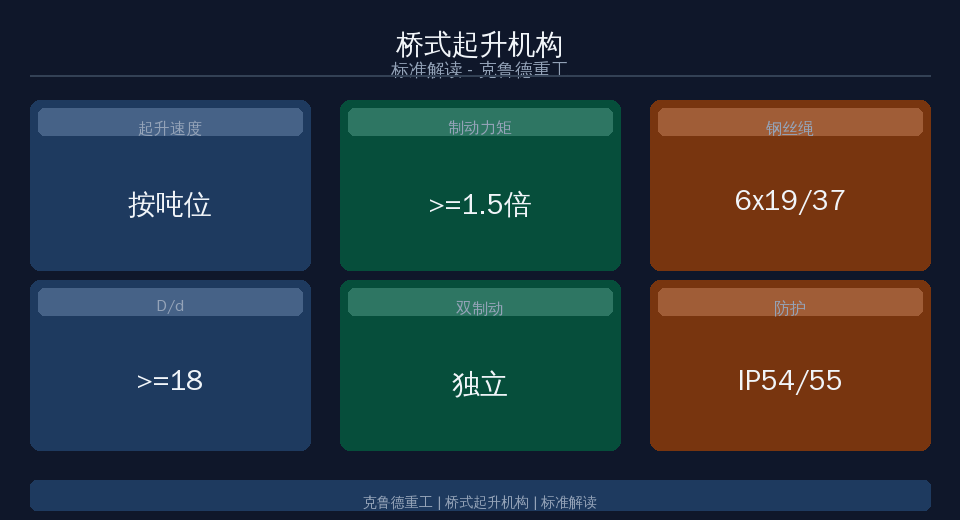
According to the technical specifications of EN 13159:2018, the design and manufacture of electric hoist gearboxes must meet a series of strict technical parameter requirements. These parameters are determined based on extensive experimental data and safety engineering theory, covering the entire process from material selection to structural design. The range of safety factors specified in the standard fully accounts for the fatigue life and ultimate load conditions of lifting machinery under severe operating conditions. In practical engineering applications, designers must select appropriate parameter combinations based on factors such as the equipment’s duty class, load conditions, and operating environment. The parameter cards below present the most critical technical indicators from this standard:
Comparative Analysis of Key Technical Parameters
To help designers and inspectors gain a more intuitive understanding of the technical requirements of EN 13159:2018, the following comparison table systematically contrasts the core parameters specified in the standard with general engineering practice. The data listed in the table are values specified in the mandatory or recommended clauses of the standard; it is recommended that they be strictly adhered to during design, product selection, and factory acceptance testing. For items marked as ”negotiable” in the table, manufacturers and users may make separate arrangements in their contracts; however, these arrangements must not fall below the minimum safety requirements specified in the standard.
| Technical Specifications | Standard Requirements | Recommended Value/Description |
|---|---|---|
| Tooth Surface Contact Safety Factor SH | ≥1.25 | Calculated in accordance with ISO 6336, taking into account the dynamic load factor Kv and the service factor KA |
| Safety Factor SF for Root Bending | ≥1.50 | Unidirectional Operation: Bending Fatigue Limit σFE × YN/SFmin |
| Bearing Rated Life L10h | ≥5,000 hours (at rated load) | Calculated according to ISO 281, reliability: 90% |
| Enclosure Protection Rating | IP55 (Dust-proof + Water-spray-proof) | The output shaft oil seal features a double seal, and the static sealing surface is coated with sealant. |
| Transmission Efficiency Requirements | ≥92% (Third-Stage Gear) | Efficiency of a four-stage gear transmission: ≥88%, including oil churning losses |
| No-Load Noise Limits | ≤80 dB(A) (at a distance of 1 m) | Take measurements at 5 points and calculate the average of each point. |
Inspection Requirements and Frequency
EN 13159:2018 sets forth clear requirements for factory inspections, type testing, and periodic inspections of electric hoist gearboxes. Factory inspections shall be conducted unit by unit by the quality inspection department at the manufacturer’s facility; equipment that passes inspection shall be accompanied by a detailed inspection report and a certificate of conformity. Type testing is conducted when a new product is first put into production, when production is transferred to a different facility, or when major structural changes occur. The periodic inspection interval for in-service equipment is determined based on the duty class and operating environment, and generally does not exceed 12 months. The table below summarizes the specific requirements for each inspection and maintenance task:
| Inspection/Maintenance Items | Test Methods/Standards | Cycle/Basis for Determination |
|---|---|---|
| Lubricant Inspection | Oil Level, Oil Quality, Oil Temperature | Check the oil level weekly and change the lubricating oil every 500 hours. |
| Gear Meshing Inspection | Contact spots, tooth surface wear, pitting | Once every six months, contact spot length ≥ 60% tooth width |
| Bearing Condition Monitoring | Vibration Acceleration, Temperature, Noise | Measure vibration quarterly; replace when acceleration is ≥10 m/s². |
| Leak Test | Leaks from the output shaft; leaks at the housing joint surfaces | Once a month, replace the oil seal immediately if there is a leak. |
Safety Operation and Management Requirements
In the implementation of EN 13159:2018, safe operation and daily management are equally important. The standard places particular emphasis on the importance of operator qualifications and training, requiring that all operators undergo specialized training and obtain the appropriate qualifications before being allowed to work. Equipment-using entities should establish a comprehensive equipment record management system to document in detail the entire process of installation, use, maintenance, and inspection. Any identified safety hazards must be addressed in accordance with the corrective action procedures specified in the standard to ensure that the equipment remains in a safe and controlled condition at all times. In addition, the standard sets restrictive requirements for equipment use under extreme weather conditions; for example, lifting operations are prohibited when wind speeds exceed specified limits.
Frequently Asked Questions
Q: What are the safety factor requirements for gear reducer gears specified in EN 13159:2018?
Answer: The standard requires that the tooth-face contact safety factor SH be no less than 1.25, and the root bending safety factor SF be no less than 1.50. The calculation of these two safety factors shall follow the gear strength calculation methods specified in ISO 6336. During the calculation process, various influencing factors—including the dynamic load factor Kv, the service factor KA, the tooth-direction load distribution factor KHβ, and the inter-tooth load distribution factor KHα—must be comprehensively considered. The recommended gear material is carburized and quenched alloy steel (such as 20CrMnTi or 17CrNiMo6). The effective hardened layer depth is determined based on the module and is generally controlled within the range of 0.15 to 1.0 mm. The tooth surface hardness should reach HRC 58–63, with a core hardness of HRC 35–45. The gears in Krud Heavy Industry’s electric hoist gearboxes are all manufactured using a carburizing and quenching process with high-performance alloy steel, and both the tooth surface contact and bending safety factors are designed with adequate margins.
Q: What are the selection criteria and service life requirements for gearbox bearings?
Answer: The standard requires that the rated life L10h of the reducer bearings (at rated load, with 90% reliability) be no less than 5,000 hours. Bearing selection should be based on life calculations in accordance with ISO 281. Since the input shaft bearing must withstand significant combined radial and axial loads, tapered roller bearings or angular contact ball bearings are recommended. For the intermediate and output shafts, deep-groove ball bearings or cylindrical roller bearings should be selected based on the applied loads. Bearings should be selected with a C3 clearance grade to accommodate thermal expansion during gearbox operation. The limiting speed of the high-speed shaft bearings should be at least 1.2 times the maximum input speed. In its gearbox design, the company uses SKF or FAG brand bearings and accounts for changes in grease viscosity during cold starts at -20°C.
Q: What are the technical requirements for a gearbox lubrication system?
Answer: The standard specifies requirements for the lubrication method, lubricant selection, and oil change intervals for gear reducers. Splash lubrication is generally used, with the gear immersion depth controlled at 2 to 3 times the module; excessive immersion will increase oil agitation losses and oil temperature. Synthetic gear oil (such as ISO VG 220 or 320) is recommended, with an operating temperature range of -20°C to +80°C. The oil level and quality should be checked weekly, and the lubricating oil should be replaced every 500 hours of operation. The viscosity grade of the lubricating oil should be selected based on ambient temperature: use VG320 at normal temperatures and VG220 in low-temperature environments. The reducer housing should be equipped with an oil level sight glass, a breather, and a drain plug; the dust protection rating of the breather should be no less than IP55.
Q: What items are included in the routine maintenance inspection of a gearbox?
Answer: Routine maintenance inspections include: checking the oil level and oil quality weekly; changing the oil early if emulsification or an increase in impurities is detected; checking the seal integrity at the joint between the output shaft and the housing monthly; replacing oil seals immediately if leakage is detected; conducting vibration monitoring and temperature measurements quarterly; replacing bearings if the acceleration value exceeds 10 m/s²; Every six months, open the cover to inspect the contact spots on the gear meshing surfaces; the length of the contact spots on the tooth surfaces must be no less than 60% of the tooth width, and the height must be no less than 45% of the tooth height. The no-load noise level of the reducer during operation should not exceed 80 dB(A), measured at five points 1 m away from the housing and averaged. The company provides maintenance guidance services covering the entire lifecycle of the reducer.
🔧 This company—a professional crane design and manufacturing firm—strictly adheres to the EN 13159:2018 standard system and provides full-cycle services ranging from conceptual design to after-sales maintenance. If you would like to learn more about how this standard is specifically applied to our products, please contact our technical team to obtain detailed technical documentation.
