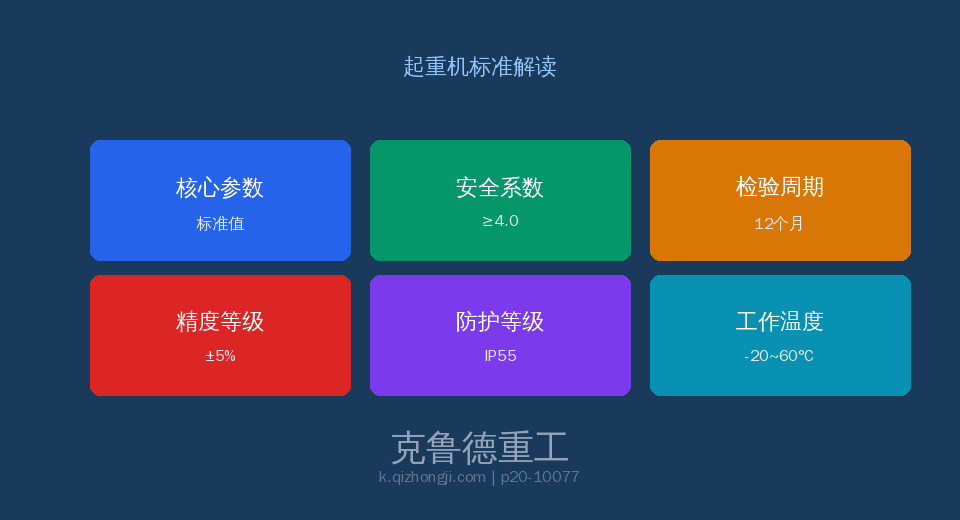

FEM 9.911 Electric Lighting System Standard Explained
FEM 9.911 — Electric Lighting System Specification is a key technical standard in the crane industry, dedicated exclusively to the design of electric lighting systems for lifting appliances.
The standard provides a unified technical basis for design personnel, inspection bodies, and end users. Kelude strictly adheres to its technical requirements throughout product development and manufacturing.
Scope and Positioning of the Standard
FEM 9.911 defines the technical requirements and safety indicators for electric lighting systems on cranes, covering all types of lifting appliances with a rated lifting capacity above 0.5 t. The standard applies not only to the design and manufacturing of new equipment, but also provides clear technical guidance for the inspection, maintenance, and modification of cranes already in service. As a key component of the crane standard system, it aligns with the EN 13001 Crane Safety Standard series and ISO 4309 Wire Rope Inspection Standard, together forming a complete framework of technical specifications. The explicit technical parameters and safety factor requirements give design personnel a clear design basis, while also providing third-party inspection bodies with quantifiable acceptance criteria for type tests and factory acceptance tests.

Core Technical Parameter Framework
Under FEM 9.911, the design and manufacturing of electric lighting systems must satisfy a stringent set of technical parameters. These values are established through extensive test data and safety engineering theory, covering the full spectrum from material selection to structural design. The safety factor ranges specified in the standard account for fatigue life and limit load conditions in demanding operating environments. In engineering practice, design personnel must translate these requirements into concrete design parameters, ensuring that the load capacity of every component meets the applicable safety requirements.
Comparative Analysis of Key Parameters
| Item | technical requirements | Description |
|---|---|---|
| illuminance Standard | Operator150lux/Walkway50lux/Exterior20lux | Not Affecting Operational Safety |
| Protection Rating (IP) | Luminaire IP54/Switch IP65 | Outdoor IP65 |
| Voltage Grade | Main Lighting AC220V/Local DC36V | Not Affecting Operational Safety Voltage Shock Protection |
| Emergency Lighting | Automatic Illumination upon Power Failure≥90min | Independent Power Supply+UPS |
| Luminaire Type | LEDVibration-Resistant(Preferred)/Classic Explosion-proof | Explosion-proof Area Use Explosion-Proof Light |
| Switch Location | Ground-Level Entrance+Inside Operator | Convenient Switching without Interference |
Inspection Requirements and Intervals
FEM 9.911 sets forth explicit requirements for Factory Acceptance Tests, Type Tests, and periodic inspections of electric lighting systems. Factory Acceptance Tests must be performed on every unit at the manufacturer's facility by the quality inspection department, and each certified unit must be accompanied by a detailed inspection report and a Certificate of Conformity. Type Tests are conducted when a new product enters production, when manufacturing is transferred to another facility, or when significant structural changes are introduced. For cranes already in service, the periodic inspection interval is determined by the work duty/classification and operating environment, generally not exceeding 12 months. For heavy-duty cranes operating continuously at A7 to A8 duty levels, the inspection interval should be shortened to 6 months.
| Item | technical requirements | Description |
|---|---|---|
| Luminaire Inspection | Damage/Aging/Protection | Monthly+Replace upon Detection |
| Emergency Lighting | Simulated Power Failure Testing | Monthly+≥90min |
| illuminance Measurement | illuminance Meter Measurement | Annual+≥Standard Value |
| Switch Circuit | Contact/insulation | Annual+No Disconnection |
Safe Operation and Management Requirements
Safe operation and routine management play a critical role in the implementation of FEM 9.911. The standard places particular emphasis on operator qualification and training, requiring that all operators complete specialized training and obtain the necessary certifications before being allowed to operate the equipment. User units must establish a comprehensive equipment file management system that documents the full lifecycle of the equipment, including installation, operation, maintenance, and inspection. Any safety hazards identified must be addressed through the rectification procedure specified in the standard to ensure the equipment remains safe and controllable at all times. Additionally, the standard imposes restrictive requirements on equipment usage under extreme operating conditions.
FEM 9.911 FAQ: Lighting, Protection, and Inspection
Q: What are the illuminance requirements under FEM 9.911?
A: 150 lux in the operator's cab, 50 lux on walkways, and 20 lux for external areas. Insufficient illuminance can compromise operational safety.
Q: What are the Protection Rating (IP) and voltage grade requirements?
A: Luminaires must meet IP54, and switches must meet IP65. Main lighting operates at AC220V, while local lighting uses DC36V safety voltage.
Q: What are the Emergency Lighting requirements?
A: Emergency lighting must activate automatically upon power failure and maintain operation for at least 90 minutes. It requires an independent Power Supply. Monthly simulated power-outage Testing is mandatory.
Q: What are the requirements for luminaire selection and Inspection?
A: LED anti-vibration luminaires are preferred, with Explosion-Proof Light required in hazardous areas. Monthly inspections check for damage and Aging. Annual illuminance measurements are also required.
Kelude Heavy Industry — Specialized in crane design and manufacturing, with products strictly compliant with the FEM 9.911 Standard system.