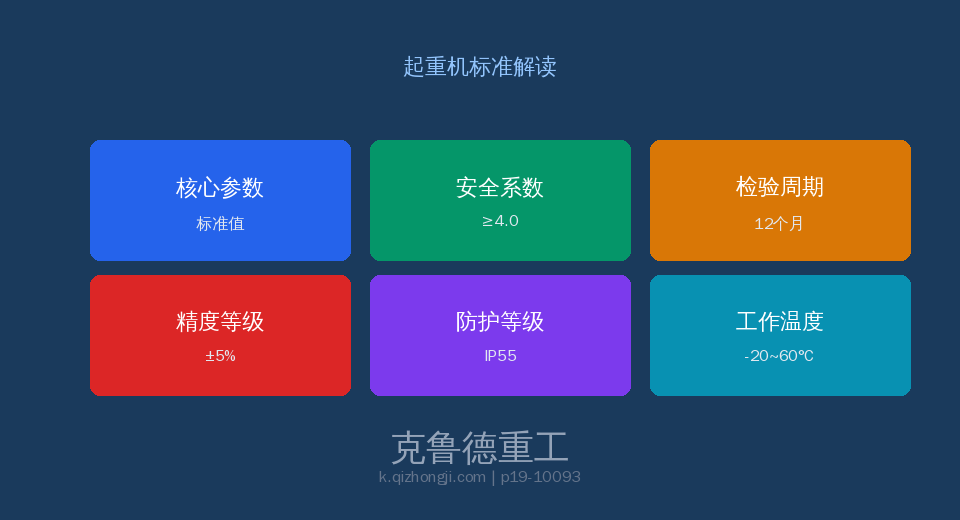

ISO 24619:2022 Crane IoT Interface Specification Explained
ISO 24619:2022 Crane IoT Interface Specification is a key technical standard for the crane industry, developed by the International Organization for Standardization.
It provides a unified technical basis for design personnel, inspection bodies, and users. Kelude strictly adheres to its technical requirements throughout product development and manufacturing.
Scope and Application of the Standard
ISO 24619:2022 defines the technical requirements and safety indicators for IoT interfaces on cranes, covering all types of lifting appliances with a Rated Lifting Capacity above 0.5t. The standard applies not only to the design and manufacturing of new equipment but also provides clear technical guidance for the inspection, maintenance, and modification of existing machinery. As a critical component of the crane standard system, it aligns with the EN 13001 Crane Safety Standard and ISO 4309 Wire Rope Inspection Standard, forming a comprehensive technical framework. Its clearly defined technical parameters and Safety factor requirements give design personnel a solid design basis, while offering quantifiable acceptance criteria for third-party inspection bodies conducting Type Tests and Factory Acceptance Tests.

Core Technical Parameters
Under ISO 24619:2022, the design and manufacturing of crane IoT interfaces must meet a stringent set of technical parameters. These values are derived from extensive test data and safety engineering principles, covering everything from material selection to structural design. The standard's specified Safety factor ranges account for the fatigue life and limit load conditions of lifting appliances in severe operating conditions. In engineering practice, design personnel must translate these requirements into concrete design parameters, ensuring that the load capacity of every component meets the required safety requirements.
Comparative Analysis of Key Parameters
| Item | technical requirements | Description |
|---|---|---|
| Interface Protocol | MQTT/OPC UA/Modbus TCP | Compatibility HTTP API |
| Data Format | JSON(Priority)/XML | Structured Data Field Definition |
| Security Certification | TLS 1.2+Client Certificate/Token | encrypted data transmission |
| latency | Local≤10ms/Cloud≤100ms | Real-time Monitoring Maintenance Requirements |
| Compatibility | Backward Compatibility Modbus RTU/Profibus | Seamless Integration with Legacy Equipment |
| Hardware | Io T gateway+SDK/Data Acquisition Module | Industrial-grade Design |
Inspection Requirements & Intervals
ISO 24619:2022 sets out explicit requirements for Factory Acceptance Tests, Type Tests, and periodic inspections of crane Internet of Things (IoT) interfaces. Factory Acceptance Tests must be performed on each unit by the quality inspection department at the manufacturer's facility, and equipment that passes inspection must be accompanied by a detailed inspection report and a certificate of conformity. Type Tests are required when a new product enters production, when manufacturing is transferred to a different facility, or when significant structural changes are made. The periodic inspection interval for in-service equipment is determined by its work duty and operating environment, generally not exceeding 12 months. For heavy-duty cranes operating continuously at Work Duty Levels A7 through A8, the inspection interval should be shortened to 6 months.
| Item | technical requirements | Description |
|---|---|---|
| Communication Testing | Protocol Compatibility/Data Integrity | Quarterly+latency Testing |
| Security Inspection | Certificate Validity/Encryption Configuration | Annual+Certificate Renewal |
| Equipment Status | Gateway Operation/Connection Status | Monthly+Power-on Self-test |
| data storage | Cloud Data Integrity | Monthly+Backup Verification |
Safe Operation and Management Requirements
Under ISO 24619:2022, safe operation and routine management play a critical role in crane operations. The standard places strong emphasis on operator qualification and training, requiring that all operators complete specialized training and obtain the necessary certifications before being allowed to operate equipment. User units must establish a comprehensive equipment file management system that documents the full lifecycle of the equipment, including installation, usage, maintenance, and inspection. Any safety hazards identified must be addressed through the rectification procedure specified in the standard to ensure the equipment remains safe and controllable at all times. Additionally, the standard imposes restrictive requirements on equipment usage under extreme operating conditions.
FAQ
Q: What interface protocols does ISO 24619 require?
A: MQTT (preferred) / OPC UA / Modbus TCP. Backward compatible with Modbus RTU and Profibus.
Q: What are the data security requirements?
A: TLS 1.2 encryption plus client certificate or token-based authentication. All data transmissions must be encrypted.
Q: What are the latency requirements?
A: ≤10ms locally, ≤100ms to the cloud. These thresholds must be met for real-time monitoring scenarios.
Q: What hardware deployment is required?
A: Industrial-grade IoT gateway with data acquisition modules. SDK development and integration supported.
Kelude Heavy Industry — Specialized in crane design and manufacturing, with products fully compliant with the ISO 24619:2022 standard system.