

Pneumatic Fixture TCO: Clamping Force, Energy & Maintenance
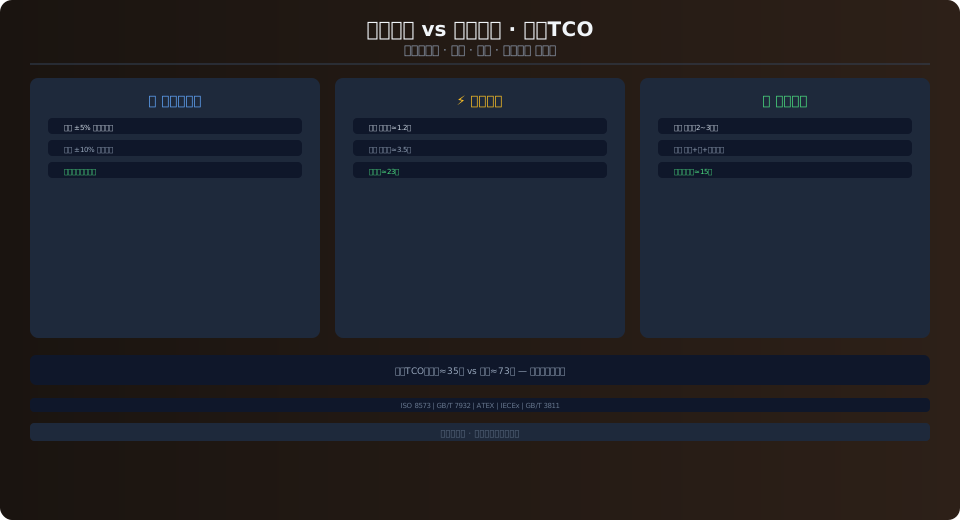
A 10t pneumatic fixture costs $150,000 to purchase, with a total ten-year spend of about $350,000. A hydraulic fixture of the same specification costs $120,000 upfront but totals roughly $730,000 over ten years—hydraulic is cheaper to buy but far more expensive to run, and the gap comes down to energy consumption and maintenance.
Initial Investment: Where Pneumatic Costs More
| Cost Item | Pneumatic | Hydraulic | Difference |
|---|---|---|---|
| Fixture Main Body | 8~10Ten Thousand | 6~8Ten Thousand | +2Ten Thousand |
| Power Source | air compressor Allocation1.5Ten Thousand | Hydraulic Power Unit2~3Ten Thousand | -1Ten Thousand |
| Piping | stainless steel pipe1~2Ten Thousand | High-Pressure Hose2~3Ten Thousand | -1Ten Thousand |
| Total | Approx.13~15Ten Thousand | Approx.10~12Ten Thousand | +2~3Ten Thousand |
Pneumatic systems demand higher precision from cylinders and valve manifolds, but that initial cost gap is typically erased within a year by maintenance savings.
10-Year Energy Costs: The Hidden Differentiator
A hydraulic power unit must maintain system pressure even when idle, drawing 1.1–1.6 kW against a 5.5 kW rated power. Over 6,000 annual operating hours, idle consumption alone costs roughly ¥6,240, plus ¥8,000 in working energy—totaling about ¥15,000 per year. In contrast, a pneumatic system's air compressor only kicks in when pressure drops below the setpoint, achieving roughly 40% duty cycle. A 3 Nm³/min compressor draws about 2.2 kW, translating to approximately ¥10,560 in annual electricity. Over ten years: hydraulic ≈ ¥150,000 vs. pneumatic ≈ ¥10,000. The advantage widens under intermittent duty—hydraulics run idle 70% of the time, while pneumatic compressors cycle automatically.
Maintenance Comparison: Oil Changes vs. Seal Replacements
Hydraulic systems require annual oil sampling to check cleanliness, water content, and acid number—any exceedance triggers a full change. A 200 L refill costs about ¥12,000, plus ¥3,000 for filters and ¥5,000 for high-pressure hose replacement every 2–3 years. Ten-year maintenance totals ¥200,000–250,000. Pneumatic systems mainly need cylinder seal replacement (every 2–3 years, ¥3,000–5,000) and valve spool cleaning (¥1,000–2,000 annually), bringing the decade total to ¥50,000–80,000. Reference: ISO 4301 Crane Design Standard and ISO 8573.
10-Year TCO Comparison
Pneumatic: ¥150,000 + ¥10,000 + ¥70,000 = ¥330,000–350,000. Hydraulic: ¥120,000 + ¥150,000 + ¥220,000 + ¥30,000 waste oil disposal = ¥500,000–550,000. The ¥200,000 gap over ten years equals the cost of a new fixture. Even factoring in a dedicated air compressor (¥30,000–50,000), pneumatic TCO of ¥380,000–400,000 still undercuts hydraulic.
Pneumatic Fixture Design Calculation Formulas
| Calculation Item | Formula | Example(Φ100/0.6MPa) |
|---|---|---|
| Pneumatic Cylinder Thrust Force F_push | F=P×π D²/4×η | 0.6×3.14×100²/4×0.85=4,000N |
| Pneumatic Cylinder Tension Force F_pull | F=P×π(D²-d²)/4×η | d=25mm3,750N |
| Gripping Force F_clamp | F_clamp=F_push×Leverage Ratio×Friction Coefficient | Lever2:1Friction0.32,400N |
| Air Consumption Q | Q=(π D²/4)×L×(P+0.1)/0.1 | Stroke200mm Approx.16NL/Cycles |
High-Temperature Design for Pneumatic Fixtures in Steel Mills
In steel and aluminum plants, the biggest challenge for pneumatic fixtures isn't clamping force—it's heat destroying the cylinder seals. Standard cylinders use nitrile rubber (NBR) seals rated for a maximum of 80°C. At steel coil gripping stations, the fixture sits just 0.5–1 m from coils at 700°C, pushing ambient air temperature around the piston rod to 120–180°C—far beyond NBR's limits. The solution works in three tiers. First is passive heat shielding: a mirror-polished stainless steel reflector (reflectivity >90%) plus a ceramic fiber insulation layer (thermal conductivity <0.1 W/m·K) between the cylinder and heat source cuts radiated heat by 70–80%. Second is active cooling: heat-dissipating fins on the piston rod (increasing surface area 3–5×) with clean compressed air forced across the rod for convective cooling (air consumption ≈5–10 NL/s). Third is material upgrades: switching cylinder seals from NBR to FKM (rated 200°C) or FFKM (rated 300°C), and upgrading the end caps and piston from aluminum to ductile iron—whose thermal expansion coefficient is closer to steel, minimizing clearance changes at high temperatures.
Cost breakdown for the three protection tiers: passive shielding runs about $300–$740, active cooling $740–$1,480, and material upgrades $1,480–$2,960. For a station lifting steel coils 300 times a day, unprotected NBR seals last only 1–2 months—meaning 6–12 seal replacements per year, each requiring 2–4 hours of downtime. Annual losses from downtime plus maintenance run roughly $7,400–$14,800. Investing about $2,960 in full thermal protection (shielding + cooling + FKM seals) extends seal life to 1–2 years—a payback period of under 3 months.
Pneumatic Fixture FAQs: Clamping Force, Leaks & Dust
Q: What is the maximum clamping force of a pneumatic fixture?
A: A single cylinder delivers up to 5 tons (Φ320 × 0.8 MPa). For higher forces, use multiple cylinders in parallel or an air-over-oil intensifier (up to 20 tons). With multiple cylinders, synchronization is critical.
Q: What should I do about air leaks?
A: For minor leaks, first tighten the joints. If leaking persists, replace the gasket. For valve manifold leaks, inspect the O-rings. Minor leakage (less than 5% of system pressure) is normal. However, if the compressor cycle interval drops below 1 minute, service is required.
Q: Can pneumatic fixtures be used in dusty environments?
A: Yes, with special protection. Fit the piston rod with a silicone-coated aramid fiber protective boot. Install a 5 μm filter at the air inlet. For conductive dust, ensure proper anti-static grounding.
Q: Can pneumatic and hydraulic fixtures be used together?
A: Technically yes, but we don't recommend it from a maintenance standpoint. Intertwined piping for the two systems makes troubleshooting confusing. If you must combine them, at minimum use color-coded lines, incompatible fittings, and physical separation.
For a cost-benefit analysis of pneumatic fixtures, contact the Kelude Heavy Industry engineering team.
