

Cleanroom Crane Selection for Class 1-5
In an ISO Class 1 cleanroom, a single 0.1μm particle is a reportable event—yet a standard overhead crane running for just one hour can shed thousands. You've switched to stainless steel and upgraded the lubricant, so why is the particle counter still climbing? Because the contamination sources go far beyond those two.
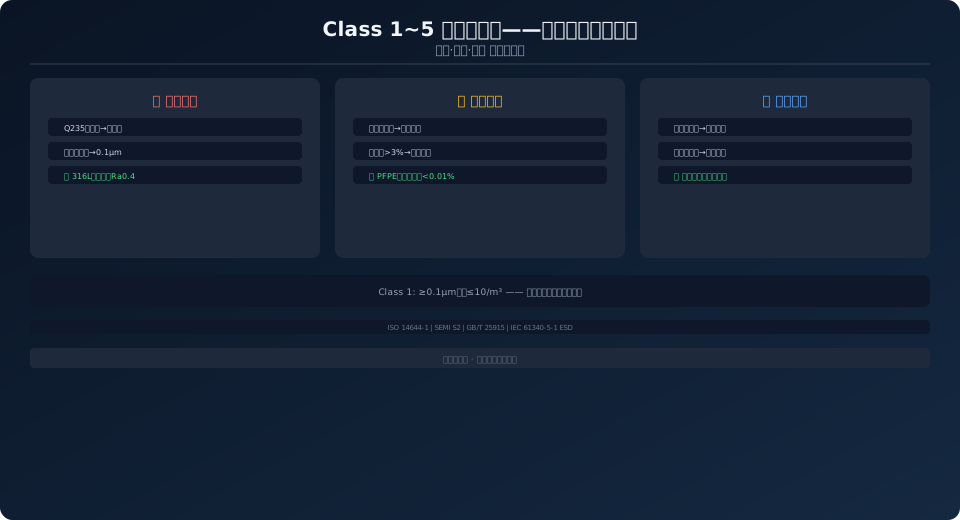
Quantified Cleanliness Limits for ISO Class 1–5 Cranes
ISO Class 5 permits no more than 3,520 particles ≥0.5μm per cubic meter; Class 3 caps ≥0.1μm particles at 1,000 per cubic meter; and Class 1 allows just 10 particles ≥0.1μm per cubic meter. A typical 30m × 10m × 6m cleanroom holds roughly 1,800 m³ of air—meaning the entire ≥0.1μm particle budget for an ISO Class 1 space is under 18,000 particles. A standard overhead crane running continuously for 10 minutes—with flaking paint, vaporized oil mist, and wire rope fiber shedding combined—can easily blow through that allowance.
Three Root Sources of Particle Contamination
Source 1: Surface material shedding. Painted Q235B (≈S235JR) components under vibration release paint dust in the 0.5–5μm range as the coating powders and flakes. Galvanized surfaces are more insidious—in low-humidity environments, zinc whiskers (1–5μm in diameter) grow on the surface; when they fracture, they become conductive metallic fibers that float freely. While 304L stainless steel doesn't shed paint, its as-rolled surface finish (Ra 1.6–3.2μm) is microscopically pitted and creviced—a perfect trap for contaminants.
Source 2: Lubricant volatilization. Standard lithium grease exhibits a 3%–5% evaporation rate at 30°C (ASTM D972). The vaporized oil condenses into 0.01–0.1μm organic particles, which in semiconductor processes become airborne molecular contamination (AMC) that adsorbs onto wafers and disrupts photolithography.
Source 3: Mechanical wear. Metallic micro-debris from gears, fiber fragments from brake linings, and fine powder from wire rope—these are inherent byproducts of crane operation. Unless these particle-generating sources are sealed and isolated, every other mitigation measure is futile.
Eliminating Each Contamination Source
Material strategy: For ISO Class 1–5 applications, use 316L stainless steel with electropolishing to Ra ≤0.4μm. Electropolishing also removes surface micro-cracks and residual stress from the base metal. Bolts and nuts must receive the same electropolishing or full-surface polishing treatment.
Lubrication strategy: PFPE (perfluoropolyether) grease offers an evaporation rate of <0.01%—roughly 50–100× lower than conventional grease. At ¥5,000–8,000/kg (approx. $740–$1,180/kg), it's a premium investment, but annual consumption for a single crane is only 2–3 kg.
Sealing strategy: Fully enclosed stainless steel bellows with a slight positive internal pressure (+10–30 Pa of clean nitrogen) provide a complete barrier. These bellows—made from 2–3 layers of 301 stainless steel—are rated for 1,000,000+ telescoping cycles. Design and work-duty classification follow the ISO 4301 standard, with duty levels from M5 to M6.
AMC: The Invisible Contaminant Particle Counters Miss
Particle counters detect only solid and liquid particulates—they are completely blind to airborne molecular contamination (AMC). Yet in semiconductor manufacturing, AMC is every bit as damaging as particulate contamination. Photoresist is extremely sensitive to amine compounds; ammonia at just a few tens of ppb can trigger T-topping defects. Similarly, hydrofluoric acid etching processes are sensitive to dopant elements like boron and phosphorus, where a few ppb can alter doping concentrations.
AMC from overhead cranes comes from three primary sources:
① Volatilization of base oils in lubricants and greases—mineral-oil-based greases release C10 to C30 alkane and aromatic hydrocarbon molecules;
② Outgassing of plasticizers from seals and plastic components—phthalate esters slowly release at cleanroom temperatures;
③ Residual acid residue on electropolished surfaces—if post-EP rinsing is inadequate, trace phosphoric and sulfuric acids continue to volatilize.
Solving AMC requires more than switching to a different grease—it demands a comprehensive material outgassing test program. Per SEMI S23, every material must be tested at cleanroom operating temperature to characterize total outgassing rate and the chemical composition profile.
Case Study: Lessons from a Class 3 Crane Retrofit
A 300mm wafer fab installed a "Class 3-compliant" cleanroom crane from a supplier in 2023. Within one month of commissioning, particle counters in the yellow-light area of the lithography bay detected ≥0.1μm particle counts running 3–5× above specification. After ruling out the FFU system, personnel behavior, and chemical reagents, a segment-by-segment particle counter scan finally pinpointed the highest concentration directly beneath the crane rail.
Opening the protective covers revealed three root causes:
① The reducer was filled with ISO VG 220 mineral oil instead of PFPE grease—at 30°C, the mineral oil's evaporation rate was dramatically accelerated by gear churning and agitation;
② The bellows end-face seals used NBR (nitrile) gaskets rather than FKM (fluoroelastomer)—in the cleanroom's low-humidity environment, the nitrile aged and shrank, opening up leak paths;
③ The protective covers maintained no positive internal pressure—heat generated by the mechanism raised the internal pressure above ambient, literally "blowing" particles out through every joint gap.
Frequently Asked Questions
Q: What's the real difference between 316L and 304L?
A: 316L contains 2%–3% molybdenum, giving it far superior pitting resistance compared to 304L. Semiconductor cleanrooms routinely use hydrochloric acid + hydrogen peroxide (SC2) cleaning baths, which can pit 304L within days. If budget is tight and no corrosive chemicals are present, electropolished 304L to Ra ≤0.4μm can still meet ISO Class 5 requirements.
Q: Electropolishing or mechanical polishing—which should I choose?
A: Electropolishing (EP) achieves Ra ≤0.2μm and forms a dense, passive oxide layer—it's the only option for ISO Class 1–3 applications. Mechanical polishing (MP) tops out at Ra 0.4–0.8μm, which is acceptable for ISO Class 5–8. Expect to pay 2–3× more for EP.
Q: Is CFD airflow simulation necessary for a cleanroom crane?
A: For ISO Class 1–3, CFD simulation is mandatory—the bridge and hoist act as obstructions in laminar airflow. For Class 5–8 it's not required but strongly recommended. A full CFD analysis typically runs ¥30,000–50,000 (approx. $4,400–$7,400).
Q: How is electrostatic discharge (ESD) protection verified?
A: Per IEC 61340-5-1: resistance from the wheel tread to the metal structure must be ≤10⁶Ω, and the entire crane's grounding resistance must be ≤1Ω. Test and document quarterly—semiconductor ESD audits will check these records.
For cleanroom crane solutions in semiconductor fabs, contact the Kelude engineering team.
