

Cleanroom Crane vs. Standard Overhead Crane: Sealing & Materials
A GMP auditor stands under the overhead crane and asks: "Where is the validation file for this equipment?" If you can't produce a complete set of IQ/OQ/PQ records, that's a critical defect. The difference between a GMP crane and a standard crane isn't just the stainless steel shell—it's the entire quality system from design qualification to performance qualification.
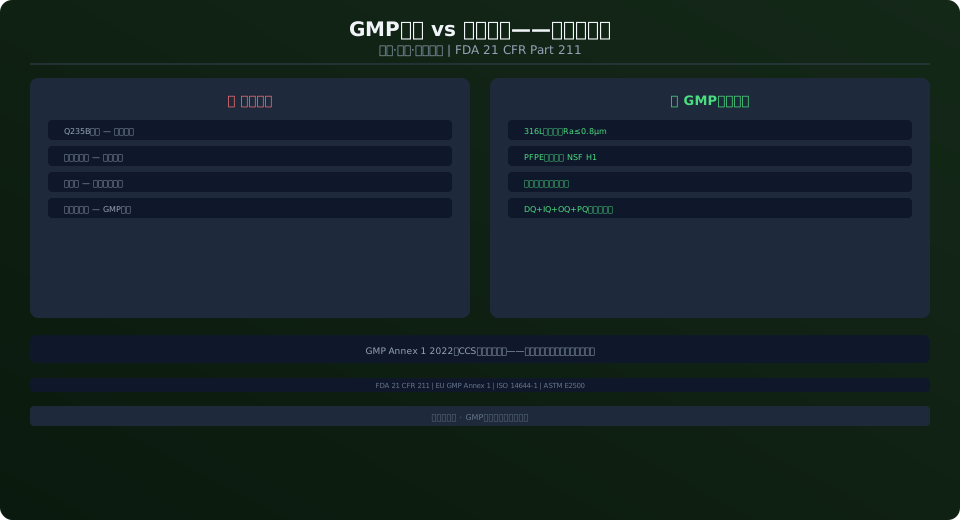
Three Hard Requirements for GMP-Compliant Cranes
1. Material & surface finish — The crane must not introduce any contamination to pharmaceutical products. 316L stainless steel is the standard for pharmaceutical applications; 304L is only acceptable in auxiliary areas that don't come into direct contact with products. A surface roughness of Ra≤0.8μm is the minimum requirement—at this smoothness, bacteria cannot form biofilms, and surface microbial residue stays below <1 CFU/cm² after each CIP cycle. 2. Sealing — No moving component may release particles, oil mist, or fibers into the cleanroom, and sealing materials must not react with cleanroom disinfectants (VHP, peracetic acid). 3. Validation documentation — Cranes designed and manufactured to ISO 4301 must pass DQ/IQ/OQ/PQ; missing any single stage results in automatic failure during GMP certification audits.
What IQ/OQ/PQ Validation Actually Covers
| Phase | Core Content | Output | Cycle |
|---|---|---|---|
| DQ | URSItem-by-Item Design Review | DQReport+Drawing Approval | 2~4Week |
| IQ | Installation Position/Level/Electrical/Grounding | IQScheme+Report+Deviation | 1~2Week |
| OQ | Full-Load Particle Release+Vibration+Noise | OQScheme+Data+Particle Report | 2~3Week |
| PQ | Actual Material Linkage Operation3Batch | PQReport+Product Quality Data | 4~8Week |
One of the most overlooked steps in OQ is particle release testing—many projects skip straight from IQ to production. When a GMP audit uncovers incomplete equipment validation, the consequences range from crane requalification to, in severe cases, recall of every pharmaceutical batch handled by that crane.
GMP 2022 Annex 1: New CCS Requirements
The CCS (Contamination Control Strategy) requires a comprehensive contamination control framework across four dimensions: facility, equipment, personnel, and materials. As a permanent fixture in the cleanroom, the crane must be included. The molybdenum in 316L stainless steel forms a more stable passivation layer in the highly oxidizing environments of VHP and peracetic acid, making it the irreplaceable material for pharmaceutical cleanroom cranes. Cleaning validation must demonstrate that residual API on equipment surfaces is below 1/1000 of the ADE—this is the ultimate test for seal design.
Writing the URS: The First Document for GMP Cleanroom Cranes
The first document in the GMP validation sequence is not the DQ report—it's the URS, which defines what you expect the crane to achieve.
A compliant cleanroom crane URS should include at least the following:
① Cleanliness requirements—specify the ISO class and allowable particle release (upper limit of ≥0.5 μm particles at a defined distance and operating time);
② Material requirements—material grade (316L/304L) and surface finish grade (EP/MP/Ra value) corresponding to the level of drug contact risk;
③ Cleaning and disinfection requirements—the types of disinfectants the crane must withstand (VHP concentration and exposure time, peracetic acid atomization cycles), cleanability standards (surface microbial residue <1 CFU/cm²), and CIP compatibility (whether online cleaning ports are required);
④ Documentation requirements—the list of validation documents to be delivered (DQ/IQ/OQ/PQ protocols and reports, Material Certificates, surface roughness test reports, particle release test reports, FAT/SAT records);
⑤ Operational requirements—Lifting Capacity, Span, lifting height, Work Duty / Classification, Travel Speed, and control mode (Manual / Semi-automatic / PLC);
⑥ Supplier qualifications—whether the supplier has GMP equipment manufacturing experience and documented validation cases from similar projects.
The quality of the URS directly impacts downstream DQ efficiency and validation success rates. A vague URS (e.g., "must meet GMP requirements") typically results in the supplier delivering to minimum standards, significant deviations discovered during DQ, and 3–6 month project delays. We recommend having the URS reviewed by a GMP consultant during the drafting phase—this consulting fee (approximately $3,000–$4,500) is the highest-ROI investment in the entire cleanroom crane project.
Disinfection Tolerance of Pharmaceutical Cleanroom Cranes
| Disinfection Method | Typical Concentration/Parameter | On316LEffect | On Seal Effect | Frequency |
|---|---|---|---|---|
| VHPVaporized Hydrogen Peroxide (VHP) | 300~500ppm 30min | Minor Effect on Passivation Layer Acceptable | EPDM/FKMResistant Nitrile Rubber (NBR)Aging | Per Batch/Daily |
| Peracetic Acid Atomization | 1,000~2,000ppm 60min | Oxidative Attack Post-Exposure Rinsing Required | Only FKM/PTFETolerable | Weekly/Monthly |
| Ozone Disinfection | 5~20ppm 120min | No Effect | Natural Rubber Not Suitable | Weekly |
| Ultraviolet (UV)UV-C | 254nm Dose>200J/m² | No Effect | Polymer Materials Require UVStabilized Type | Continuous |
Disinfection tolerance testing is not optional—during the OQ phase of GMP equipment validation, you must include a test that verifies the equipment still meets cleanliness requirements after three consecutive disinfection cycles under the harshest conditions. If your cleanroom uses VHP disinfection and your crane's seals are made of nitrile rubber, micro-cracks will begin to appear after the third cycle, and particle counts detected by the particle counter will spike from 15 particles/m³ after the first cycle to 200 particles/m³ by the fifth. This is precisely why seal materials and the disinfectant must be specified together in the URS.
GMP Cleanroom Crane FAQs
Q: Is 316L stainless steel mandatory for GMP cleanroom cranes?
A: Yes, for areas with direct product contact (filling rooms, aseptic dispensing), 316L is required. For non-contact areas (packaging rooms, cleanroom warehouse zones), 304L is acceptable. However, we recommend specifying 316L throughout—auditors won't differentiate between zones, and the cost savings from 304L aren't worth explaining a critical defect finding.
Q: Can we perform IQ/OQ/PQ ourselves?
A: IQ can be completed in-house, but OQ and PQ require sign-off from an independent validation team—GMP does not allow self-installation and self-validation. If you don't have a dedicated validation department, you must engage a third party.
Q: What grease is approved for GMP use?
A: The grease must comply with FDA 21 CFR 178.3570—even though the drug product never contacts the crane directly. We recommend an NSF H1-certified PFPE (perfluoropolyether) grease.
Q: Can the crane pass GMP revalidation after 5 years?
A: It depends on maintaining surface roughness (316L EP still at Ra≤0.5μm after 5 years) and seal aging (bellows last 8–10 years, but gaskets age out in 3–5 years). We recommend a pre-validation assessment in year 4.
For GMP cleanroom crane validation support, contact the Kelude technical team.
