

Crane Gearbox Lubrication: Oil Selection & Replacement Intervals
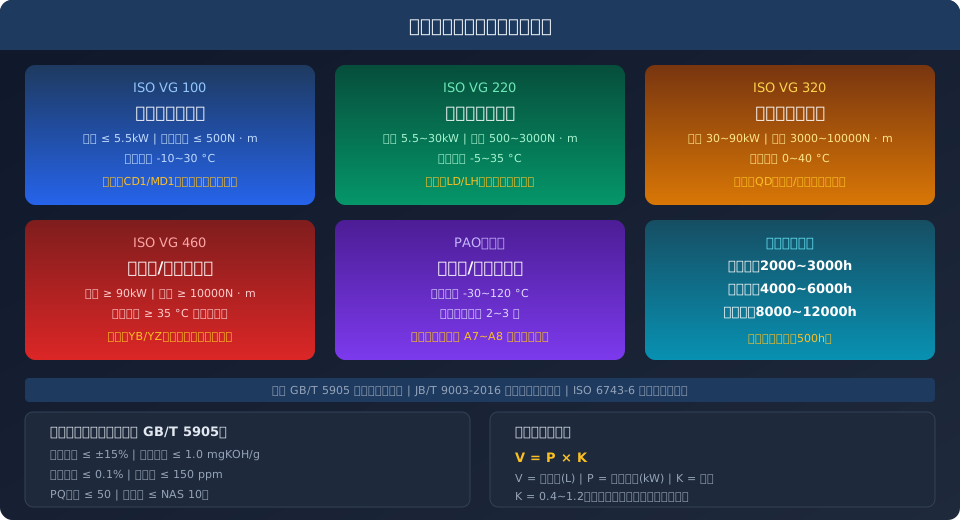
Gearbox lubricant selection for overhead cranes should be based on ISO VG viscosity grade (VG 100–460), matched to reducer power and ambient working temperature. Fill volume is calculated using the formula V = P × K (K = 0.4–1.2). Mineral oil change intervals are 2,000–3,000 hours, with the first change due after 500 hours of operation. Oil analysis should monitor key indicators including viscosity deviation ≤ ±15%, acid number ≤ 1.0 mgKOH/g, and moisture content ≤ 0.1%.
The gearbox is the heart of any crane drive system—its reliability directly determines overall machine safety and productivity. Proper lubricant selection and scheduled oil changes are the most cost-effective way to extend reducer service life. Yet in the field, mis-specified oils, incorrect fill volumes, and guesswork-based change intervals remain common, leading to gear pitting, bearing burnout, and seal leakage. This article provides a systematic reference for crane gearbox lubrication management across four dimensions: viscosity grade selection, oil volume calculation, change interval determination, and sampling/testing procedures.
Core Functions of Gearbox Lubricating Oil and Failure Mechanisms
Lubricating oil performs four essential functions inside a gearbox: Friction reduction and anti-wear—it forms an elastohydrodynamic lubrication film between gear tooth flanks and bearing rolling elements, converting direct metal-to-metal contact into shear within the oil film, reducing the friction coefficient to 0.001–0.005; Heat dissipation—the circulating oil carries away frictional heat from the meshing zone, keeping tooth surface temperatures below 90°C (mineral oil) or 120°C (synthetic oil); Rust and corrosion prevention—rust inhibitors in the oil form a polar adsorption film on metal surfaces, blocking moisture and oxygen attack; Contaminant transport—micron-sized metal wear particles generated during gear run-in are suspended and carried to the filtration system for removal.
Three primary oil failure mechanisms: Oxidative degradation—high temperatures (>70°C) accelerate the reaction between oil and oxygen, producing aldehydes, ketones, acids, and high-molecular-weight polymers, evidenced by rising viscosity, increasing acid number, and darkening color; Additive depletion—extreme-pressure anti-wear additives (such as ZDDP) are consumed progressively under heavy gear loads; once depleted, film strength drops and micropitting appears on tooth flanks; Contaminant accumulation—ingress of external dust (Si elements), iron wear debris (Fe elements), and condensed moisture degrades oil cleanliness; when NAS class deteriorates from Class 10 to Class 14, bearing life is reduced by 50%.
Viscosity Grade Selection: Matching Oil to Crane Duty
Industrial enclosed gear oils are classified under ISO 3448 into seven viscosity grades: VG 68, VG 100, VG 150, VG 220, VG 320, VG 460, and VG 680. The primary selection criteria are the low-speed stage center distance, input speed, and ambient working temperature. Getting this wrong has immediate consequences: Viscosity too low—the oil film is too thin to separate tooth surfaces, allowing asperity contact under boundary lubrication, with scoring visible within 48 hours; Viscosity too high—churning resistance increases, oil temperature rises by 10–15°C, and parasitic power loss reaches 2–3% of rated power.
Quick selection rules for common crane applications: For hoist reducers up to 5.5 kW (CD1/MD1 electric hoists), use VG 100–150—these reducers typically have low-speed center distances ≤150 mm and are sensitive to churning losses; for long travel reducers on LD/LH type cranes and cross travel reducers on QD type cranes in the 5.5–30 kW range, use VG 220, which covers the majority of standard industrial crane duty; for QD type hoist reducers rated 30–90 kW, use VG 320 to ensure adequate film thickness at higher pitch-line speeds; for hoist reducers on YB/YZ metallurgical cranes rated ≥90 kW, or for continuous-duty applications with ambient temperatures ≥35°C, use VG 460.
For continuous-duty overhead cranes operating at A7 to A8 duty classifications, PAO (polyalphaolefin) synthetic oil is recommended over mineral oil. Synthetic oils offer a viscosity index of ≥140 (versus 95–105 for mineral oils), providing more stable viscosity across a wide −30°C to 120°C temperature range. Change intervals can be extended to 8,000–12,000 hours, making the total lifecycle cost lower than frequent mineral oil changes.
Oil Volume Calculation and Filling Procedures
Gearbox oil fill volume directly affects both heat dissipation efficiency and churning power loss. The traditional "fill to the middle of the sight glass" approach lacks precision and cannot be quantified. The recommended engineering formula is V = P × K, where P is the rated input power of the reducer (kW) and K is an empirical coefficient: for reducers ≤11 kW, K = 0.8–1.2 (smaller units generate more heat per unit power and require relatively more oil); for 11–55 kW, K = 0.5–0.8; for >55 kW, K = 0.3–0.5. Taking a 7.5 kW CD1 electric hoist hoisting reducer as an example: V = 7.5 × 1.0 = 7.5 L. In practice, fill 6 L first, run for 5 minutes, then top up to the sight glass center line.
An alternative method based on gearbox housing volume: fill horizontal reducers to 30–40% of housing capacity and vertical reducers to 50–60%. Additionally, the oil level must remain at least 15–20 mm below the lowest gear root circle to keep churning losses controllable while ensuring adequate lubrication. Key filling practices: always fill after the reducer has been shut down and cooled to ambient temperature (hot oil levels read 8–12% higher than actual); install a 100-mesh (149 μm) strainer at the fill port; use opened oil within 24 hours to prevent moisture absorption. Never mix oils of different brands or viscosity grades—incompatible additive systems can reduce extreme-pressure performance by more than 40%.
Oil Change Intervals and Sampling/Testing Methods
Change intervals should not be determined by operating hours alone—they must be dynamically adjusted based on oil analysis results. Baseline reference intervals: mineral oil (L-CKC medium-load industrial enclosed gear oil) every 2,000–3,000 hours or within 12 months, whichever comes first; semi-synthetic oil every 4,000–6,000 hours; fully synthetic PAO oil every 8,000–12,000 hours. The first oil change must be performed after 500 hours of operation—new reducers generate high concentrations of metallic wear debris during run-in (Fe content can reach 300–500 ppm). If not changed promptly, these abrasive particles circulate in the oil and accelerate wear in a self-reinforcing loop.
Oil sampling should follow three principles: take samples while the reducer is at operating temperature (cold sampling allows contaminants to settle, compromising representativeness); draw from the middle of the oil sump (not the bottom sediment layer or surface foam); use clean, dry PET or glass containers (avoid soft plastic bottles containing plasticizers). Test parameters and acceptance limits: kinematic viscosity at 40°C must not deviate more than ±15% from the new oil value—exceeding this indicates oxidative degradation or contamination with a different viscosity grade; acid number increase must not exceed 1.0 mgKOH/g—exceeding this signals accumulation of oxidation products; moisture content must not exceed 0.1% (1,000 ppm)—excess water causes additive hydrolysis and bearing micropitting; iron content must not exceed 150 ppm—a sudden spike indicates abnormal gear or bearing wear; PQ index (magnetic plug ferromagnetic particle content) must not exceed 50 for rapid screening. If any two parameters exceed their limits simultaneously, change the oil immediately.
Common Oil Selection and Change Mistakes
Mistake 1: Higher viscosity means better lubrication. Higher-viscosity oils do form thicker films on tooth surfaces, but they also increase churning resistance and raise oil temperature. Once oil temperature exceeds 80°C, viscosity drops sharply and lubrication performance actually deteriorates. The correct approach is to follow the reducer manufacturer's recommended viscosity grade—never upgrade viscosity on your own.
Mistake 2: Dark oil means it's time for a change. Darkening is primarily caused by oxidation products and additive reactions, and does not necessarily indicate loss of lubricating performance. Sulfur-phosphorus extreme-pressure gear oils naturally transition from amber to dark brown during normal service. The only scientific basis for changing oil is laboratory test data—never rely on visual color inspection alone.
Mistake 3: Mixing new and old oil saves money. Oxidation products and metal wear particles in old oil catalyze the oxidation of fresh oil. Tests show that mixing 30% old oil into new oil shortens the oxidation induction period by more than 60%. The correct procedure is to drain the old oil completely, flush the housing with new oil, and only then refill.
Mistake 4: If the gearbox doesn't leak, the oil doesn't need changing. Even with perfect external sealing, oil continues to oxidize under heat and metal catalysis, and additives are gradually depleted. Sealing integrity only prevents external contamination—it does not replace scheduled oil changes.
Related reading: Key provisions of ISO 4301 Crane Design Standard explained | Understanding the three-in-one gear reducer standard for cranes | 5 common causes of gearbox oil leaks on overhead cranes and how to fix them
Frequently Asked Questions
Q: What's the practical difference between ISO VG 220 and VG 320 gearbox oil, and how do I choose?
A: The kinematic viscosity at 40°C is 198–242 mm²/s for VG 220 and 288–352 mm²/s for VG 320—a difference of roughly 40%. Selection is primarily based on the low-speed stage center distance: use VG 220 for center distances ≤250 mm, and VG 320 for center distances >250 mm or when operating temperatures exceed 35°C. For example, on a QD type 32 t bridge crane hoist reducer (center distance approximately 400 mm), the tooth contact fatigue safety factor may fall below 1.0 with VG 220, but recovers to above 1.2 after switching to VG 320. Never mix oils of different viscosity grades in the same reducer.
Q: What are the first oil change and routine oil change intervals for Three-in-One Reducers under JB/T 9003-2016?
A: JB/T 9003-2016 specifies that reducers leave the factory pre-filled with L-CKC 220 medium-duty industrial closed-gear oil to the center line of the oil sight glass. The first oil change must be performed after 500 hours of cumulative operation or within 3 months of commissioning, whichever comes first. Thereafter, oil changes are required every 2,000–3,000 hours or once per year. The standard also requires inspecting the drained oil for metallic wear particles during each change. If visible metal chips are found or the oil appears milky/emulsified, the oil must be replaced immediately after the underlying fault is corrected—do not wait for the next scheduled change.
Q: Oil temperature suddenly spikes from 65°C to 90°C—is it an oil problem or a gearbox problem?
A: A 25°C temperature surge is abnormal and points to the gearbox itself. Step 1: Check the oil level—too high increases churning losses; too low reduces heat dissipation. Step 2: Test the oil's iron content—if it jumps from below 50 ppm to over 300 ppm, severe gear or bearing wear is underway, and the resulting friction is generating the heat. In this case, changing the oil will not solve the problem; the unit must be shut down for inspection. Step 3: Check whether external ventilation is blocked by dust accumulation on the cooling fins, which can reduce heat dissipation efficiency by up to 30%. If the oil level is correct and iron content is normal, send an oil sample for viscosity analysis—mixing in a lower-viscosity oil can cause film breakdown and increased friction.
Q: Why is the first oil change required at 500 hours? Can I wait until 2,000 hours instead?
A: During the break-in period (the first 200–500 hours), the micro-asperities on gear tooth surfaces are gradually worn smooth, generating large quantities of ferromagnetic wear particles in the 1–50 µm range. Iron content can reach 300–500 ppm during this phase (normal steady-state operation should stay at or below 150 ppm). These particles have a hardness of HRC 58–62 and circulate through the oil like lapping compound, accelerating three-body abrasive wear on gear flanks and bearing raceways. Delaying the first oil change to 2,000 hours can increase tooth surface wear by 2–3 times compared to a timely change and shorten overall gearbox service life by more than 30%. This is why both FEM 1.001 and JB/T 9003-2016 mandate the first oil change within 500 hours—it is not optional.
Kelude Heavy Industry supplies factory-recommended lubricants and scheduled oil sampling and analysis services for crane gearboxes across all major models. Our offering covers the full ISO VG 100–460 viscosity range in both mineral and PAO synthetic oils, and our equipment file management system provides automatic oil change reminders. To obtain the recommended lubricant list for your specific gearbox model, contact our technical engineers for the selection manual.
