

Single Girder vs Double Girder Bridge Crane: 5 Key Factors for 5-20t
The choice between single-girder and double-girder comes down to three key parameters: lifting capacity, span, and work duty. For lifting capacities up to 20t, spans up to 25m, and light-to-medium duty cycles (A3–A5), a single-girder design (LD Type) is the right fit, cutting procurement costs by 40%–60%. For capacities of 20t and above, larger spans, or heavy-duty applications (A6–A8), a double-girder configuration (LH/QD Type) delivers superior stiffness and long-term reliability. This article provides a complete selection reference for bridge crane main girder types, covering structural differences, side-by-side comparisons, cost payback, and application fit.
Bridge cranes are the most common material handling equipment in industrial workshops, and the fundamental structural difference lies in the main girder configuration: single-girder (one main girder with an electric hoist) versus double-girder (two main girders with a trolley-mounted hoisting mechanism). Many buyers face this critical decision at the project planning stage—and getting it wrong doesn't just inflate the initial purchase price; it can lead to insufficient stiffness, frequent maintenance downtime, and even failure to pass special equipment inspection down the road. In our years of project delivery at Kelude, we've found that roughly 30% of first-time buyers select the wrong girder type due to underestimating the work duty or miscalculating factory building headroom—and the cost of retrofitting later far exceeds the initial price difference. This article is grounded in ISO 4301 Crane Design Standard and TSG 51-2023 Crane Safety Technical Supervision Regulation, and lays out a systematic selection comparison framework for single-girder versus double-girder cranes.
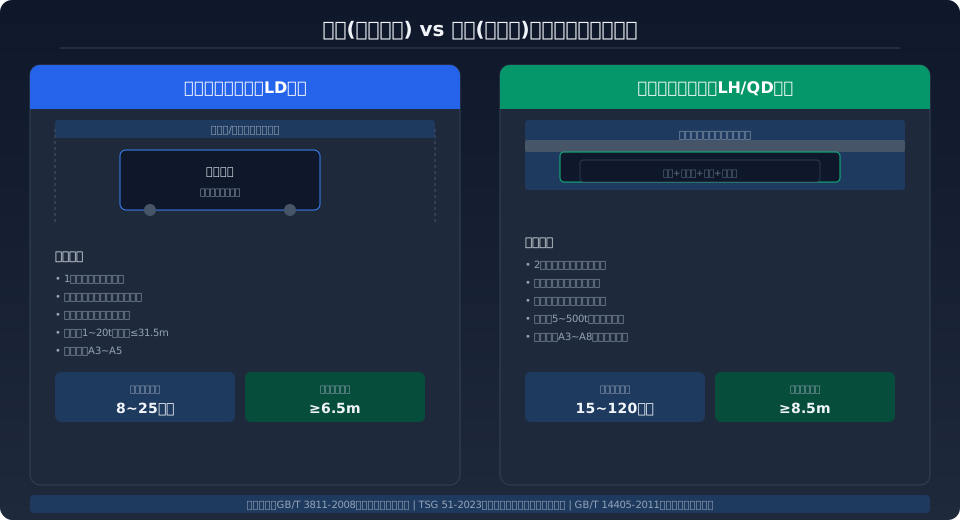
Single-Girder vs. Double-Girder: Structural Differences
A single-girder bridge crane (typically the LD Type) uses one box girder or I-beam main girder to carry the full load, with the electric hoist running directly on the lower flange of the girder. The hoist integrates both lifting and travel functions into one compact unit, keeping dead weight low and reducing demands on the factory building's crane rail brackets and runway rail height. However, lifting height is limited by the hoist drum's rope capacity, typically capped at 18m, and the maximum work duty is A5, making it unsuitable for high-frequency continuous operation.
A double-girder bridge crane (typically the LH or QD Type) consists of two parallel box girders forming the load-bearing frame, with trolley travel rails laid on top. The independent trolley frame houses the motor, gearbox, drum, and wire rope pulley block, allowing each component to be serviced or replaced individually. The stiffness of a double-girder structure is 2–3 times that of a comparable single-girder crane, and main girder deflection is easily controlled within S/800 (the A5 duty requirement is S/700). Lifting height can reach 30m or more, and work duty covers the full A3–A8 range. Per the technical requirements of FEM 1.001 General Purpose Bridge Crane, the elastic deformation of the main girder under a static load test at 1.25 times the rated load must not exceed 1/800 of the span.
Lifting Capacity and Span Selection Comparison Table
The comparison table below covers the selection parameter boundaries for single-girder (LD Type) and double-girder (LH/QD Type) cranes across six dimensions: lifting capacity, span, work duty, lifting height, runway rail height requirements, and reference cost.
| selection parameters | single girder(LD Type) | double girder(LH Type) | double girder(QD Type) | selection Description |
|---|---|---|---|---|
| Lifting Capacity | 1~20t | 5~32t | 5~500t | ≤20tPreferred Optionsingle girder,≥32tMandatory Selectiondouble girder |
| Span | 7.5~31.5m | 10.5~31.5m | 10.5~40m+ | Span>25mWhendouble girder Stiffness Clear Advantage |
| Work Duty / Classification | A3~A5 | A3~A5 | A3~A8 | A6and Aboveor Daily Operation≥8hMandatory Selection QD Type |
| Lifting Height | 6~18m | 6~24m | 6~50m+ | Hoist Drum Rope Capacity Limitationsingle girder Lifting Height |
| Factory building Rail Top Height Requirement | ≥6.5m | ≥8.0m | ≥8.5m | workshop height When Insufficientsingle girder Only Option |
| reference cost(Including Installation) | 8~250,000 | 12~350,000 | 15~1,200,000+ | single girder Comparable to Same Capacitydouble girder Savings40%~60% |
5 Key Decision Factors for Crane Selection
Crane selection goes far beyond rated lifting capacity—these five factors carry equal weight in engineering practice, and a misjudgment in any one of them can leave you with equipment that fails to meet your process requirements once in service:
Factor 1: Work Duty Classification and Operating Frequency—The duty classification (A3~A8) reflects the combined rating of load spectrum and operating frequency. LD-type single-girder cranes, with electric hoists whose hoisting motors and brakes are designed for intermittent duty (S3), suit applications rated A3~A5. QD-type double-girder cranes employ a trolley-based hoisting mechanism with motors selected for S4/S5 duty, covering A6~A8 for continuous heavy-load operation. If your operation exceeds 200 lifts per day or regularly runs at more than 70% of rated load, a double girder configuration rated A6 and above is mandatory.
Factor 2: Span and Main Girder Stiffness—The larger the span, the faster bending moment and deflection grow in the main girder (deflection increases proportionally to the cube of span). Single girder cranes struggle to control deflection at spans above 25 m, and increasing girder height is constrained by the geometric limits of the hoist running on the lower flange. Double girder designs allow deeper girder sections, keeping deflection within S/800 at equivalent spans—meeting the stiffness requirements of ISO 4301 for A5 classification. For a 20 t / 28.5 m example: an LD-type single girder deflects approximately 42 mm (S/680), slightly exceeding the standard; an LH-type double girder deflects about 32 mm (S/890), providing ample margin.
Factor 3: Lifting Height and Factory Building Clearance—The drum rope capacity of a single girder electric hoist limits maximum lifting height to roughly 18 m (a 5 t hoist drum accommodates about 48 m of wire rope, yielding approximately 11 m of net lift at a 4-part reeving). Double girder cranes with independent trolley frames can accommodate large-diameter drums, achieving lifting heights above 50 m. However, the double girder configuration consumes more vertical space (trolley height plus upper hook limit), requiring 2–3 m additional runway elevation compared to single girder layouts. For retrofit projects in existing factory buildings, available headroom often becomes the hard constraint that rules out double girder solutions.
Factor 4: Maintenance Convenience and Spare Parts Commonality—LD-type single-girder cranes use a fully purchased electric hoist assembly (e.g., CD1/MD1 models); routine maintenance mainly involves replacing the rope guide and adjusting brake clearance, and when failures occur, the entire hoist is typically swapped out. QD-type double-girder cranes feature a modular hoisting trolley where the motor, gearbox, brake, and drum can each be serviced or replaced independently, with a well-stocked spare parts market. For plants in remote locations with long lead times for spare parts, the QD-type's independent serviceability significantly reduces downtime.
Factor 5: Special Equipment Regulation and Certification Costs—Under TSG 51-2023, all bridge cranes with a rated lifting capacity of 3 t and above fall under special equipment supervision, but the complexity of type testing and supervision inspection varies by main girder configuration. Double girder cranes—particularly QD-type—involve additional inspection items such as main girder welding procedure qualification records (WPQR), trolley track gauge tolerance, and hoisting mechanism overspeed protection, making initial inspection costs and lead times roughly 30%–50% higher than single girder alternatives. For general-purpose workshops with lifting capacities between 3 t and 20 t, the LD-type single girder offers the most straightforward certification path. Kelude provides full turnkey service—from design, fabrication, and installation through TSG supervision inspection and registration—helping clients complete special equipment certification efficiently.
Price and Return on Investment Comparison Across Models
| typical configuration | LD Typesingle girder | LH Typedouble girder | QD Typedouble girder |
|---|---|---|---|
| 5t/16.5m | 8~120,000 | 12~160,000 | 15~200,000 |
| 10t/22.5m | 13~180,000 | 16~220,000 | 20~300,000 |
| 16t/25.5m | 16~220,000 | 20~280,000 | 28~400,000 |
| 20t/28.5m | 20~250,000 | 25~350,000 | 35~500,000 |
| 32t/28.5m | —(Not Applicable) | 30~400,000 | 38~600,000 |
The cost figures above are indicative ranges covering the crane, crane rail, conductor rail system, and installation & commissioning, excluding civil foundation work. Actual pricing fluctuates with steel market conditions, configuration level (VFD / two-speed / remote control / anti-sway), and regional variations. When making a purchasing decision, we recommend evaluating the full life cycle cost over 5–10 years—electricity, maintenance, and spare parts—rather than comparing only the initial purchase price. Taking a 10t/22.5m span as an example, the QD-type double-girder crane carries an initial investment roughly 40% higher, yet under A6 duty classification over 10 years of operation, its motor and brake failure rate is approximately one-third that of an LD-type single-girder crane, resulting in lower overall maintenance costs.
Recommended Applications by Work Condition
Requirements vary significantly across industries and workshops. Below are recommended configurations by duty profile:
Light Machining Workshops — Lifting capacity 1–10t, span ≤ 22.5m, fewer than 50 lifts per day, duty classification A3 to A4. Recommended: LD-type single-girder crane with a CD1 electric hoist, pendant or remote control. Low procurement cost, short installation period (7–10 days).
Medium-Duty Assembly / Warehousing Workshops — Lifting capacity 10–20t, span 16.5–25.5m, 50–150 lifts per day, duty classification A4 to A5. Recommended: LD-type single-girder crane (with VFD option) or LH-type double-girder crane. The LD with VFD achieves positioning accuracy of ±5 mm on hoisting, suitable for precision assembly work. The LH type is preferred for long workpieces requiring synchronized dual-hook lifting.
Heavy-Duty Foundry / Metallurgy Workshops — Lifting capacity ≥ 32t, span ≥ 22.5m, more than 200 lifts per day, duty classification A6 to A8. A QD-type double-girder crane is mandatory, with VFD speed control, anti-sway control, and overspeed protection recommended as standard. Metallurgical environments additionally require heat shielding and H-class insulated motors and other heat-resistant measures.
Outdoor Yards / Rail Freight Terminals — Lifting capacity 10–32t, large spans ≥ 30m, significant wind load exposure. Due to the larger wind-facing area and higher lateral stiffness requirements of double-girder structures, a gantry crane (MG type) is recommended over an overhead bridge crane. If an overhead crane is preferred, the QD-type double-girder crane travel mechanism must be reinforced for outdoor duty with upgraded braking and wind anchoring devices. Kelude Heavy Industry has accumulated extensive outdoor duty design experience across multiple gantry crane projects in freight yards and can tailor wind anchoring solutions based on site-specific wind load conditions.
Related Reading: ISO 4301 Crane Design Standard — Key Provisions Explained · TSG 51-2023 Crane Safety Technical Supervision Regulation — Key Provisions Explained · FEM 1.001 General Purpose Bridge Crane — Standard Explained · Gantry Crane Span and Overhang Selection Guide · Safety Brake vs. Service Brake Configuration Requirements
Frequently Asked Questions
Q: For a 5t duty, is a single-girder or double-girder crane more suitable?
A: 5t falls in the overlapping range between single- and double-girder selection. If the duty classification is A3 to A5, span ≤ 25m, and daily lifts do not exceed 100, an LD-type single-girder crane is fully adequate, with a procurement cost of approximately $12,000–$22,000—roughly 40%–60% less than a QD-type double-girder crane of the same capacity. However, if continuous A6 duty is required or the span exceeds 28m, a QD-type double-girder crane is recommended, as its main girder stiffness and hoisting mechanism reliability are better suited to high-frequency operation.
Q: Can a single-girder crane be upgraded to a higher lifting capacity later?
A: The lifting capacity of an LD-type single-girder crane is determined by both the electric hoist and the main girder cross-section, and it cannot be easily upgraded by simply swapping the hoist—the main girder's moment of inertia and strength are verified against the rated load at the design stage. Upgrading from 10t to 16t typically requires replacing the entire crane. Double-girder cranes, particularly the QD type, can be designed with a 20%–30% hoisting capacity margin at the design stage, offering greater upgrade potential—but a fresh load verification and type test are still required.
Q: Can a double-girder crane be installed in an existing building with limited headroom?
A: This depends on the clearance from the rail top to the bottom chord of the roof truss. A QD-type double-girder crane typically requires a rail-top height of at least 8.5m, while an LD-type single-girder crane needs only 6.5m. For workshops with 7–8m of clearance, an LH-type low-headroom double-girder crane with electric hoist is a viable option—its trolley height is approximately 500–800mm lower than a conventional QD-type. For buildings with less than 6.5m of clearance, only a single-girder configuration or floor-mounted transfer equipment should be considered.
Q: What are the different rail installation requirements for single-girder vs. double-girder cranes?
A: Single-girder cranes (LD type) typically use P-series light rails (P24/P38/P43), with a horizontal misalignment tolerance at rail joints of ≤ 1mm (per GB/T 10183-2023). Double-girder cranes (QD type) use QU-series heavy rails (QU70/QU80/QU100). Because cross-travel speeds are higher (up to 40 m/min or more), rail installation accuracy requirements are more stringent—the elevation difference between the two rails at any cross-section must be ≤ 10mm, and the deviation of the rail centerline from the reference line must not exceed ±3mm over the full length. Rail installation costs for double-girder cranes are typically about 30% higher than for single-girder units.
Kelude Heavy Industry offers complete selection, design, and manufacturing services for LD-type single-girder, LH-type and QD-type double-girder bridge cranes, covering the full 1–500t capacity range with non-standard customization available. Our engineering team can provide a comparative economic analysis between single- and double-girder configurations and a selection recommendation based on your workshop layout, production cycle time, and budget constraints. Consultation hotline: 400-086-9590.
Kelude Heavy Industry: Overhead Crane & Hoist Solutions
Kelude Heavy Industry specializes in the design, manufacture, and supply of industrial overhead cranes, gantry cranes, and electric hoists. Our equipment is engineered for demanding environments, providing reliable performance for manufacturing, warehousing, and logistics operations across the United States and Europe.
Frequently Asked Questions
Q: What is the typical lead time for a standard overhead crane?
A: Lead times vary depending on the configuration and customization level. A standard single-girder crane can typically be delivered within 8-10 weeks, while more complex double-girder or explosion-proof systems may require 12-16 weeks.
Q: Do you provide installation services?
A: Yes, we offer professional installation supervision by our experienced engineers. We can also provide a complete turnkey installation service, including rigging, alignment, and testing, upon request.
Q: What safety standards do your cranes comply with?
A: Our cranes are designed and manufactured to comply with international standards such as ISO 4301 for crane classification and IEC 60204-32 for electrical equipment. We can also engineer to meet specific local regulations or project requirements.
Q: Can you provide spare parts for cranes from other manufacturers?
A: While our primary focus is on our own equipment, we do supply compatible spare parts for many common crane models. Please contact us with your specific part numbers or specifications for assistance.
