

AI Anti-Sway Accuracy & Stability Gains for Cranes
📋 Key Summary
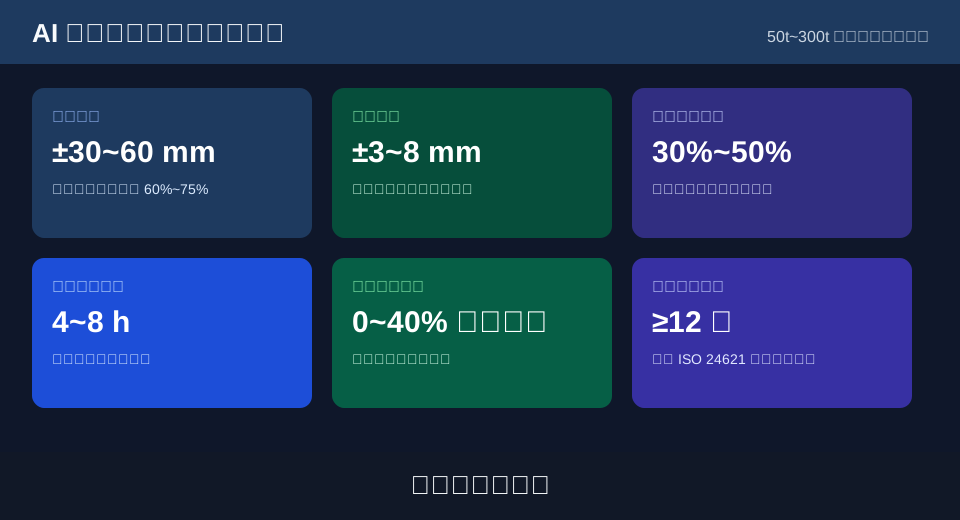
Based on a study of 50t–300t European-standard double-girder cranes, the AI Anti-Sway System reduces lateral load swing from ±150–±250 mm under conventional open-loop control to ±30–±60 mm in typical hoisting conditions — an improvement in positioning accuracy of roughly 40%–65%. Under gust, eccentric-load, and emergency-stop disturbances, stabilization time drops by about 30%–50%, and parameter tuning time is compressed from several days to 4–8 hours. Actual values are subject to the signed contract and Site Acceptance Test.
How Crane AI Rebuilds Anti-Sway Control and Sensing
Traditional anti-sway control relies mostly on a simplified pendulum model, using open-loop speed curves or fixed filtering to dampen load swing. This works well when rope length, load, and trolley acceleration stay relatively constant — but on 50t–300t European-standard double-girder cranes, where large spans, long ropes, eccentric loads, and sudden wind disturbances are common, fixed parameters tend to under- or over-compensate. During emergency stops, rapid inching, or shifts in the load's center of gravity, an open-loop model simply cannot sense the actual swing phase of the lifting spreader in time; it can only wait passively for the swing to decay.
The AI Anti-Sway System brings sensing, prediction, and correction into a closed control loop. The sensing layer fuses trolley position, crane bridge position, hoisting rope length, load mass, tilt angle, acceleration, motor current, and wind speed. The prediction layer uses an online-trained time-series model to estimate load swing amplitude and phase in advance. The correction layer converts those predictions into fine adjustments to trolley and hoisting speed. Rather than "swing first, suppress later," AI leans toward "predict first, cancel ahead." For example, once a travel command is issued, the AI adds a counter-phase speed compensation during trolley acceleration, keeping load lag within a tighter range.
In real-world installations, AI anti-sway control does not replace the PLC master controller — it runs as an overlay on the motion control layer. Command signals, limit switch signals, and braking logic are still handled by the existing PLC; the AI only makes minor corrections to speed setpoints. The advantage: even if the AI model fails, the system falls back to conventional closed-loop or manual mode without disrupting the existing safety chain. For 50t–300t European-standard double-girder cranes, this architecture matters greatly — a heavy load that goes out of control carries far higher safety risk than on a small crane.
For fault diagnosis and data closed loop, the framework in ISO 24621:2022 "Crane AI Fault Diagnosis" can be referenced, incorporating sensor residuals, model output deviations, and drive current signatures into the diagnostic sample set. This way, the anti-sway controller doesn't just suppress swing — it can also identify early warning signs such as sensor drift, wire rope wear, and declining motor response. The more complete the sensor data, the more stable the AI's identification of load swing, and the more effective subsequent online learning becomes.
In Kelude Heavy Industry's 50t–300t European Standard Double-Girder high-end customization projects, AI anti-sway control is layered as an independent control layer on top of the existing PLC safety logic. Even if AI control fails, the equipment can revert to conventional closed-loop or manual mode, avoiding any impact on the main circuit and safety protection. The control cycle is typically set at 10–20 ms, covering the main frequency bands of load swing without placing excessive load on the industrial network.
Quantifying Anti-Sway Accuracy Gains and Field Test Benchmarks
Anti-sway accuracy is typically measured by three indicators: steady-state swing amplitude, positioning deviation, and repeat positioning deviation. Because the AI system can predict load swing phase, it can actively apply small counter-phase speed compensation as the lifting spreader approaches the target position, significantly reducing residual swing after the load stops. For precision assembly, die handling, and large workpiece flipping, this accuracy improvement reduces the need for radio coordination and repeated inching.
The following comparison data ranges apply to 50t–300t European Standard Double-Girder models under typical spans of 22 m–31 m, lifting heights of 12 m–18 m, and rated load at 50%–80%. Actual results are subject to the on-site Load test.
| Comparison Parameter | Conventional Open-Loopanti-sway control | Conventionalclosed loopelectronic anti-sway | AI Predictiveanti-sway control |
|---|---|---|---|
| Steady-State Swing Amplitude | ±120~±200 mm | ±60~±100 mm | ±30~±60 mm |
| Positioning Accuracy | ±15~±25 mm | ±8~±15 mm | ±3~±8 mm |
| Gust Resistance/eccentric loadCapability | FixingParameter,Prone to Overcompensation | Lag Compensation,Slower Recovery | Feedforward Prediction,Reduced Settling Time 30%~50% |
| ParameterSettling Time | Approx. 3~5 day(s) | Approx. 1~2 day(s) | Approx. 4~8 hour(s) |
As the table above shows, the main benefits of AI anti-sway go beyond simply reducing sway amplitude. They also include shorter parameter tuning times and faster recovery from sudden disturbances. Traditional open-loop systems often require repeated trial-and-error adjustment of speed curves and filter time constants during on-site commissioning. An AI system, by contrast, uses online self-learning to automatically adjust compensation parameters based on different rope lengths and loads, reducing the need for manual intervention.
It is important to note that AI anti-sway accuracy improvements are not unconditional. If encoder resolution is insufficient, the hoisting rope length signal fluctuates significantly, or the spreader sway angle sensor has noticeable latency, even a powerful AI model will struggle to output stable control signals. Therefore, field testing should first confirm the quality of the underlying sensor chain before evaluating AI control performance.
Stability Gains Through Multi-Sensor Fusion and Online Auto-Tuning
Stability does not mean eliminating sway entirely. It means maintaining predictable, non-oscillating, non-drifting behavior across different rope lengths, loads, and wind conditions. Fixed-parameter controllers are prone to resonance when encountering eccentric loads, rope length changes, or rail surface slope variations. AI models can learn these variation patterns from historical data and automatically adjust control gains based on lifting height and load torque. In large-span factory buildings, rail surface settlement differs between the ends and mid-span of the crane rail. AI can use long travel position as an input to proactively compensate for lateral load deflection caused by rail height differences.
Multi-sensor fusion employs Extended Kalman Filter (EKF) and noise-adaptive methods to perform time synchronization and outlier rejection on inclination, angular velocity, and acceleration signals. For example, wireless inclination sensor data on the spreader and trolley encoder data may have tens of milliseconds of latency. Without compensation, the predicted phase shifts, degrading AI anti-sway performance. The Kelude technical team performs sensor latency calibration and communication jitter testing during system integration before proceeding to model training.
The key to online auto-tuning is sample quality. Training samples need to cover no-load, half-load, full load, eccentric load, acceleration, constant speed, deceleration, emergency stop, and gust disturbance conditions. If samples are incomplete, the AI may misclassify low-frequency sway caused by eccentric loads as wind disturbance, leading to incorrect control direction. Kelude completes baseline sample collection on the factory test bench, then performs incremental learning at the customer site so the model gradually adapts to the actual crane rail, spreader, and operator habits.
Stability also extends to protecting the drive system. If AI output changes too rapidly, it causes frequent motor speed changes, increasing gearbox impact and wire rope wear. In engineering practice, AI output is typically subject to amplitude limiting and slope constraints so that corrections stay within what the mechanical system can withstand. This avoids the problem of "better anti-sway performance at the cost of reduced drive system service life."
AI Commissioning and Acceptance for 50t to 300t European-Standard Double-Girder Custom Cranes
When AI anti-sway is introduced to high-end customization cranes, a "shadow run" phase must be added to the commissioning process. In a shadow run, the AI only computes without outputting, running in parallel with the existing control system for a period of time. Engineers compare AI output against actual operation curves to confirm the model does not produce erroneous actions before switching to online control. Shadow run time is typically no less than 4 hours, and can be extended to 1–2 days for complex eccentric load conditions.
For acceptance testing, sway amplitude, positioning accuracy, settling time, and safety fallback should be treated as core items. For example, at a test point with 60% rated load, 15 m lifting height, and 60 m/min cross travel speed, run 5 consecutive cycles and record the lateral sway amplitude of the spreader and residual sway after stopping. Simultaneously simulate emergency stop, communication interruption, and sensor disconnection to verify whether the AI can fall back to conventional control or safe stop within 200 ms. The shorter the fallback time, the safer the system.
Kelude provides the AI anti-sway system control parameter report, sensor calibration records, and shadow run curves before delivery. During Site Acceptance Test, users should focus on whether the speed correction frequency in the curves is excessively high, whether motor torque reverses frequently, and whether abnormal wire rope vibration occurs. If high-frequency chattering appears, check communication latency and encoder resolution first rather than simply increasing AI output gain.
For 50t–300t European-standard double-girder cranes, AI anti-sway should also coordinate with the hoisting, long travel, and cross travel mechanisms. Suppressing sway through a single mechanism has limited effect. Only by incorporating lifting speed, trolley acceleration, and long travel speed into the same model can good stability be maintained when luffing, eccentric loads, and wind disturbances occur simultaneously. In high-end customization solutions, Kelude first runs simulations based on the customer's process path, then determines AI control boundaries and sensor placement positions.
FAQ
Q: What signals does the AI anti-sway control system primarily collect?
A: It typically collects trolley position, crane bridge position, lifting height, load mass, inclination, acceleration, motor current, and wind speed. The AI performs time-series modeling on these signals to extract sway frequency, phase, and disturbance characteristics for speed command correction.
Q: Does retrofitting AI anti-sway on 50t–300t European-standard double-girder cranes affect existing safety protection?
A: No. The AI is superimposed as a motion control layer and interlocked with limit switches, overload protection, and emergency stop safety circuits. If the AI module loses power, communication is interrupted, or output exceeds limits, the system falls back to conventional closed-loop control or safe stop. Kelude constrains AI control output within permissible ranges in the electrical design.
Q: How long does AI anti-sway parameter commissioning take?
A: Baseline modeling takes approximately 4–8 hours, with an additional 1–2 days of validation for complex eccentric load conditions. The specific timeline is subject to the actual contract. On-site work includes sensor calibration, shadow run, and acceptance test.
Q: What practical benefits does improved anti-sway accuracy deliver?
A: It reduces waiting time for sway to settle, minimizes collisions between the spreader and equipment, and improves one-shot positioning rates during hoisting. The effect is more pronounced for die installation, precision assembly, and large-span workshops. Users can also typically reduce manual jog operations, easing operator fatigue.
