

Crane AI Applications: Anti-Sway to Predictive Maintenance
📋 Key Summary
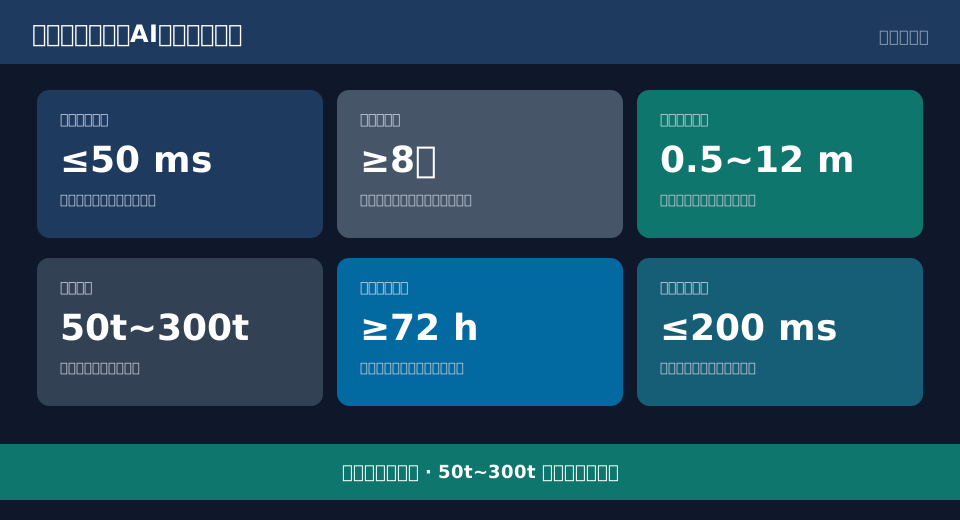
Crane AI has moved well beyond standalone anti-sway control into hoisting path planning, structural health monitoring, predictive maintenance, and remote health management. On its 50 t to 300 t European-standard double-girder crane platforms, Kelude can integrate no fewer than 8 categories of status signals, closing the loop on trolley speed and load sway angle at a 50 ms cycle, while using machine learning to flag trends in brakes, gearboxes, main girder welds, and other critical components. Predictive maintenance shifts reactive breakdown repairs into planned downtime, cutting unplanned downtime.
Heavy-duty bridge and double-girder cranes run continuously in metallurgy, shipbuilding, heavy equipment, and precast concrete operations, where loads vary widely and start-stop cycles are frequent. Bringing AI into the crane control system is not simply a matter of adding cameras or screens — it means feeding electrical drives, structural response, load attitude, and equipment health data into a single computational chain. At the design stage, structural verification must follow the allowable stress, stiffness, and dynamic load factor requirements of FEM 1.001 Crane Design Standard. Integrating safety monitoring and intelligent warning functions also requires compliance with TSG 51-2023 Crane Safety Technical Supervision Regulation for monitoring records, fault alerts, and operating status archiving.
From a functional standpoint, crane AI applications fall into three broad categories.
Motion control — addressing load sway, precise positioning, and synchronous hoisting across multiple mechanisms.
Visual perception — addressing blind-spot obstacle avoidance, personnel detection in the work zone, and structural deformation monitoring.
Health management — addressing bearing wear, gearbox pitting, brake response degradation, and main girder weld crack detection.
In its European-standard double-girder products, Kelude breaks these three capability sets into verifiable modules that are configured per project operating conditions.
How AI Replaces PID Control in Crane Anti-Sway Systems
Traditional bridge crane anti-sway relies on open-loop input shaping or PID speed closed-loop control. Open-loop input shaping is sensitive to rope length changes, and PID parameters depend on on-site commissioning — once load weight, rope length, lifting height, or wind load changes, residual sway tends to reappear. Operators often have to wait for the load to settle before making a precise hook placement, which hurts cycle times.
AI anti-sway uses online learning or model predictive control to take trolley position, speed, rope length, load mass, and load sway angle as inputs, computing the next speed command within tens of milliseconds. Compared with fixed-parameter PID, an AI controller can dynamically adjust acceleration and braking timing based on the current sway state, reducing reliance on manually tuned parameters.
The AI anti-sway algorithm Kelude deploys on its 50 t to 300 t European-standard double-girder cranes interfaces with VFD torque ports and encoder signals. For a detailed engineering breakdown of the processing logic, see AI anti-sway algorithm. During commissioning, the rope length ranges for three typical conditions — empty hook, half load, and full load — are written into a parameter table, and the controller interpolates online, avoiding adaptation to only a single load weight.
In practice, the hoisting mechanism and trolley mechanism coordinate within a few seconds. The improvements from AI anti-sway show up mainly as reduced residual sway amplitude, fewer operator corrections, and smoother braking. Some projects also combine visual measurement of the hook position to achieve joint anti-sway and positioning control.
Note that AI anti-sway does not eliminate the need for mechanical safety margins. Structural calculations must still cover hoisting dynamic loads, horizontal inertia forces, and wind load combinations. The AI algorithm improves handling smoothness — it does not replace strength verification.
Machine Vision for Crane Path Planning and Obstacle Detection
In large workshops, crane travel zones often intersect with personnel walkways, columns, stockpiles, and other equipment. Laser distance measurement or mechanical limit switches alone can only cover fixed positions — they struggle with temporary material piles, moving vehicles, and sudden personnel entry.
By fusing machine vision with LiDAR, the system can build a 3D grid map of the work zone and identify and track obstacles. AI path planning generates executable deceleration, detour, or stop strategies based on current load dimensions, spreader height, trolley speed limits, and crane bridge braking distance. Unlike fixed safety distances, this approach can differentiate response levels by obstacle type.
Anti-collision strategy design must account for both site layout and personnel exposure risk. The distance-layering method described in crane anti-collision safety distance can be applied to define warning, deceleration, and emergency-stop zones in the PLC and edge controller. Vision AI provides position and velocity of dynamic targets — it does not directly take over the emergency stop circuit.
In the electrical systems of its European-standard double-girder cranes, Kelude typically routes vision processors, LiDAR, and millimeter-wave radar signals through a dedicated gateway, then links to the main controller via EtherCAT or Profinet. This keeps video data off the backbone network and delivers target positions as real-time data packets to the anti-sway and path planning modules.
It should be noted that visual recognition is affected by dust, oil mist, backlighting, and vibration. Engineering deployments should include lens cleaning, supplementary lighting, appropriate protection ratings, and redundant sensors. A single camera cannot serve as the sole basis for personnel safety — the safety circuit still relies on emergency stops, mechanical limits, and audible and visual alarms.
How Machine Learning Uses Vibration and Temperature Data for Predictive Maintenance
Crane maintenance has traditionally relied on periodic servicing and reactive repair. By the time a gearbox, brake, or drum bearing housing shows abnormal noise, temperature rise, or unusual sounds, damage may already be spreading.
The core of predictive maintenance is collecting vibration acceleration, temperature, current, lubrication condition, and operating cycle data as time series, then feeding extracted features into a machine learning model. The model determines whether the current state deviates from the normal baseline and provides remaining useful life or a recommended maintenance window.
Vibration data is well suited to detecting early bearing spalling, gear meshing wear, misalignment, and looseness. Temperature data helps identify brake drag, poor lubrication, and localized heating from motor overload. Current signals reveal load changes, mechanism jamming, and whether brake application is delayed.
Long-term fatigue in main girder welds and structures is more complex. Strain gauges, acoustic emission, or visual measurement can capture local stress changes, and regression algorithms can then identify abnormal trends. For engineering approaches to weld crack detection, see main girder weld crack detection. Kelude pre-installs measurement point interfaces on European-standard double-girder structural components before delivery, making it easier to connect a health monitoring system later.
Predictive maintenance does not mean eliminating periodic servicing entirely. For wear parts such as brake friction linings, periodic inspection per manufacturer requirements is still necessary. AI prediction is better suited to slow degradation processes — early bearing failure, gear pitting progression, and abnormal structural stress.
Data quality directly determines whether predictions are reliable. Sensor installation position, sampling rate, temperature compensation, and load calibration all affect results. Projects need a baseline learning phase under normal operating conditions — otherwise the model may misclassify normal heavy loads as anomalies.
| comparisonItem | ConventionalPIDanti-sway control | AIclosed loopanti-sway control | AIPredictive Maintenance |
|---|---|---|---|
| Primary Objective | SuppressionloadSway | Sway Suppression with Positioningcontrol system | Early Detectiondegradation trend |
| Input Signal | trolley speed、rope length | trolley speed、rope length、load、Sway Angle、visionPosition | vibration、temperature、Current、Operating Cycles、Load |
| Parameteradjustment | Manual Tuning、operating conditionLimited Adaptability | online learningor Model Prediction,ParameterAdaptive | Machine Learning Baseline Training,Trend Evaluation |
| Response Level | transmissioncontrol system | transmissioncontrol systemPlusPath Planning | alarm、maintenance plan、Health Score |
| Implementation Conditions | Frequency Inverter / VFDPlusEncoder | EdgeControllerPlusSensor,visionOptional | SensorPlusedge gatewayPlushistorical dataplatform |
| Pairsafety circuitImpact | Does Not ReplaceMachinerylimit switch | Does Not Replaceemergency stopand SafetyIdentification | Does Not Replace Periodic Disassembly Inspection |
AI Safety Monitoring and Remote Health Management for European-Standard Double-Girder Cranes
European-standard double-girder cranes demand high stiffness, low noise, robust safety monitoring, and consistent manufacturing quality. Kelude Heavy Industry builds 50 t to 300 t cranes for heavy equipment, metallurgical, shipbuilding, and large precast concrete applications. Because lifting height, span, and work duty vary widely from project to project, every AI system is engineered to order.
In a typical installation, an edge computing unit is mounted inside the electrical cabinet on the bridge girder, where it collects data from the hoisting mechanism, trolley mechanism, crane travel mechanism, Safety Brake, and main girder measurement points. The edge unit handles real-time alarms and lightweight inference, while historical data is uploaded to a local or cloud platform. If the network goes down, the edge side keeps the most recent operation log so nothing is lost.
The remote health management platform organizes data from multiple cranes into an equipment tree, generating indicators such as load spectrum, brake actuation counts, motor temperature rise, and gearbox vibration trends. Managers can view health scores and receive planned maintenance alerts. For European-standard double-girder equipment, the platform also supports exporting operation logs to simplify safety supervision recordkeeping.
Safety monitoring and intelligent early warning should cover lifting capacity, torque, lifting height, stroke, speed, brake status, and interlock protection. During on-site commissioning, functional verification is carried out in line with applicable safety supervision requirements. Kelude Heavy Industry provides factory calibration, on-site commissioning, and operator training to ensure a clear boundary between the intelligent modules and the existing safety circuit.
In practical application, the benefits of AI go beyond fewer breakdowns: it reduces the repeated adjustment a driver makes during precise positioning, lowers operator workload, and improves perception at night or in harsh environments. When building an intelligent crane system, the safety interlock and basic electrical control system should be solid first — AI functions are layered on top, so the intelligent module never becomes a new single point of failure.
FAQ
Q: Does an AI anti-sway retrofit require replacing the entire crane electrical control system?
A: Not necessarily. Most projects can keep the main hoist, trolley and crane VFDs, and motors, then add an inertial measurement unit, encoder interface, and edge controller that close the loop through the VFD torque or speed interface. Kelude Heavy Industry evaluates the retrofit scope based on each 50 t to 300 t European-standard double-girder configuration.
Q: How many sensors are needed for predictive maintenance?
A: Typically at least 4 combined vibration and temperature measurement points covering the Hoisting Motor, gearbox, Drum Bearing Housing, and trolley frame; for cranes with more mechanisms, this can expand to 12 or more. Current, load, and brake status collection points are also required. Sensor placement should avoid inspection and repair access systems and be baseline-calibrated per operating condition.
Q: Can AI hoisting path planning avoid people directly?
A: It can identify personnel and issue an early warning, but it must not be the only safety measure. Physical barriers, Audible and Visual Alarm, emergency stop, and mechanical limit switch must still be in place. Vision modules are affected by dust, backlight, and vibration, so missed detection is possible. AI serves only as a supplementary basis for warning and deceleration.
Q: Will the anti-sway algorithm frequently adjust trolley speed and cause mechanical shock?
A: An optimized algorithm limits acceleration and jerk and applies a speed smoothing window, so it will not make large sudden changes within each control cycle. Kelude Heavy Industry performs calibration before delivery under empty hook, half load, and full load condition to prevent high-frequency jitter and braking impact.
