

Smart Crane Sensors: How Vision and LiDAR Work Together
📋 Key Summary
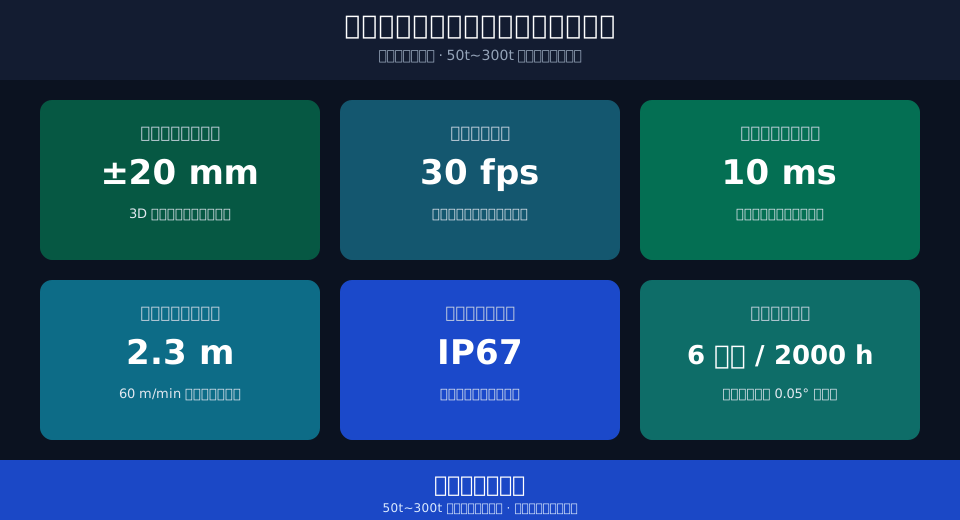
A smart crane doesn't "see" the world — it reconstructs a measurable working scene from multi-sensor data. On Kelude Heavy Industry's 50t–300t European Standard double-girder high-end custom models, 3D LiDAR delivers geometric point clouds with ±20 mm ranging accuracy, industrial vision cameras identify the spreader, lug positions, and personnel at 30 fps, and millimeter-wave radar adds velocity sensing of moving targets in rain and fog. After time synchronization and spatial calibration, the three are fused to verify the crane bridge's braking safety distance within 2.3 m, cutting both false braking and missed detection. The vision-LiDAR collaboration follows a simple logic: LiDAR provides distance, vision provides semantics, and fusion provides reliability.
Designing a smart crane perception system starts with staying inside the regulatory boundaries. Under FEM 1.001 Crane Design Standard — covering work duty, load combinations, and structural safety — and TSG 51-2023 Crane Safety Technical Supervision Regulation — covering safety monitoring, fault self-diagnosis, and operating records — sensor fusion is not about stacking hardware. It is about converting environmental information into verifiable control inputs. On its 50t–300t European Standard double-girder high-end custom models, Kelude Heavy Industry integrates vision, LiDAR, millimeter-wave radar, inertial measurement, and load cells into a single safety monitoring chain.
Hardware Configuration and Data Characteristics of Smart Crane Multi-Sensor Perception
A smart crane's perception system typically consists of three categories: active ranging sensors, passive imaging sensors, and motion-state sensors. Take Kelude Heavy Industry's 50t–300t European Standard double-girder high-end custom models as an example. The 3D LiDAR reaches a measurement radius of up to 100 m, with typical ranging accuracy of ±20 mm within 50 m, outputting 500,000 points per second to build geometric point clouds beneath the main girder and along the crane bridge travel direction. Industrial vision cameras use 1920×1080 resolution at 30 fps to identify spreader posture, hoisting lug positions, personnel crossing, and temporary obstacles.
Millimeter-wave radar provides relative target velocity within a 150 m range, with a velocity resolution of approximately ±0.1 m/s, and remains usable in rain, fog, and dusty environments. Load cells are configured at ±0.5% FS accuracy to capture real-time suspended load mass and feed anti-sway control. The anemometer covers a 0–30 m/s range; when wind speed exceeds 15 m/s, the system automatically restricts high-speed travel.
Every sensor has its limits. Vision cameras lose identification range in backlight, at night, and when lenses are contaminated. LiDAR returns fewer valid points in heavy fog, heavy rain, and against black light-absorbing targets. Millimeter-wave radar has limited angular resolution and struggles to classify target types on its own. Multi-sensor perception, therefore, is not redundant stacking — it is complementarity.
Kelude Heavy Industry standardizes all on-site sensor interfaces and enclosures to IP67, with surge protection and EMC filtering on electrical interfaces, keeping perception hardware running continuously across an ambient temperature range of -20°C to +60°C.
Vision-LiDAR Collaboration Logic and Complementary Boundaries Across Operating Conditions
The core of vision-LiDAR collaboration is a "geometry-semantics" division of labor. 3D LiDAR actively emits laser pulses and receives reflections, outputting 3D coordinates for each point — highly sensitive to distance and profile. Vision cameras receive visible or infrared light and output pixel arrays — highly sensitive to color, texture, text, and category. Combined, the system can answer both "how far and how fast" and "what is it and is it allowed to pass."
Spatially, cameras and LiDAR require extrinsic calibration. In engineering practice, rotational error is typically held within 0.05° and translational error within 5 mm. This allows LiDAR point clouds to be projected onto the image plane and image pixels to be back-projected into the point cloud region. Kelude Heavy Industry performs joint calibration with checkerboards and reflective targets before delivery, and verifies calibration stability on a main girder vibration test rig.
Temporally, LiDAR at 10 Hz, vision at 30 Hz, and millimeter-wave radar at 20 Hz do not share the same frame rate. The system aligns data using the main controller timestamp, requiring time synchronization deviation within 10 ms. Beyond that threshold, moving targets become misaligned due to crane displacement — for example, at a crane bridge speed of 60 m/min, a 10 ms offset equals 10 mm of displacement, already approaching LiDAR ranging accuracy and therefore must be suppressed.
The collaboration logic can be stated as follows: LiDAR first identifies long-range geometric targets, vision performs secondary confirmation on the target region, millimeter-wave radar provides relative velocity, and load cells plus IMU provide the crane's own motion state. In low-light conditions at night, vision identification degrades, so the system automatically increases the weighting of LiDAR point cloud density criteria. In strong backlight, LiDAR still provides distance, while vision uses HDR and polarizing filters to reduce overexposure.
| SensorType | TypicalParameter | Core Output | Collaborative Role | Typical Boundary |
|---|---|---|---|---|
| 3D LiDAR | 100 m Measurement Radius,50 m Internal ±20 mm,10 Hz | 3D Point Cloud、profile、distance | Provides GeometryPositioningandbraking distanceInput | Dense Fog、Number of Points on Black Light-Absorbing TargetsLowering |
| Industrialvision camera | 1920×1080,30 fps,HDR | Image、Texture、Semantic | IdentificationLifting spreader、Personnel、Hole Position with Secondary Confirmation | Nighttime、Backlight、Lens ContaminationIdentificationLowering |
| millimeter-wave radar | 150 m Detection,speedResolution ±0.1 m/s | Targetdistance、Relativespeed | Provides Moving Targets in Rain and Fogspeed | AngleResolutionLimited,Weak Type Classification |
| IMU andEncoder | IMU Pose Update 100 Hz,EncoderResolution 0.1 mm | Pose、Plusspeed、Position Increment | Provides Self-Motion State and Vehicle Body Reference | Long-Term Drift Requires Periodic Zeroing or Fusion Correction |
| Load Cell / Weighing Sensor | Accuracy ±0.5% FS,Sampling 100 Hz | suspended loadQuality | Anti-Sway ControlandOverload protection | Requires Filtering During Dynamic Oscillation |
Safety Distance Calculation and Engineering Verification for Multi-Sensor Fusion Anti-Collision
Multi-sensor fusion ultimately comes down to braking distance. Take the crane travel mechanism of a Kelude 50 t European-standard double-girder crane as an example: travel speed is 60 m/min, or 1 m/s. If the Safety Monitoring System sets electrical braking deceleration at 0.5 m/s², the pure braking distance is s = v² / (2a) = 1² / (2 × 0.5) = 1 m. Add roughly 0.3 s for control response and alarm confirmation, during which the crane bridge continues at a constant 1 m/s, contributing an additional 1 m/s × 0.3 s = 0.3 m. With a 1.0 m safety margin, the system should trigger deceleration or braking approximately 2.3 m before an obstacle.
The trolley mechanism is verified using the same logic. At a trolley speed of 30 m/min (0.5 m/s) and a deceleration of 0.4 m/s², the pure braking distance is 0.5² / (2 × 0.4) = 0.3125 m. Adding 0.15 m for the 0.3 s response time and a 0.8 m safety margin gives a minimum triggering distance of approximately 1.26 m. This value must be adjusted upward to account for load swing, wet crane rails, and wind speed.
LiDAR delivers ±20 mm ranging accuracy within 50 m, while a vision camera can identify personnel targets within 80 m—though recognition confidence depends on lighting conditions. A fusion system does not wait for a single sensor to trigger an alarm; instead, it continuously outputs "target existence probability" and "target distance." When LiDAR and vision agree on the same target, the braking threshold is executed. When they disagree, the system enters a conservative deceleration mode.
For a complete configuration of anti-collision safety distances, see crane anti-collision safety distance. For load swing suppression and motion planning, refer to AI anti-sway algorithms. For visual recognition challenges in main girder structural health monitoring, see main girder weld crack detection.
Sensor Selection and Field Availability Assessment for European-Standard Double-Girder High-End Customization
Sensor selection cannot be copied across different Work Duty / Classifications and structural layouts of European-standard double-girder cranes. Kelude selects sensors for 50 t to 300 t models based on travel speed, Lifting Height, Work Duty / Classification, and Ambient Temperature. For indoor heavy-duty units, where temperature is stable but dust is prevalent, IP67 LiDAR and vision cameras with air-blow dust removal are preferred. For outdoor models operating from -20°C to +60°C, cameras require heated anti-fog protection and LiDAR needs wide-temperature compensation.
Availability assessment must be quantified. Over 24 hours of continuous operation, sensor data loss rate should remain below 0.5%, and timestamp synchronization error must not exceed 10 ms. When the LiDAR effective point ratio drops below 40%, the system identifies a low-visibility environment and automatically limits crane bridge travel speed to below 30 m/min. When the visual image clarity score falls below a preset threshold, visual semantic output is suspended, and the system relies solely on LiDAR and millimeter-wave radar data.
The vibration characteristics of sensor brackets are equally critical. The main girder undergoes elastic deformation and low-frequency vibration when hoisting a 300 t load. The bracket's natural frequency must avoid the primary excitation frequencies of crane travel and the Hoisting mechanism. Kelude requires the first-order natural frequency of sensor brackets to exceed 25 Hz and performs a 0–50 Hz sweep test after assembly to prevent resonance from amplifying calibration error.
For Site Acceptance Test, three test groups are recommended: static calibration verification, dynamic tracking at 60 m/min crane bridge travel, and low-illuminance recognition at night. Across all three, the average reprojection error of LiDAR point clouds projected onto images must not exceed 2 pixels, and the system's time from target entry to alarm output must not exceed 0.3 s. This elevates the perception system's availability from "can display" to "can participate in safety control."
FAQ
Q: Which matters more on a Smart Crane—the vision sensor or LiDAR?
A: They are not substitutes for each other. LiDAR provides geometric distance and 3D point clouds; vision provides texture, edges, and semantics. For European Standard Double-Girder models above 50 t, both should be configured. A single sensor can produce false alarms or missed detection under backlight, rain, fog, or Dusty Environment Service conditions.
Q: How often does multi-sensor fusion require calibration?
A: Generally, extrinsics should be rechecked every 6 months or after 2,000 hours of crane bridge travel. If on-site vibration is frequent, sensor brackets are struck, or alarms behave abnormally, immediately check whether rotation error exceeds 0.05° or translation error exceeds 5 mm, and recalibrate if necessary.
Q: Will LiDAR fail in rain or fog?
A: It will attenuate but not fail completely. A 3D LiDAR can still retain partial valid point clouds within 50 m, and fusion with millimeter-wave radar and vision reduces false alarms. The system automatically adjusts deceleration thresholds based on the effective point ratio, preventing environmental degradation from causing an immediate shutdown.
Q: Is Kelude's smart sensor solution compatible with retrofitting existing older equipment?
A: Yes. Kelude provides modular sensor brackets and independent electrical interfaces. European Standard Double-Girder models from 50 t to 300 t can be retrofitted with LiDAR, vision cameras, and an anti-collision controller without welding onto the main girder body. Specific solutions and pricing are subject to the actual contract.
