

Cleanroom Crane Design: 5 Mistakes That Cause Rework
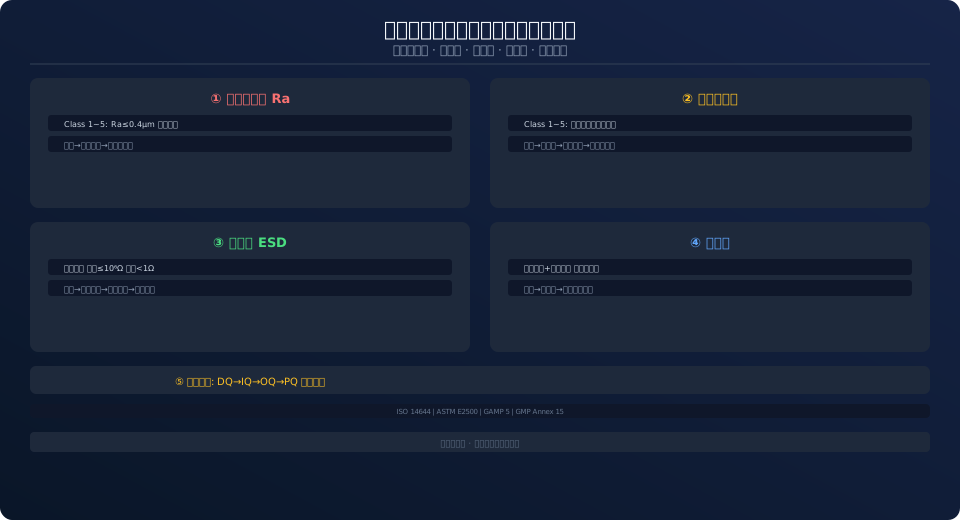
A cleanroom overhead crane has five critical parameters. Get one wrong at the design stage, and you'll be reworking it during validation—at a cost ten times that of getting it right upfront. Too-low surface roughness fails IQ; a mis-selected protective cover floods OQ with red flags; skipped ESD protection kills a batch of wafers; standard wire rope sends particle counters into overdrive; and an incomplete validation protocol earns a blanket rejection in GMP audits.
Surface Roughness Ra: The First Design Gate
Surface roughness is the single most important parameter for a cleanroom crane—it directly governs particle release rates and cleanability. Moving from Class 8 to Class 5 means dropping Ra from 1.6μm to 0.8μm, which requires upgrading from mechanical polishing to electropolishing at 3–5 times the cost. Going from Class 5 to Class 1, Ra drops from 0.8μm to 0.4μm—doubling the cost again. Ra is not a one-and-done measurement at the factory; GMP requires annual verification to confirm no degradation. If Ra starts at 0.4μm in year one but degrades to 0.8μm by year three, Class 1–3 qualification is void and repolishing is mandatory. Specify Ra degradation of ≤0.1μm over a 15-year service life at the design stage—choose a high-purity 316L substrate with sulfur content <0.005%. Beyond the material requirements in ISO 4301, add explicit chemical composition and surface treatment grade specifications.
Protective Cover Sealing: The Weakest Link
The protective cover is one of the most complex subsystems on a cleanroom crane. Classes 1–5 require all-stainless-steel construction (301/316L); Classes 6–8 can use PTFE-coated fiberglass fabric over a stainless steel frame. Bellows-type covers offer better sealing than telescoping designs but have a 30–50% shorter service life. Inject 0.5–2L/min of clean nitrogen into the cover to maintain a +10–30Pa positive pressure—the most reliable way to keep external particles out. Use double labyrinth seals with flexible silicone lip edges at all interfaces—these are the most leak-prone points and must be inspected segment by segment during IQ.
ESD Protection: Non-Negotiable for Wafer Handling
| Detection Item | Requirement | Standard | Frequency |
|---|---|---|---|
| Wheel-to-Rail Contact Resistance | ≤10⁶Ω | IEC 61340-5-1 | Quarterly |
| Complete Machine Grounding Resistance | <1Ω | ISO 4301 Crane Design Standard | Semi-annually |
| Static Surface Voltage | <100V | ANSI/ESD S20.20 | After Each Operation |
Standard polyurethane wheels with insulation resistance at the 10¹²Ω level can accumulate several thousand volts of static electricity within just a few steps of travel. The solution is to switch to static-dissipative polyurethane (doped with carbon nanotubes or conductive carbon black) with resistance controlled between 10⁴ and 10⁶Ω—this drains static charge effectively while avoiding short-circuit conditions that could trip leakage protection.
④ Wire Rope
Standard wire rope uses a natural or synthetic fiber core—during repeated bending, these fibers fracture into micron-sized fragments that get squeezed out between the strands. Cleanroom cranes must use an independent wire rope core (IWRC) made from stainless steel wire—AISI 316 grade—with the core injection-filled to eliminate fiber shedding. The trade-off is that stainless steel rope has roughly 15%–20% lower breaking force than carbon steel rope of the same diameter, so a safety factor of 6.0 is specified instead of 5.0. Additionally, the rope surface must be coated with an ultra-thin layer of PFPE grease—not for corrosion protection, but to reduce fretting wear between the rope and pulleys that generates sub-micron metal oxide particles.
⑤ Verification Protocol
DQ is completed before contract signing—each URS requirement is checked against the design. IQ is performed immediately after installation—baseline particle counts are established under empty cleanroom conditions. OQ is the real acceptance test—the crane runs continuously for 2 hours at full load and rated speed, with particle counters monitoring at three distances (1m, 2m, and 5m) simultaneously. All particle counts at ≥0.5μm must not exceed 1.5 times the baseline value. PQ involves long-term testing linked to actual production materials—the crane runs through three complete production batches with product quality testing to prove the crane has no negative impact on product quality.
Vibration Control in Cleanroom Cranes—The Hidden Metric for Precision Manufacturing
Precision manufacturing (optical lens coating, aerospace gyroscope assembly, chip packaging) demands more from a crane than just cleanliness—vibration is equally critical. Standard overhead cranes typically generate vibration acceleration of 0.5–2.0m/s² in both the crane bridge and trolley travel mechanisms, across a frequency range of 10–100Hz. This level of vibration is perfectly acceptable in a normal workshop, but in a precision manufacturing facility, it can shift the exposure accuracy of a multi-million-dollar electron beam lithography machine from 3nm to 5nm—a two-nanometer drift that drops yield rates from 95% to 70%.
When a cleanroom crane is used for precision manufacturing, additional vibration analysis is required:
①Wheel roundness and rail straightness—wheel roundness tolerance ≤0.05mm (standard overhead cranes allow ≤0.2mm), rail joint height deviation ≤0.3mm with welded and ground joints;
②Variable speed control—both the crane bridge and trolley use VFDs with S-curve acceleration and deceleration rather than linear ramps, reducing start/stop impact;
③Vibration damping—polyurethane damping pads (Shore A hardness 70–80, thickness 5–8mm) installed between the crane and the rail to attenuate vibration transmitted to the factory building by approximately 30%–50%.
Common Deviations in Verification and How to Handle Them
In GMP equipment validation, deviations are not inherently bad—they are evidence that your quality system can detect problems and drive corrective action. However, if a deviation goes unrecorded, uninvestigated, or without CAPA (Corrective and Preventive Action), that constitutes a serious GMP violation.
The three most common deviation types in cleanroom crane verification:
①A sampling point exceeds limits during particle release testing—possible causes include poor sealing at protective cover joints or a contaminated particle counter sampling tube. Handling procedure: immediately document the deviation, halt testing, investigate root cause (section-by-section leak checking plus blank controls), implement corrective action once the cause is confirmed, re-test, and archive the deviation report.
②Excessive operating noise during OQ testing—the fully enclosed protective covers on cleanroom cranes can amplify mechanism noise (similar to a speaker enclosure effect), with measured noise levels 5–8dB(A) higher than open-type standard overhead cranes. If limits are exceeded, sound-absorbing foam can be applied to the inside of the covers (the foam's own particle-shedding characteristics must be evaluated first).
③Microbial contamination found on product surfaces during PQ testing—this is the most serious scenario. The crane must be taken out of service immediately, the cleanroom fully sanitized, microbial swab sampling performed on crane surfaces to locate the contamination source, and cleaning validation repeated. The PQ deviation resolution cycle typically takes 4–8 weeks, during which the entire cleanroom is shut down—this is why skipping proper OQ and jumping straight to PQ carries such a high price.
Retrofitting an Electric Hoist for Cleanroom Use—The Most Cost-Effective Upgrade
For users with moderate cleanliness requirements (ISO Class 6–8) and limited budgets, there is an alternative to purchasing a brand-new cleanroom crane: retrofitting an existing standard electric hoist for cleanroom duty.
The core approach is to locally isolate the hoist's contamination sources without modifying the bridge structure or main girders:
①Enclose the hoist housing in a 304L stainless steel sealed cover, with clean compressed air supplied at 0.3–0.5L/min to maintain a slight positive internal pressure;
②Replace the hoist's wire rope with stainless steel rope (6×36WS+IWRC, AISI 316), using injection-molded sockets at rope terminations instead of traditional wire rope clips (to eliminate clip loosening and metal fragment shedding);
③Replace the hook block assembly with 304L electropolished components, surface roughness Ra≤0.8μm;
④Perform a "lubricant swap" on the hoisting gearbox—drain the mineral gear oil and refill with PFPE fluorinated grease.
Frequently Asked Questions
Q: How do I determine the required cleanliness level?
A: It is determined by the production process. Semiconductor lithography requires ISO Class 1–3, wafer inspection ISO Class 3–5, pharmaceutical aseptic filling GMP Grade A equals ISO Class 5, and aseptic food packaging ISO Class 6–7. Start by having a process engineer or GMP consultant perform a cleanroom classification assessment and issue a written report before going out to tender.
Q: How is surface roughness verified at acceptance?
A: A portable surface roughness tester is used to take five measurements on each of the main girder, end carriages, and hoist housing, then averaged. Acceptance standard: measured Ra value ≤ design target value + 0.1μm tolerance. Electropolished surfaces are directional—measure both longitudinal and transverse directions and take the higher value.
Q: What if the protective cover gets damaged?
A: A locally damaged section of stainless steel bellows can be replaced—but IQ and OQ must be re-run. A rubber protective cover that is torn should be replaced in full—rubber aging is a global condition; if one section has cracked, the rest is not far behind.
Q: Is there an existing design manual for cleanroom cranes?
A: There is currently no dedicated cleanroom crane design manual. The industry-standard approach is to translate the cleanroom equipment requirements from standards such as ISO 14644, GMP, and SEMI into crane technical specifications—this is not a matter of looking things up in a manual but of translation and derivation. A cleanroom crane must be designed by a team that understands both crane engineering and cleanroom technology.
For cleanroom crane design and verification, consult the Kelude technical team.
Kelude Heavy Industry: Overhead Crane & Hoist Solutions
Kelude Heavy Industry specializes in the design and manufacture of industrial overhead cranes, gantry cranes, and electric hoists. Our equipment is engineered for demanding environments, delivering reliable performance for manufacturing, warehousing, and logistics operations across the United States and Europe.
Frequently Asked Questions
Q: What is the typical lead time for a custom overhead crane?
A: Lead times vary based on configuration and capacity. Standard single-girder cranes typically ship within 6-8 weeks, while custom double-girder systems may require 12-16 weeks from design approval.
Q: Do you provide installation services?
A: Yes, our trained technicians can handle the complete installation, including runway alignment, crane assembly, and load testing. We also offer turnkey project management for complex installations.
Q: What safety certifications do your cranes meet?
A: Our equipment is designed and manufactured in accordance with ISO 4301 for crane classification and IEC 60204-32 for electrical equipment. Specific certifications can be provided upon request based on your project requirements.
Q: Can you retrofit an existing crane with new controls?
A: Absolutely. We offer modernization packages that include VFD retrofits, wireless remote controls, and anti-collision systems. These upgrades can improve safety, productivity, and energy efficiency of your current equipment.
