

Pneumatic Crane Systems: Air Hoist, Brake & Air Station Guide
In explosion-proof workshops, chemical plants, and offshore platforms, pneumatic cranes represent the most important technology path alongside electric cranes—not as an electric alternative, but as the inherently safe solution for flammable and explosive atmospheres. This guide covers the selection logic and design parameters for four core modules: pneumatic hoists, pneumatic brakes, air pressure stations, and pneumatic fixtures.
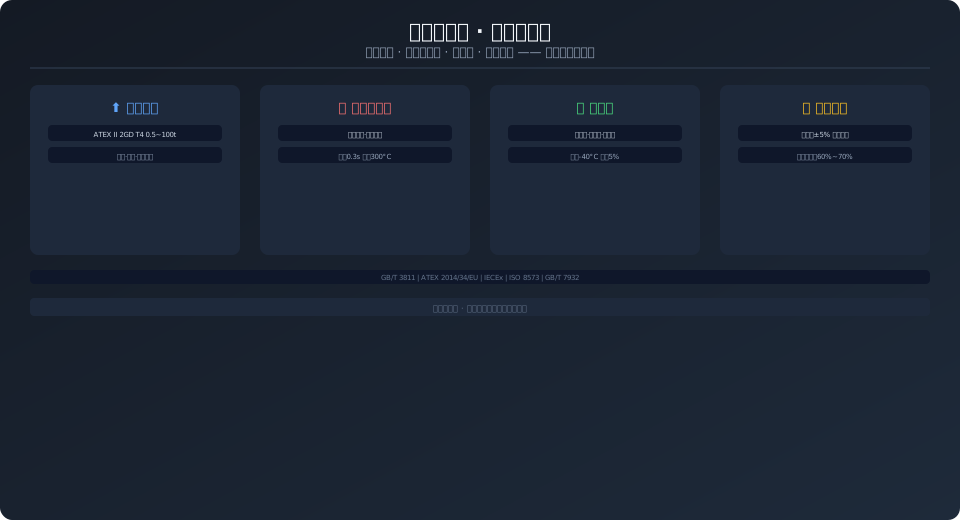
Four-Module Configuration at a Glance
| Module | Core Functions | Working Pressure | Explosion Protection Class | Typical Applications |
|---|---|---|---|---|
| Pneumatic Hoist / Air-Powered Hoist (Explosion-Proof) | Hoisting / Lifting/Lowering Materials | 0.4~0.8 MPa | ATEX II 2GD T4 | Chemical Reactor Hoisting |
| Pneumatic Brake / Air Brake | Emergency Braking/Parking | 0.5~1.0 MPa | ATEX II 2GD T6 | High-Temperature Metallurgy Workshop |
| Compressed Air Station | Compressed Air Supply | 0.7~1.2 MPa | Not Applicable | Plant-Wide Pneumatic Equipment Air Supply |
| Pneumatic Fixture | Load Gripping/Handling | 0.4~0.8 MPa | ATEX II 3GD | Steel Millsteel coil Grabbing |
Why Air-Powered Operation Is the Preferred Choice for Explosion-Proof Environments
The core challenge with explosion-proof cranes is eliminating ignition sources. Electric crane retrofits for explosion-proofing work by containing the hazard—explosion-proof motors use flameproof enclosures to seal off arcs, and explosion-proof control boxes use positive-pressure ventilation to purge flammable gases. Air-powered cranes take a fundamentally different approach—compressed air is inherently non-flammable and produces no arcs or sparks. Air motors operate without any electrical contacts, meaning there is zero opportunity for spark generation throughout the entire process. This is why, in Zone 1 areas, air-powered cranes face far lower certification barriers than electric explosion-proof cranes.
However, air power comes with trade-offs—air motor efficiency ranges from just 15% to 25% (compared to 85%–95% for electric motors), consuming 3 to 5 times more energy. The initial investment for a compressed air station runs between $12,000 and $22,000, and it demands exceptionally high compressed air quality. Per ISO 4301, air-powered cranes must also comply with GB/T 7932 and ISO 8573 requirements.
Three Critical Technical Indicators for Pneumatic Systems
First is compressed air quality—classified under ISO 8573-1 into three parameters: particulates, dew point, and oil content. The minimum requirement for crane pneumatic systems is Class 3 particulates, a dew point of -20°C, and oil content ≤1 mg/m³. Excessive oil content directly compromises the friction coefficient of the brake friction lining. Second is pressure stability—a pneumatic hoist requires a minimum inlet pressure of 0.55 MPa during full-load lifting, and pressure fluctuations exceeding ±0.1 MPa will cause lifting speed variations of ±20%. Third is exhaust handling—air motor exhaust is discharged directly into the environment, so in cleanroom applications, the exhaust must be routed to a safe area.
Air vs. Electric vs. Hydraulic: A Full-Spectrum Comparison of Three Power Sources
| Dimension | Pneumatic | Electric Explosion-proof | Hydraulic |
|---|---|---|---|
| Explosion-proof Certification | Natural Explosion-proof ATEX Zone 1/2 | Flameproof Enclosure ATEX Zone 2 | Requires Additional Explosion-proof Retrofit |
| Energy Efficiency Ratio | 15%~25%(Low) | 85%~95%(High) | 60%~75%(Medium) |
| Speed control Accuracy | Pneumatic Speed control ±10% | Variable Frequency Speed Control ±1% | Proportional Valve ±2% |
| Temperature Resistance Range | -40°C~300°C | -20°C~80°C | -20°C~150°C |
| Decade TCO(10t) | Approximately60~80Ten Thousand | Approximately30~45Ten Thousand | Approximately55~75Ten Thousand |
ATEX and IECEx Explosion-Proof Certification Systems
Explosion-proof certification is unavoidable when selecting a pneumatic crane. ATEX (EU) and IECEx (International) are the two dominant certification frameworks. While their technical requirements are largely aligned, they are not interchangeable—ATEX is mandatory for exports to Europe, while IECEx is typically preferred for the Middle East and Southeast Asia. Under ATEX, pneumatic equipment falls under the "non-electrical equipment" category (EN 13463 series), with certification focusing on mechanical spark risk assessment and hot surface temperature control. The friction between the pneumatic motor's vanes and cylinder bore is classified as "frictional contact under normal operating conditions"—as long as the vane material is non-metallic (e.g., phenolic resin or PEEK), even dry running will not generate mechanical sparks. The maximum surface temperature of a pneumatic motor depends on inlet air temperature and workload—after 1 hour of continuous full-load operation at 0.6MPa, the cylinder surface temperature typically stays below 85°C, well under the T4 Temperature Class limit of 135°C. This is why pneumatic equipment can readily achieve II 2GD T4 certification—whereas electric explosion-proof equipment requires a triple combination of flameproof enclosure Ex d + increased-safety junction box Ex e + pressurized control cabinet Ex p to reach the same protection grade.
The Hidden Lifecycle Cost of Pneumatic Systems
The biggest hidden cost of a pneumatic crane isn't the purchase price or electricity—it's the overall efficiency decay of the compressed air system. A well-designed system starts at roughly 70%–80% total efficiency from the air compressor to the point of use (after accounting for compressor losses, dryer pressure drop, piping leakage, and filter resistance). But after 2–3 years of operation, micro-leaks at pipe joints (5%–15% annual leakage rate), clogged filters (0.05–0.1MPa added pressure drop), and compressor efficiency loss (5%–10% reduced output from carbon buildup) can drag total efficiency down to 50%–60%. The result: a previously adequate compressor becomes undersized, and insufficient end-of-line pressure degrades hoist lifting capacity or prevents full brake release—yet maintenance crews typically respond by "bumping up the compressor discharge pressure" rather than investigating the root cause of system degradation. Raising discharge pressure from 0.7MPa to 0.85MPa may seem to fix the low pressure at the point of use, but it increases compressor shaft power by roughly 15%–20%, adding $1,500–$3,000 to annual electricity costs—not to mention accelerated seal aging from high-pressure operation. The correct approach is a quarterly system efficiency audit: scan all pipe joints with an ultrasonic leak detector, tighten or replace leaking fittings, clean or replace filters, and verify end-of-line pressure meets the 0.55MPa requirement. Only if pressure still falls short should you consider raising compressor pressure.
Frequently Asked Questions
Q: How do I choose between pneumatic and electric explosion-proof cranes?
A: For Zone 2, electric explosion-proof offers better value (roughly 60% of pneumatic cost). For Zone 1, pneumatic is the only solution requiring no additional certification. For Zone 0, cranes cannot be placed in the area at all.
Q: Pneumatic hoists consume 3–5 times more energy than electric—why still use them?
A: Safety costs far outweigh energy costs. Annual electricity adds $1,500–$3,000, or $22,000–$44,000 over ten years. But a single explosion-proof failure incident can cause $740,000–$7.4 million in direct losses. Spending $30,000 to hedge against a $740,000 risk is a sound trade-off.
Q: What does routine air station maintenance involve?
A: Drain condensate from the air receiver tank daily; check dryer dew point weekly; replace filter elements monthly (three-stage: 5μm, 1μm, 0.01μm).
Q: How much weight can a pneumatic fixture hold?
A: Single-cylinder force: F=P×A×η. At 0.6MPa, a Φ100mm cylinder delivers ≈400kgf. Multiple cylinders in parallel multiply capacity but require careful synchronization.
For pneumatic crane system design, consult the Kelude engineering team.
