

Crane Hoisting Motor Overheating: 7 Causes & Temperature Rise Limits
⚠️ Overheating in crane hoisting motors is the leading cause of winding burnout, turn-to-turn short circuits, and insulation breakdown. Seven typical failure modes are responsible: overload operation (current exceeding In by ≥15%), cooling system failure (blocked air ducts reducing heat dissipation efficiency by up to 40%), three-phase unbalance in the power supply (>5% generates negative-sequence currents), frequent start/stop cycles (starting current 5–7× rated), bearing wear (friction-induced temperature rise of 15–25 K), insulation aging (following the 8°C half-life rule), and brake drag.
The hoisting motor is the most critical power component of overhead and gantry cranes, and its operational reliability directly affects personnel safety and production efficiency. Industry statistics indicate that approximately 65% of hoisting motor failures are heat-related — the progression from accelerated insulation aging to turn-to-turn short circuits and eventual phase-to-phase burnout can occur within just a few dozen hours. This article systematically examines the seven categories of overheating causes, temperature rise limits, and diagnostic and protection solutions to help equipment managers build a complete motor thermal management knowledge base.
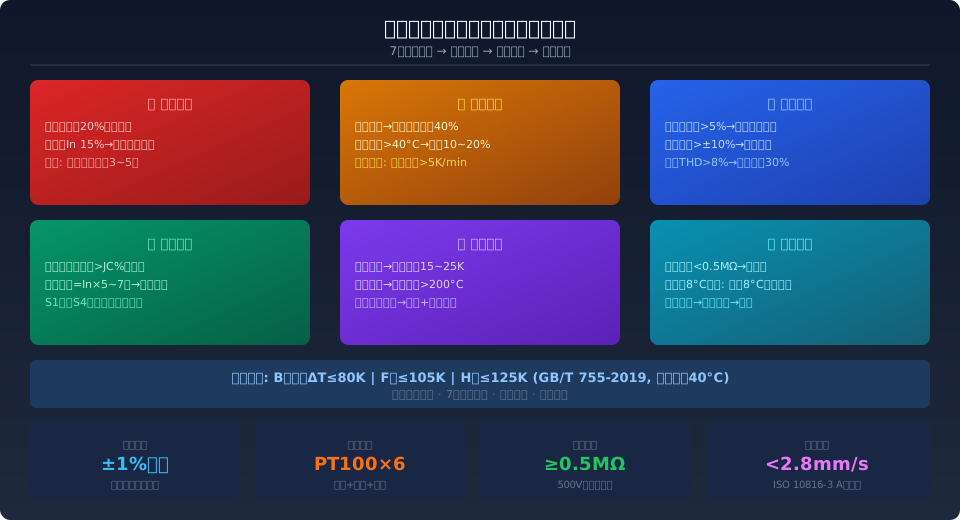
7 Causes of Hoisting Motor Overheating and How to Diagnose Them
Hoisting motor overheating is rarely caused by a single factor; it is typically the cumulative effect of multiple deteriorating conditions. The following breakdown is ordered from most to least frequent, with diagnostic thresholds and typical characteristics provided for each category.
1. Overload Operation — This is the most direct and common cause. When the lifting load exceeds the motor's rated power capacity, stator current continuously exceeds the rated current (In). Per GB/T 755-2019 Rotating Electrical Machines — Rating and Performance, continuous operation at 1.15× rated current can push winding temperature rise 20–30 K above the allowable limit for the insulation class. This typically results from "lifting a little extra" during peak production, undersized motor selection, or an excessively high gearbox speed ratio that forces the motor to run continuously in the low-speed, high-torque zone. Diagnostic method: Measure three-phase current with a clamp meter; if any phase exceeds the nameplate rating by 15%, overload is confirmed.
2. Cooling System Failure — Motor cooling relies on airflow through the cooling ducts and heat radiation from the housing. Dust in foundries, fiber particles in textile workshops, and salt crystallization in port environments can all block cooling ducts and cooling fin gaps, reducing heat dissipation efficiency by 40%–60%. Self-ventilated motors (IC410) are particularly vulnerable in high-dust environments. A damaged cooling fan, a missing wind cover, or the motor being wrapped in insulation material due to construction oversights are equally critical. Diagnostic method: Scan the motor surface with an infrared thermal imager. On a healthy motor, surface temperature should increase progressively from the fan end to the non-fan end by ≤15°C. If localized hot spots appear (temperature differential >25°C), cooling in that area is compromised.
3. Power Supply Quality Issues — When three-phase voltage unbalance exceeds 5%, the negative-sequence voltage generates a reverse-rotating magnetic field that induces double-frequency currents in the rotor, producing additional copper and iron losses. ISO 4301 Crane Design Standard requires that supply voltage fluctuation not exceed ±10% of the rated value. Regarding harmonics, when THDu exceeds 8% in VFD-driven motors, the iron losses caused by high-order harmonics can reach 30%–50% of the fundamental-frequency iron loss. Diagnostic method: Use a power quality analyzer to record voltage and current waveforms on the supply side, paying particular attention to three-phase unbalance and the content of 5th and 7th harmonics.
4. Frequent Start/Stop and Inching Operation — Every start of a hoisting motor involves acceleration from standstill to rated speed, drawing a starting current of 5–7× the rated value. Per Appendix B of ISO 4301, the duty cycle (JC%) for hoisting mechanisms is typically 25%–40%. If operators frequently use inching mode (more than 150 starts/stops per hour), the equivalent JC% far exceeds the design value, and the motor does not have sufficient time to cool between cycles. A motor rated for Duty Classification S1 (continuous running) that is used in S4 intermittent periodic duty must be derated; otherwise, temperature rise can exceed the limit by more than 40 K.
5. Additional Loads from Mechanical Faults — Bearing grease depletion or deterioration increases friction torque, and the bearing outer ring temperature can run 15–25 K higher than the winding temperature. Uneven rotor-to-stator air gap (eccentricity >10% of the gap value) creates unilateral magnetic pull; during rotor-stator rub, localized temperatures can momentarily exceed 200°C. Coupling misalignment (radial deviation >0.05 mm or angular deviation >0.1°) subjects the motor shaft bearings to additional bending moments, pushing vibration severity beyond the 2.8 mm/s A/B zone boundary of ISO 10816-3.
6. Insulation Aging and Partial Discharge — Motor insulation follows the classic 8°C thermal aging rule: for every 8°C rise in winding temperature, insulation life is halved. Class F insulation (155°C) operated continuously above 140°C will see its expected service life drop from 20 years to less than 5 years. Weak points in turn-to-turn insulation develop micro-cracks under repeated thermal cycling and electrical stress, lowering the partial discharge inception voltage to 60%–80% of the rated voltage, eventually progressing to turn-to-turn short circuits.
7. Brake Drag — The hoisting motor brake (conical rotor motor brake or electromagnetic disc brake) may fail to release fully during motor operation due to improper gap adjustment, excessive wear of the friction lining, or weakened spring force, generating additional heat through continuous drag. Drag power typically amounts to 3%–8% of the motor's rated power, but its impact on heat dissipation is significant for totally enclosed motors (IC411). Diagnostic method: With the motor running unloaded, measure the brake housing temperature with an infrared thermometer. Normal temperature should be ≤ ambient temperature +20°C; if it exceeds +40°C above ambient, brake drag is confirmed.
Motor Temperature Rise Limits and Insulation Class Standards
Motor temperature rise limits are determined by the winding insulation class, per GB/T 755-2019 Rotating Electrical Machines — Rating and Performance. Hoisting motors commonly use Class F (155°C) and Class H (180°C) insulation. For metallurgical cranes and ladle cranes operating in high ambient temperatures (up to 60°C), Class H insulation is recommended. The following table lists temperature rise limits for each insulation class (based on 40°C ambient temperature, resistance method measurement):
| Insulation Class | Max Allowable Temperature (°C) | Temperature Rise Limit (K, resistance method) | Typical Application |
|---|---|---|---|
| Class B | 130 | 80 | General-purpose cranes |
| Class F | 155 | 105 | Standard hoisting motors |
| Class H | 180 | 125 | Metallurgical & ladle cranes |
Kelude Heavy Industry: Overhead Cranes & Industrial Hoists
Kelude Heavy Industry is a full-service manufacturer of overhead cranes, gantry cranes, and electric hoists. We design, build, and support material handling equipment for demanding industrial environments across the United States and Europe. From a single hoist to a complete crane system, our focus is on engineering reliability, safety, and long-term performance.
Frequently Asked Questions
Q: What is the typical lead time for a standard overhead crane?
A: Lead times vary based on configuration and capacity. A standard single-girder crane can typically be delivered within 4-6 weeks, while larger or custom-engineered systems may take 8-12 weeks. Please contact us with your specific requirements for an accurate timeline.
Q: Do you provide installation services?
A: Yes, we offer professional installation services by our certified technical teams. We handle everything from site preparation and assembly to testing and commissioning, ensuring your crane is operational safely and correctly.
Q: What safety certifications do your cranes comply with?
A: Our cranes are designed and manufactured in accordance with international standards, including ISO 4301 for crane classification and IEC 60204-32 for electrical equipment. We can also provide documentation to support local regulatory compliance in the US and EU.
Q: Can you customize a crane for an existing facility?
A: Absolutely. We specialize in retrofitting and customizing cranes to fit existing buildings and operational needs. Our engineers will conduct a site survey to assess structural supports, power supply, and operational clearances to design a solution that maximizes your existing infrastructure.
Q: What is your spare parts policy?
A: We guarantee the availability of spare parts for all our crane models for a minimum of 10 years after purchase. Our global logistics network ensures fast delivery of genuine parts to minimize any potential operational downtime.
Q: How often should a crane be inspected?
A: We recommend a formal inspection at least annually, or more frequently depending on the duty cycle and operating environment. Regular preventive maintenance is crucial for safety and longevity. We offer tailored maintenance contracts to suit your usage patterns.
Q: What is the price range for a 10-ton overhead crane?
A: The price for a 10-ton overhead crane depends on factors like span, lifting height, and control system. As a general reference, a standard 10-ton double-girder crane starts at approximately $66,600. For a detailed quotation, please provide your specific technical parameters.
| Insulation Class | Maximum Permissible Temperature | temperature rise limitΔT(K) | Applicable Operating Conditions | Typical Motor Type |
|---|---|---|---|---|
| BClass(130°C) | 130°C | 80K | Standard Workshop, Environment≤40°C | YZR Wound Rotor Motor (Slip Ring Motor) |
| FClass(155°C) | 155°C | 105K | General Industrial, A3~A5Work Duty / Classification | YZP Variable Frequency Motor |
| HClass(180°C) | 180°C | 125K | Metallurgical/Casting, Environment≤60°C | YZP-HMetallurgical Motor |
| CClass(>180°C) | >200°C | >140K | Special High-Temperature Duty | Special Motor |
A: Note: The temperature rise limits above refer to the average winding temperature measured by the resistance method. For hot-spot temperature measured with embedded temperature detectors (ETD), Class F motors must not exceed 155°C and Class H motors must not exceed 180°C. In practice, a 15–20 K margin is recommended to prevent insulation from operating at its thermal limit for extended periods.
Motor Overheating: Key Diagnostic Parameters at a Glance
Motor Overheat Protection Solutions and Inspection Intervals
A systematic motor thermal management strategy should integrate real-time monitoring, periodic inspection, and preventive maintenance. The following protection layers are arranged from online to offline:
Online Monitoring — PTC Thermistors + Current Transformers. PTC thermistors (Curie temperature 135°C/155°C) are embedded in each phase winding and connected to a motor protection relay (e.g., Siemens 3RB series or Schneider TeSys series). When winding temperature reaches the PTC trip point, the control circuit is automatically opened. Three-phase current transformers (accuracy class 0.5) feed current signals into the PLC analog input module for real-time detection and alarming of overload, phase loss, and three-phase unbalance. Kelude Heavy Industry equips its bridge cranes with PTC + current dual protection as standard, reducing motor burnout incidents to below 0.3 per 100 units per year.
Periodic Inspection — Monthly Insulation Resistance + Quarterly Vibration Spectrum. Measure winding-to-ground insulation resistance monthly using a 500 V megohmmeter and track the trend. If insulation resistance drops more than 50% from the baseline, shorten the interval to weekly. Every quarter, use a vibration analyzer to measure three-axis vibration velocity (mm/s RMS) at the motor's front and rear bearings. Assess results per ISO 10816-3: Zone A (≤2.8 mm/s) is good; Zone B (2.8–4.5 mm/s) allows continued operation but requires attention; Zone C (4.5–7.1 mm/s) calls for scheduled maintenance; Zone D (>7.1 mm/s) requires immediate shutdown.
Preventive Maintenance — Annual Bearing Re-Greasing + 3-Year Insulation Re-Impregnation. Before the hot season each year, regrease motor bearings with lithium grease (No. 2 or No. 3, dropping point ≥180°C), filling to one-third to one-half of the bearing cavity volume. Every three years, re-impregnate the winding insulation using solvent-free epoxy impregnating varnish (e.g., Class H TJ1356) to restore turn-to-turn and phase-to-phase insulation strength. After 20,000 cumulative operating hours, or if insulation resistance falls below 0.5 MΩ, winding replacement or motor overhaul is recommended.
Motor Overheating: Step-by-Step Diagnosis and Corrective Actions
If the motor housing feels abnormally hot on site (back of hand cannot stay on the surface for more than 5 seconds, indicating a housing temperature above 60°C), follow the troubleshooting sequence below to avoid unnecessary shutdowns or continued operation under fault conditions:
Kelude Heavy Industry: Overhead Cranes & Industrial Hoists
Kelude Heavy Industry specializes in the design, engineering, and manufacturing of heavy-duty overhead cranes, gantry cranes, and electric wire rope hoists. With decades of experience serving industrial facilities across the United States and Europe, we deliver material handling solutions built for reliability, safety, and long-term performance in demanding environments.
Electric Wire Rope Hoists for Precise Load Handling
Our electric wire rope hoists are the workhorse of many production lines, offering fast lifting speeds, precise positioning, and minimal maintenance requirements. Built with self-locking gearboxes and multi-pole motors, these hoists deliver reliable performance in cyclic duty applications. Available with various suspension options, including fixed, lug-mounted, and motorized trolley versions.
Frequently Asked Questions
Q: What is the typical lead time for a standard overhead crane?
A: Lead times vary depending on the crane configuration and capacity. For standard single-girder cranes up to 10 tons, typical lead time is 6-8 weeks. For larger or custom-engineered double-girder cranes, please contact our sales team for a specific schedule.
Q: Do you provide installation services?
A: Yes, we offer full installation supervision and commissioning services. Our experienced technicians can either oversee your in-house installation team or provide complete turnkey installation, depending on your project requirements.
Q: What safety standards do your cranes comply with?
A: All our cranes are designed and manufactured in accordance with ISO 4301 for crane classification, ISO 12480 for safe use, and IEC 60204-32 for electrical equipment. We also offer options to meet additional local regulations and site-specific requirements.
Q: Can you customize a crane to fit an existing building structure?
A: Absolutely. We regularly engineer cranes to fit existing facilities with specific column spacing, headroom constraints, or runway beam configurations. Our engineering team will conduct a site assessment and provide a tailored solution.
Q: What is your warranty policy?
A: We provide a standard 12-month warranty on all crane components, covering manufacturing defects and workmanship. Extended warranty options are available upon request.
| Troubleshooting Procedure | inspection item | acceptance criteria | Corrective Action |
|---|---|---|---|
| Step1Step | clamp meter Measure Three Phases Current | Any Phase> In×1.1 | Reduce Load to Rated Capacity, Inspect Machinery Seizure / Binding |
| Step2Step | Infrared Thermographic Surface Scan | Local Temperature Differential>25°C | Clean Air Duct, Check Fan Operation |
| Step3Step | Megohmmeter (Insulation Tester)Measure Insulation Resistance | <0.5MΩ | Bake-Out / Drying Treatment(80°C/24h), Re-Measure / Re-Test |
| Step4Step | Power Quality Analysis | Unbalance>5%Or THDu>8% | adjustment Power Distribution, Retrofit / Install Filter |
| Step5Step | Vibration Analyzer Measurement | >4.5mm/s RMS | Inspect Bearing, shaft alignment, Foundation Bolt |
| Step6Step | Infrared Measurement Brake Enclosure / Housing | Temperature Rise>40°C | adjustment Brake Clearance To0.5~0.8mm |
Handling Protocol: If any phase current exceeds the rated value by more than 20% AND insulation resistance drops below 0.5 MΩ, the crane must be shut down for inspection. If only the temperature is elevated (winding temperature rise < limit + 10K) and all other parameters are normal, operation may continue, but with increased inspection frequency (temperature checks every 4 hours) and a scheduled deep inspection at the nearest planned maintenance window.
Hoisting Motor Selection & Retrofit Guide
For new projects, we recommend sizing the hoisting motor with a power margin of 1.15 to 1.25 times the calculated shaft power (for A3 to A5 duty classifications) or 1.3 to 1.5 times (for A6 to A7 classifications). Prioritize inverter-duty motors (YZP series), which feature reinforced insulation systems, built-in encoder interfaces, and independent forced ventilation (IC416) that improves low-speed cooling capacity by over 50%.
For addressing overheating issues in existing motors, we recommend the following upgrade path, from simplest to most comprehensive:
- Install an independent axial fan (IC416 retrofit): Investment approx. ¥2,000–5,000. Reduces winding temperature rise by 15–25K.
- Rewind with Class H insulation: Investment approx. ¥8,000–15,000. Increases the temperature rise limit from 105K to 125K.
- Replace the entire motor with a same-frame inverter-duty motor and matching VFD: Investment approx. ¥30,000–80,000. Completely resolves start/stop shock and low-speed cooling issues. The specific approach should be based on a comprehensive assessment of motor age, failure history, and retrofit budget.
Related Reading: ISO 4301 Crane Design Standard provides systematic requirements for hoist duty classification and motor selection; TSG 51-2023 Crane Safety Technical Supervision Regulation specifies motor safety protection and periodic inspection requirements. For detailed procedures on motor insulation testing and megohmmeter selection, refer to our related technical articles.
Hoist Motor Overheating: FAQ
Q: What is the actual temperature rise difference between Class F and Class H insulation in crane hoist motors, and how does it impact service life?
A: Class F insulation (155°C) has a temperature rise limit of 105K, while Class H (180°C) has a limit of 125K — a difference of 20K. Based on the 8°C thermal aging halving rule, at an ambient temperature of 40°C, a Class F motor winding operating at 145°C has an expected life of about 5 years. Under the same conditions, a Class H motor at 145°C would have approximately 40 years of life remaining (using only 20K of its margin). In metallurgical crane applications where ambient temperatures often reach 55–60°C, the allowable temperature rise for a Class F motor is only 40–45K, making it practically unusable — Class H is mandatory.
Q: Will a three-phase current imbalance exceeding 5% definitely burn out the motor? What is the mandatory shutdown threshold?
A: A 5% current imbalance is an early warning threshold, not a mandatory shutdown value. Per GB/T 755-2019: imbalances between 5% and 10% allow derated operation (approximately 2% derating for every 1% of imbalance); imbalances exceeding 10% require immediate shutdown for troubleshooting — at this level, the negative-sequence current component causes rotor additional heating equivalent to 1%–3% of the positive-sequence heating, and winding hotspot temperatures can exceed the limit by more than 30K within 48 hours of continuous operation. Common causes: unbalanced three-phase loading on the supply transformer, excessive contact resistance on one phase of a contactor (voltage drop > 5% of line voltage), or a turn-to-turn short circuit in one motor phase winding.
Q: Our hoist motor keeps burning out. Will upgrading to a larger motor solve the problem? What should we watch out for?
A: Simply increasing motor power does not guarantee a solution — you must first diagnose the root cause. If frequent inching/jogging causes the equivalent duty cycle (JC%) to exceed the rating, a larger motor will still overheat (since starting current increases proportionally). If the issue is poor cooling, installing an independent fan on the same frame size (IC416 retrofit) offers better cost-effectiveness. If uprating is indeed necessary, note the following: ① Check mounting dimensions and coupling compatibility when increasing the frame size; ② The VFD capacity must be upgraded accordingly (when motor power increases one frame size, we recommend increasing the VFD by two sizes to cover starting peaks); ③ The circuit breaker and contactor in the power distribution cabinet must be re-selected based on the new rated current, referencing the electrical design section of ISO 4301.
Q: How much does it cost to replace a complete crane hoist motor system, and how long does it take to resume production including installation and commissioning?
A: Using a 32t bridge crane YZP315M-6 (75kW) hoist motor as an example: motor itself approx. ¥50,000–80,000; matching VFD (e.g., Inovance MD880 series 90kW) approx. ¥30,000–50,000; encoder + PTC sensor + mounting accessories approx. ¥8,000–12,000; installation and commissioning approx. ¥5,000–10,000. Total: approximately ¥90,000–150,000. Timeline: old motor removal + new motor installation ≈ 1.5 days; electrical wiring + VFD parameter setup ≈ 1 day; no-load + loaded test run ≈ 0.5 days. Production can typically resume within 3 days. OEM-matched motors and 48-hour rapid replacement service are available; the specific plan is subject to an on-site condition survey.
Kelude Heavy Industry specializes in lifting appliances, offering complete hoisting mechanism solutions for bridge and gantry cranes, with standard PTC + current dual-overheat protection on all motors.
