

How to Choose Crane Alarms: Rotating Light, Buzzer & Voice
#7f1d1d
In the daily operation of lifting appliances, the audible and visual alarm device plays a critical role in conveying equipment status information to operators and nearby personnel. Whether it's the crane bridge travel warning on an overhead crane, the overload alarm during hoisting on a gantry crane, or the safety zone alert in automated overhead crane work areas, the Audible & Visual Alarm is an indispensable component for ensuring operational safety.
This article systematically compares three mainstream solutions—rotating warning lights, buzzers (electric horns), and voice annunciators—covering their working principles, technical parameters, installation wiring specifications, and inspection & maintenance requirements, providing a reference for engineering professionals in selection and configuration. Design and selection should comply with the provisions of GB/T 12602-2020《Overload Protection Device for Lifting Appliances》 and IEC 60204-32《Electrical Safety of Machinery》, and meet the safety technical requirements of TSG Q0002《Safety Technical Supervision Procedure for Lifting Appliances》.
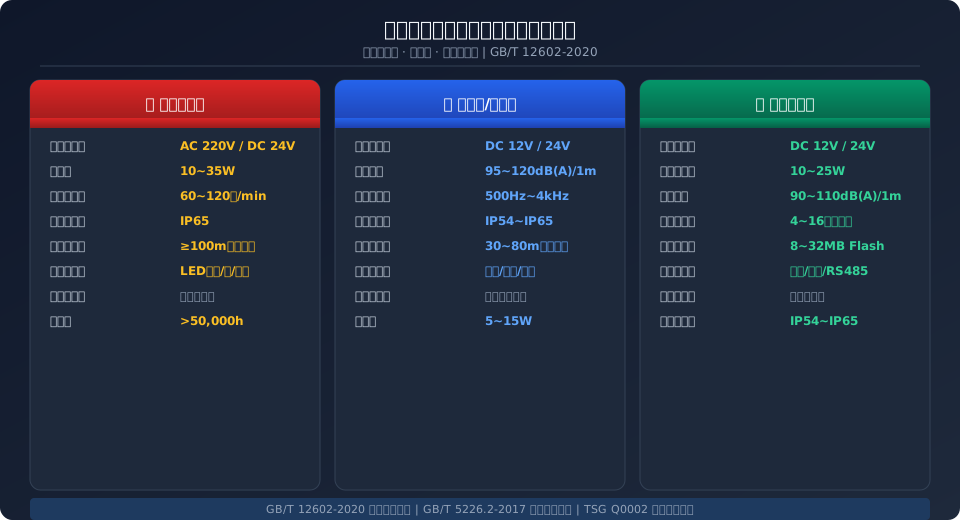
Three Main Types of Crane Audible and Visual Alarm Devices
Rotating Warning Light — Utilizes high-brightness LED light sources, with the reflector or lamp body rotated by a motor (60–120 RPM) to produce a 360° visible flashing warning light. Red is the default emergency/danger color, yellow is used for general warnings, and blue is commonly used for equipment operation indication. Typical products achieve a Protection Rating (IP) of IP65, suitable for harsh environments such as outdoor docks and open-air storage yards, with a visible range of over 100 meters indoors. Mounting options include magnetic base, bolt fixing, and pole mounting; power supply options are AC 220V or DC 24V.
Buzzer / Electric Horn — Uses electromagnetic oscillation or piezoelectric ceramics to drive a diaphragm to produce sound, with a sound pressure level typically in the range of 95–120 dB(A)/1m. The frequency is concentrated in the 500 Hz–4 kHz range, which is highly sensitive to the human ear, offering strong penetration suitable for high-noise workshop environments. Tone types include continuous, intermittent, and sweep tones, which can be selected via the control circuit to differentiate alarm levels. Power consumption is low (5–15W), typically powered by DC 24V, and can be directly connected to the PLC output points of the crane.
Voice Annunciator — Features a built-in Flash memory chip (8–32MB) and a Class D amplifier, capable of pre-storing 4–16 custom voice messages (e.g., "Crane starting, please pay attention to safety," "Overload alarm, stop hoisting immediately"). Triggering supports level trigger, pulse trigger, and RS485 bus control, and can be linked with the crane PLC or host computer for automatic switching of broadcast content based on operating conditions. Output power is 10–25W with a sound pressure level of 90–110 dB(A), and voice clarity remains intelligible even in noisy workshop environments. It is the preferred solution for safety alerts on intelligent overhead cranes and unmanned crane systems.
Key Technical Parameters Comparison for Alarm Selection
The following comparison evaluates the core technical parameters of the three audible and visual alarm devices across ten key dimensions, helping engineering professionals quickly select the right solution based on actual operating conditions:
| Parameter Item | Rotating Warning Light | Buzzer/Electric Horn | Voice Annunciator |
|---|---|---|---|
| Warning Method | Visible Light(360°Rotation) | Audible Sound(Single Frequency/Frequency Sweep) | Audible Sound(Speech Synthesis) |
| Operation Voltage | AC 220V / DC 24V | DC 12V / 24V | DC 12V / 24V |
| Power Range | 10~35W | 5~15W | 10~25W |
| Protection Rating (IP) | IP65 | IP54~IP65 | IP54~IP65 |
| Sound pressure level(1m) | — | 95~120dB(A) | 90~110dB(A) |
| Coverage Area | ≥100m(Visual) | 30~80m(Audible) | 20~60m(Audible) |
| Applicable Environment | Adequate Lighting Workshop/Outdoor | High-Noise Environment | Automation/unmanned overhead crane |
| Response time | <0.5s | <0.3s | <1s(With Voice Loading) |
| Reference Price | 150~500RMB/Unit | 80~300RMB/Unit | 300~1200RMB/Unit |
Installation Wiring Guide for Crane Alarm Systems
The mounting position and wiring method of an audible and visual alarm device directly determine its warning effectiveness and long-term reliability. Follow these guidelines step by step:
Mounting Position — Install the warning light at the highest point on either end of the crane bridge or on top of the trolley to ensure a full 360° unobstructed view. Position the buzzer and voice annunciator toward primary personnel activity areas, at a height of 2.5–4 m above the floor. Avoid mounting flush against metal surfaces, which can cause sound reflection interference. When installing multiple units, keep a minimum spacing of 1.5 m between adjacent devices to prevent acoustic wave interference.
Power Wiring — For DC 24V devices, take a dedicated feed from the switching power supply inside the crane control cabinet, using copper-core wire of at least 1.5 mm². AC 220V devices must be protected by an independent miniature circuit breaker (rated current 6 A, C-curve trip characteristic). Maintain a minimum separation of 200 mm between signal cables and power cables; where they must cross, do so at a 90° angle.
Signal Trigger Wiring — The trigger signal for the buzzer and voice annunciator can be taken from the PLC's digital output (NPN or PNP type, depending on the model). It is recommended to connect an intermediate relay (DC 24V coil, contact rating 5 A / 250VAC) in series between the PLC output and the alarm device to prevent inductive load back-EMF from damaging the PLC output transistor. The relay's freewheeling diode must be connected in parallel correctly (1N4007, cathode to the positive supply rail).
Grounding and Shielding — The metal enclosure of the alarm device must be connected to the crane's main grounding bus via a yellow-green grounding wire (≥2.5 mm²). Grounding resistance should be ≤4 Ω. For RS485 voice annunciators, use a twisted-pair shielded cable (RVVSP 2×0.5 mm²) for the signal lines. Ground the shield at the control cabinet end only, and leave the device end floating.
Post-Installation Verification — Before powering up, use a multimeter to confirm correct polarity of the power supply. After energizing, simulate each alarm trigger condition and verify the rotation direction of the rotating light, the buzzer's sound pressure level (measure at 1 m with a sound level meter; should be ≥95 dB(A)), and the voice announcement content. Once functional verification is complete, tighten all terminal block connections and place a desiccant pack inside the terminal enclosure.
Periodic Inspection and Troubleshooting Guide
To ensure the audible and visual alarm device operates reliably when it matters most, establish a periodic inspection schedule. The table below outlines the key inspection items, technical requirements, and recommended intervals:
| Inspection Item | Technical Requirement | Recommended Interval |
|---|---|---|
| Visual inspection of warning light and buzzer enclosure | No cracks, deformation, or corrosion; IP54 protection rating maintained | Monthly |
| Functional test of audible and visual alarm | Trigger each alarm condition; verify light rotation and buzzer output ≥95 d B(A) at 1 m | Monthly |
| Grounding continuity check | Grounding resistance ≤4 Ω; grounding wire securely connected, no corrosion | Quarterly |
| Terminal block and wiring inspection | All terminals tight; no signs of overheating, discoloration, or loose strands | Quarterly |
| Intermediate relay and circuit breaker check | Relay contacts clean and free of pitting; breaker trips correctly at rated current | Semi-annually |
| Full system verification per TSG Q0002 | Complete functional test of all alarm modes; verify compliance with applicable standards | Annually |
Common Faults and Troubleshooting
Fault: Warning light does not rotate or illuminate. Check the power supply voltage at the terminal block with a multimeter. Verify the circuit breaker has not tripped. Inspect the bulb or LED module for failure. If the light still does not operate, test the relay contacts for continuity.
Fault: Buzzer produces no sound or low volume. Measure the sound pressure level with a sound level meter at 1 m — it should be ≥95 dB(A). Check for loose wiring at the buzzer terminals. Verify the trigger signal is present at the PLC output. If the buzzer is driven through an intermediate relay, confirm the relay is energizing and its contacts are closing properly.
Fault: Intermittent false alarms. Inspect the signal cable for damage or poor shielding. Verify the shield is grounded at the control cabinet end only. Check for electromagnetic interference from power cables — ensure minimum 200 mm separation is maintained. Confirm the PLC output configuration matches the device input type (NPN vs. PNP).
Fault: Voice annunciator garbled or no audio output. For RS485 models, verify correct wiring of the twisted-pair shielded cable and proper termination. Check the device address and baud rate settings against the PLC configuration. Confirm the audio file or message content is correctly programmed in the device.
| Inspection Item | Technical Requirement | Inspection Method | Period |
|---|---|---|---|
| Flash Frequency | 60~120Times/min | Stroboscope Measurement | Monthly |
| Sound pressure level | ≥95dB(A)/1m | sound level meter AWeighted | Quarterly |
| Insulation Resistance | ≥1MΩ(DC 500V) | Megohmmeter (Insulation Tester)Stroboscope Measurement | Semi-Annually |
| Protection Sealing | Seal ring None Aging Cracking | Visual Inspection | Monthly |
| Terminal Block | tightening torque0.8~1.2N·m | Torque Wrench | Quarterly |
| Function Testing | Power-On Self-Test Normal, Trigger Alarm | Simulated Trigger Signal | Weekly |
How to Choose the Right Crane Alarm System
Start by evaluating the crane's working environment. For general-purpose indoor workshops, a rotating warning light paired with a buzzer offers the best value, with total unit costs typically ranging from $45 to $90. For outdoor or high-noise environments, upgrade to a Protection Rating (IP) of IP65 and select a buzzer with a sound pressure level of at least 110 dB(A). For automated overhead cranes or applications requiring differentiated alarm levels, a voice annunciator is the preferred choice, as it enables multi-level voice alerts through PLC Control programming.
For power supply, a DC 24V system is recommended for easier integration with the PLC Control System and improved safety. If an AC 220V supply is unavoidable, install a dedicated Circuit Breaker and clearly label the Terminal Block with a "Caution: High Voltage" warning. In explosion-proof areas, the audible and visual alarm device must carry the appropriate explosion-proof certification (Ex d IIB T4 Gb or higher), and the power supply must be isolated through a safety barrier.
Prioritize products with CE or CCC certification and verify that the supplier can provide a Factory Acceptance Test Report (FAT) including sound pressure level and IP rating test data. As a best practice, keep spare units at 10%–15% of the installed count, and increase the reserve to at least 20% for critical applications such as metallurgical or casting cranes.
Frequently Asked Questions
Q: What is the difference between a rotating warning light and a steady LED warning light for crane applications?
A: A rotating warning light uses a 360° dynamic beam to attract attention, offering strong visibility across large areas such as open workshops and outdoor docks. A steady LED warning light relies on color coding (red/yellow/green) to convey status information and is best suited for control rooms or equipment panel indicators. Per IEC 60204-32, Section 10.2, crane motion areas must be equipped with rotating or flashing warning lights; steady lights do not meet the requirements for motion hazard warning. Rotating warning lights typically consume 10–35W, provide a visible range of ≥100m, and are recommended for installation at heights of 3–5m.
Q: What sound pressure level should a crane buzzer have without disrupting normal communication in the workshop?
A: The required buzzer sound pressure level depends on the ambient noise in the workshop. According to ISO 7731:2003, "Ergonomics — Danger signals for public and work areas — Auditory danger signals," the alarm level should be at least 15 dB(A) above background noise. In typical machine shops with background noise around 75–85 dB(A), a buzzer rated at 95–105 dB(A) is sufficient. In heavy industries like metallurgy or forging, where background noise can reach 95–100 dB(A), a high-output buzzer rated at 110–120 dB(A) is necessary. Remember that sound pressure drops by approximately 6 dB(A) for each doubling of distance; a 120 dB(A) buzzer measured at 1m will be around 102 dB(A) at 8m, which remains manageable for temporary communication.
Q: How can I tell when the LED beads in a crane's audible and visual alarm need replacement due to aging?
A: Three key indicators signal LED bead aging: ① Lumen depreciation — measure illuminance at 3m with a light meter; initial readings are typically ≥80 lux, and replacement is needed when output drops below 70% of the initial value (approximately ≤56 lux). ② Rotation speed deviation — use a stroboscope to check the rotation frequency; a deviation of more than ±15% from the rated value (60–120 cycles/min) indicates motor or control circuit aging. ③ Discoloration — visually inspect for yellowing or black spots on the LED surface, which indicates phosphor degradation caused by excessive junction temperature. LED warning lights are typically rated for ≥50,000 hours (about 5.7 years of continuous operation); proactive replacement every 3 years or 25,000 hours is recommended to ensure reliability.
Q: How much does a crane voice annunciator system cost, including installation and PLC programming?
A: Voice annunciator pricing varies by feature level: Basic models (4 fixed voice messages, level trigger) cost approximately $45–$75 per unit; Standard models (8 voice messages, RS485 control) range from $75–$120 per unit; High-end models (16 voice messages, Modbus RTU protocol support, SD card for online voice updates) are priced at $120–$180 per unit. These prices are for hardware only (excluding tax). Installation wiring adds approximately $30–$60 per unit, and PLC programming and commissioning costs about $75–$150 per system (including I/O address allocation, trigger logic programming, and integrated testing). Kelude can pre-install and pre-configure the complete audible and visual alarm system at the factory for new cranes, delivering it ready to use and eliminating on-site wiring and programming costs.
Kelude supplies audible and visual alarm systems for a wide range of overhead and gantry cranes, including rotating warning lights, industrial buzzers, and programmable voice annunciators, fully compliant with GB/T 12602-2020 and TSG (Special Equipment Safety Technical Regulation) Q0002 standards. Contact our technical team for detailed configuration recommendations and Installation & Commissioning support.
