

5 Efficiency Bottlenecks of Automated Overhead Cranes vs Manual
📋 Key Summary
When an automated overhead crane is introduced but takt time fails to improve—or even lags behind an experienced operator—the root cause is rarely the crane itself. More often, it's one of five efficiency bottlenecks: overly conservative acceleration/deceleration parameters, confirmation wait times, path detours, idle waiting, and nuisance fault stoppages. This article breaks down the symptoms, diagnostic methods, and root causes of each bottleneck, then presents two speed-up strategies: parameter optimization and path planning.
Many plants that adopt automated overhead cranes face a counterintuitive problem: automation doesn't improve takt time—sometimes it's even slower than a skilled operator. Plant managers are left scratching their heads: the money was spent, but throughput didn't move.
The issue usually isn't that the crane "can't run fast enough." It's hidden in several invisible time sinks: acceleration and deceleration tuned too conservatively, every move waiting for confirmation, path planning taking detours, the crane idling while waiting on the production line, and alarms set so sensitively that they trigger frequent stoppages.
Below, we dissect these five efficiency bottlenecks one by one to find the real culprit behind "slower automation."
Five Signs a Crane Is Slowing Down Your Line
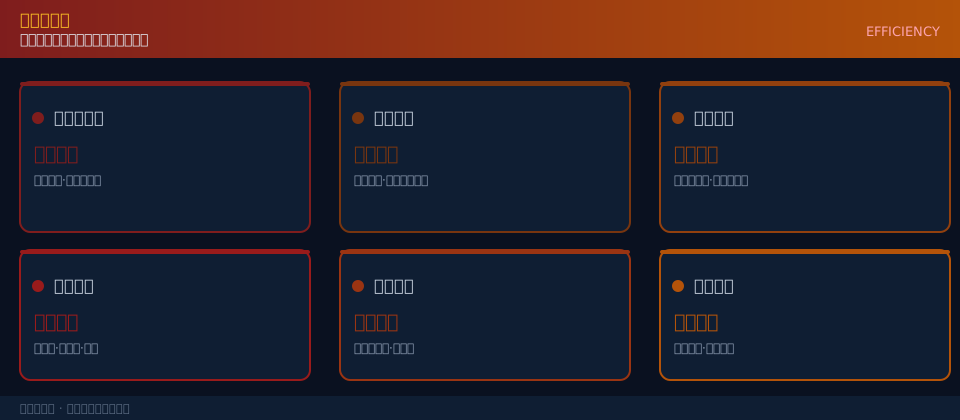
The first sign: overly conservative acceleration and deceleration. To keep the load from swaying and reduce mechanical shock, commissioning teams often set acceleration and deceleration very low. The result: most of each cycle is spent ramping up and down. For VFD parameter optimization, refer to GB/T 12668, the Variable Frequency Speed Control Technical Specification. The crane can actually run faster—the parameters are what's holding it back.
The second sign: waiting for confirmation. Every automated move requires a handshake with interlock signals—position confirm, clamp confirm, release confirm. Each one eats up anywhere from a fraction of a second to several seconds, and together they add up to a significant chunk of cycle time.
The third sign: path detours. To avoid collisions or simply for scheduling convenience, the dispatch algorithm routes the crane the long way around. A straight-line transfer becomes a longer journey, and takt time suffers.
The fourth sign: idle waiting. The crane cycle is fast, but the production line or downstream workstation is slow. The crane finishes its move and just waits—a fast crane dragged down by a slow line.
The fifth sign: nuisance fault stoppages. Alarm thresholds set too sensitively trigger stops at the slightest provocation. The crane lurches from stop to go, and effective operating time gets chopped into fragments by false alarms.
Diagnostic Procedure: Is the Crane Slow, or Is the Line Slow?
When an automated crane slows down, the first step is to assign responsibility: is the crane itself slow, or is the line holding it back? That determines where speed-up efforts should focus.
The diagnostic method is straightforward: break the cycle time down. Record the duration of each segment of a crane cycle—grab, lift, travel, lower, place, return—and see where the time actually goes.
If time is lost in the acceleration/deceleration and confirmation segments, it's a crane parameter issue. If the crane moves quickly but sits idle in front of a workstation, it's a line takt time mismatch. If the path clearly takes a detour, it's a scheduling algorithm problem. At Kelude Heavy Industry, we start diagnostics by breaking cycle time into segments, then target the fix accordingly.
Root Cause: Why Conservative Automation Parameters Drag Down Takt Time
The root cause of a slow automated crane often lies in the "play-it-safe" mindset. During commissioning, acceleration and deceleration are set conservatively to keep loads stable, alarm thresholds are tightened to avoid any risk, and confirmation wait times are padded generously. Each decision looks reasonable in isolation—but stacked together, they strangle takt time.
Digging deeper, automation parameters are set once and never adjusted to match operating conditions. A skilled operator varies speed based on load weight, distance, and real-time conditions. An automated crane, by contrast, runs on fixed parameters—even for light loads and short moves where it could safely speed up, it plods along at the same pace.
That's the essence of "slower automation": it's not that the crane can't go fast—it's that the parameters aren't optimized for actual operating conditions. At Kelude Heavy Industry, we set parameters in tiers based on load, distance, and takt time during commissioning, so the crane runs as fast as safely possible within its safe range.
Preventive Speed-Up System: From Parameter Optimization to Path Planning
Once the bottleneck is identified, speed-up has a clear direction. Two core methods stand out: parameter optimization and path planning.
Parameter optimization means tiering acceleration/deceleration and alarm thresholds by operating conditions. Light loads can handle faster ramps; heavy loads need steadier ones. For short-distance moves, optimize the acceleration curve to cut dead time. The selection of mechanism speed grades must comply with FEM 1.001, the Crane Design Specification. Parameters aren't better just because they're more conservative—the goal is to stay within the safe range while getting as close to optimal as possible.
Path planning optimizes the crane's travel routes to reduce detours and empty runs. In multi-crane collaborative operation, a good scheduling algorithm avoids conflicts, shortens total travel distance, and minimizes wait time.
Both methods need to work alongside continuous cycle time monitoring. Review takt data monthly and adjust whichever bottleneck is trending up. Kelude Heavy Industry offers cycle time monitoring as a long-term service after automation delivery, so takt time isn't just a peak at go-live—it's the result of ongoing optimization.
Five Efficiency Bottlenecks: Diagnosis and Speed-Up at a Glance
| Bottleneck | Phenomenon | diagnostic method | Root Cause | Speed-up Method |
|---|---|---|---|---|
| AddDecelerationConservative | Most Time Spent on LoadingDeceleration | Cycle Time Breakdown | ParameterOverly Conservative for Stability | ByLoadTiered Speed Increase |
| Awaiting Confirmation | Handshake Wait for Every Action | Handshake Time Statistics | Excessive Confirmation Time | Handshake Sequence Optimization |
| Path Detour | Extended Transport Route | Route Trace Review | Scheduling Algorithm Detour | OptimizationPath Planning |
| takt timeIdle Waiting | overhead craneLine Idle Waiting | comparisonoverhead craneProduction Linetakt time | Slow Line Bottleneckoverhead crane | Coordinationtakt time matching |
| False Alarm Shutdown | Frequent Stop-and-Go | Alarm Frequency Statistics | Overly Sensitive Threshold | Byoperating conditionsCalibrationThreshold |
Quick Reference: Related Standards for Automation Speed-Up
| Standard | Key Clause Points | Relation to Speed-up |
|---|---|---|
| GB/T 12668 | Variable Frequency Speed Controltechnical specification | AddDecelerationParameterOptimization Basis |
| GB/T 28264 Safety Monitoring and Management System | MonitoringTraceability andearly warning | Cycle Time Data Logging |
| TSG (Special Equipment Safety Technical Regulation) 51 Safety Technical Specification for Special Equipment-2023 Crane Safety Technical Supervision Regulation | safety interlockMonitoringrequirements | Speed-up without Reductionsafety device |
| FEM 1.001 Crane Design Standard | mechanismdesignspeedGrade | speedGradeselection basis |
FAQ: Automated Overhead Crane Efficiency
Q: Is an automated overhead crane actually faster than a skilled operator?
A: In a single lift cycle, a skilled operator can often edge out the automation thanks to variable speed control and on-the-fly judgment. But over a full shift or a month of continuous operation, automation wins on consistency and uptime. Operators get tired, take breaks, and make mistakes; automation doesn't. The catch is that if the crane's parameters aren't tuned properly, it will be consistently slow, and that advantage disappears. The key is tuning the system to match the operator's flexibility.
Q: Where should I start troubleshooting a slow automated crane?
A: Start by breaking down the cycle time. Log the duration of each phase—grabbing, lifting, traversing, lowering, placing, and returning—to see where the time goes. If time is lost in acceleration, deceleration, or waiting for confirmations, it's a parameter issue. If the crane is fast but sits idle at the workstation, it's a takt time mismatch on the line. If the travel path is clearly circuitous, the fleet scheduling algorithm is the culprit. Break down the time first, then fix the root cause—don't just blame the crane for being slow.
Q: Does speeding up an automated crane require additional investment?
A: In most cases, no new hardware is needed. Speed gains come from parameter optimization and path planning—essentially commissioning and algorithm work. Load-dependent acceleration profiles, alarm thresholds calibrated to operating conditions, and path optimization are all done on existing equipment. Additional scheduling software or sensor configuration is only necessary when takt times are severely mismatched or when multiple cranes need collaborative scheduling. Start with the free parameter tuning, then evaluate hardware needs.
For a deeper look at multi-crane speed-up strategies, see Fleet Scheduling Algorithms for Overhead Cranes: Engineering Implementation of Collision Avoidance and Task Allocation.
An automated overhead crane isn't inherently slow—it's about getting the parameters and paths close to optimal. Kelude Heavy Industry offers continuous cycle time monitoring as a long-term post-delivery service, so your takt time keeps improving safely within its operating envelope, rather than peaking right after commissioning.
