

Automatic Spreader vs Manual Hook: 4 Switching Solutions
📋 Key Summary
Manual hooking is the last remaining human step in automated loading and unloading—and the biggest bottleneck for both takt time and safety. Four solutions—quick-change joints, automatic spreader storage, electric auto-hooking, and vacuum/electromagnetic lifters—range from semi-automatic to fully automatic, each with different switching times, reliability, costs, and workpiece compatibility. This article lays out all four side by side in a single parameter table and provides a decision-making chain for selecting a spreader solution based on your operating conditions.
When you push automated loading and unloading to its limits, you often hit a wall at the very last step: the lifting spreader. The overhead crane can position itself and move loads on its own, but changing the spreader still requires a worker to climb up and hook or unhook it—which instantly knocks the system from "fully automatic" back to "semi-automatic."
Choosing the right automatic spreader-switching solution is the final piece of the puzzle for true unmanned operation in automated loading and unloading. Below, we break down and compare the four mainstream approaches.
Four Spreader Switching Solutions: From Quick-Change to Full Automation
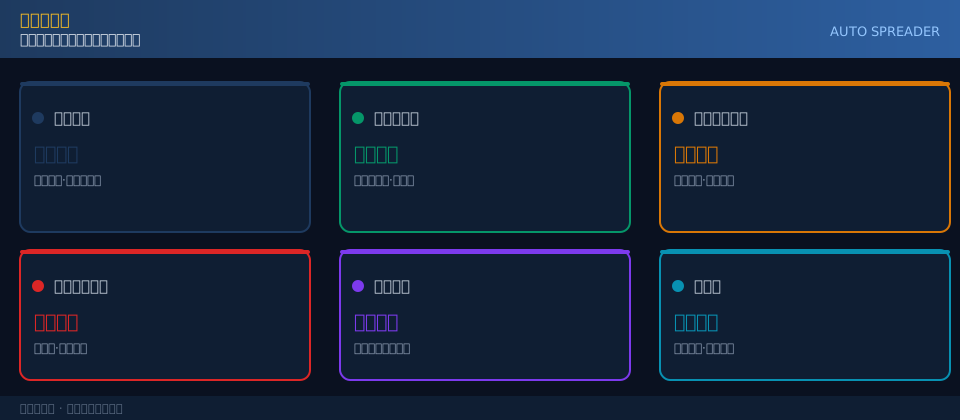
The first option is the quick-change joint. This is the lightest-duty tier: the spreader connects to the hook via a standard quick-change joint, and a worker can swap it in seconds. However, changeovers still require someone on-site, making this a semi-automatic transitional solution.
The second is automatic spreader storage. Spreaders are kept in fixed storage positions and are automatically retrieved, docked, and connected by a robotic arm or dedicated mechanism. Changeovers run entirely without human intervention, making this the mainstream choice among fully automatic solutions.
The third is electric auto-hooking. Electro-hydraulic drives let the hook automatically engage and release workpieces, eliminating the manual hooking step. This suits large-tonnage loads and heavy spreaders in automatic handling applications.
The fourth is the vacuum lifter or lifting magnet. Instead of hooks, these use negative pressure or magnetic force to grip the workpiece directly. They offer the simplest structure and fastest cycle times, but are limited to flat metal parts or magnetically conductive materials. ISO 4301-1, the standard for lifting electromagnets on cranes, sets out the performance requirements for lifting magnets. When Kelude designs a solution, we first screen these four options based on workpiece shape, weight, and material.
Six Parameters Compared: Switching Time, Reliability, Cost, and Fit
| Solution | Changeover Time | reliability | Cost | Workpiece Compatibility | Manual Intervention |
|---|---|---|---|---|---|
| Quick ChangeJoint | Manual (seconds) | High | Lowest | Universal | On-site Changeover Required |
| automatic spreaderMagazine | Automatic (seconds) | High | Above Average | Multi-SKU | Fully Unmanned |
| ElectricAutomatic Latching | Automatic (seconds) | Medium-High | Medium | large tonnageLargeLifting spreader | Automatic Latch/Unlatch |
| VacuumLifting magnet | Fastest (Suction) | Material-Dependent | Medium | Flat Metal/Magnetic (Ferromagnetic) | Hookless |
This comparison table is a core attachment in Kelude Heavy Industry's lifting spreader proposals. Every difference corresponds to specific investment and changeover takt time, allowing customers to determine how far they should go along the path to full automation.
How to Select by Operating Conditions: A Decision Chain for Spreader Solutions
There is no absolute "best" spreader solution—the selection logic follows a decision chain: first look at the workpiece, then at takt time, and finally at budget.
Step one: the workpiece. If the workpiece is flat, magnetically conductive, and consistent in weight, vacuum or electromagnetic suction cups are the simplest and most efficient option. For complex or multi-variety workpiece shapes, an automatic spreader library offers greater flexibility. For large tonnage and heavy spreaders, electric automatic hook coupling is more stable, and the selection of spreaders and hooks must comply with the requirements of FEM 1.001 Crane Design Standard.
Step two: takt time. If changeovers are frequent and the takt is tight, manual changeover with quick-change joints becomes a bottleneck—an automatic spreader library is the way to go. If changeovers are infrequent, semi-automatic quick-change joints are sufficient.
Step three: budget. Quick-change joints require the lowest upfront investment, while an automatic spreader library carries the highest cost. When budget is limited, start with quick-change joints as a transitional step, then upgrade once the benefits of automation are proven. Kelude Heavy Industry follows this decision chain, reviewing the customer's workpiece list and takt requirements before finalizing a specific solution.
Eight Key Points to Verify Before Purchase
📦
Workpiece Specifications
Are dimensions, weight, and material consistent?
🔗
Locking Confirmation
Is spreader locking detection reliable?
🛡️
Load Detachment Protection
Is anti-detachment protection fully equipped?
⚡
Changeover Time
Does changeover time align with takt time?
🧲
Suction Cup Magnetism
Does lifting force match workpiece weight?
🔧
Maintenance Accessibility
Are quick-change joint wear parts easy to replace?
📡
Interlock Signals
Are positioning, clamping, and release handshakes reliable?
📋
Certification Verification
Spreader Type Test and manufacturing license
Life Cycle Cost Comparison Across Four Solution Types
| Cost Item | Quick ChangeJoint | automatic spreaderMagazine | Electric/Suction cup |
|---|---|---|---|
| Initial Investment | Lowest | Highest | Medium |
| Labor Cost | Manual Changeover Required | Fully Unmanned | Automatic Latch/Unlatch |
| maintenance cost | JointWearWorkpiece Compatibility | MachineryArmmaintenance | Electro-Hydraulic/Seal |
| Changeovertakt time | Manual Round-Trip | Second-Level Automatic | Automatic in Seconds |
FAQ: Automatic Spreader Switching
Q: What is the fundamental difference between an automatic spreader and manual hooking?
A: The key difference comes down to whether a person is needed during changeovers. With manual hooking, no matter how intelligent the overhead crane is, an operator still has to climb up to hook and unhook the load during every changeover — and that single step takes the entire process from fully automatic back to semi-automatic. An automatic spreader hands the changeover task to quick-change joints, a spreader storage rack, automatic hooking, or suction cups, so the entire changeover runs unattended. That's what truly closes the loop on automated loading and unloading. The difference isn't the spreader itself — it's whether the changeover step can be done without human intervention.
Q: On a tight budget, which spreader switching solution should we start with?
A: Start with quick-change joints. They offer the lowest upfront investment and turn manual changeovers from "climbing up to hook" into "a few seconds of quick switching," which immediately improves takt time. If your workpieces are flat and magnetically conductive, vacuum or electromagnetic suction cups are also cost-effective options that eliminate the hooking step altogether. An automatic spreader storage rack requires the highest investment, so save it for last — upgrade once you've validated the returns from automation and changeovers have truly become the bottleneck.
Q: How do I know if my production line needs automatic spreader switching?
A: Look at changeover frequency and takt time. If changeovers are frequent and the takt is tight, manual changeovers become the bottleneck — that's when you need automatic spreader switching. If changeovers are infrequent — say, once or twice a week — quick-change joints or even manual hooking will suffice. Also consider product variety: high-mix, low-volume production creates a stronger need for a spreader storage rack. The core question is whether the changeover step is the weak link in your automation chain.
Q: Why does automatic spreader switching improve the stability of automated loading and unloading?
A: Manual hooking carries the risk of inconsistent actions, missed hooks, and accidental disengagement — changeovers rely on human judgment, which makes stability hard to guarantee. An automatic spreader standardizes and validates every changeover through lock-position detection, anti-release protection, and interlock signal handshakes. If any step isn't completed correctly, the system triggers an alarm and stops. Changeovers shift from depending on an operator's feel to depending on verifiable mechanical actions and signals — a significant step up in both stability and safety.
For more on how automatic spreaders integrate with loading and unloading workflows, see the workstation handoff approach discussed in "AGV/RGV and Overhead Crane Multi-Vehicle Coordination: A Practical Guide to Unmanned Dispatching Systems for Smart Factories".
Automatic spreader switching is the last mile of automated loading and unloading. Kelude follows a three-step decision framework — workpiece characteristics, takt time, and budget — to help customers select a spreader solution that fits their needs precisely, rather than over-specifying full automation.
