

AGV & Overhead Crane Multi-Vehicle Coordination for Smart Factory
AGV/RGV & Overhead Crane Multi-Vehicle Coordination: A Practical Guide to Unmanned Material Handling Dispatching in Smart Factories. In the material flow ecosystem of a smart factory, overhead cranes (bridge and gantry cranes) and AGVs (Automated Guided Vehicles) / RGVs (Rail-Guided Vehicles) form a three-dimensional transport network that combines aerial and ground-level movement.
In a smart factory's material handling ecosystem, overhead cranes (bridge and gantry cranes) and AGVs/RGVs form a three-dimensional transport network that spans both aerial and ground-level operations. However, these two equipment groups have long been controlled by independent dispatching systems, leading to frequent efficiency bottlenecks: cranes arrive at transfer points before AGVs are positioned, AGVs idle beneath crane working zones waiting for loads that never come, and multi-vehicle path conflicts cause deadlocks that stall production. Kelude Heavy Industry has addressed these challenges with its proprietary Multi-vehicle Coordination Platform (MCP), which unifies overhead crane fleets and AGV/RGV fleets into a single dispatching space. By integrating a hybrid scheduling strategy that combines Genetic Algorithm (GA) with Deep Q-Network (DQN), the platform delivers fully automated, end-to-end unmanned material handling. This article examines Kelude's technical approach across five dimensions: system architecture, scheduling algorithms, communication integration, crane-AGV handover protocols, and real-world engineering applications.
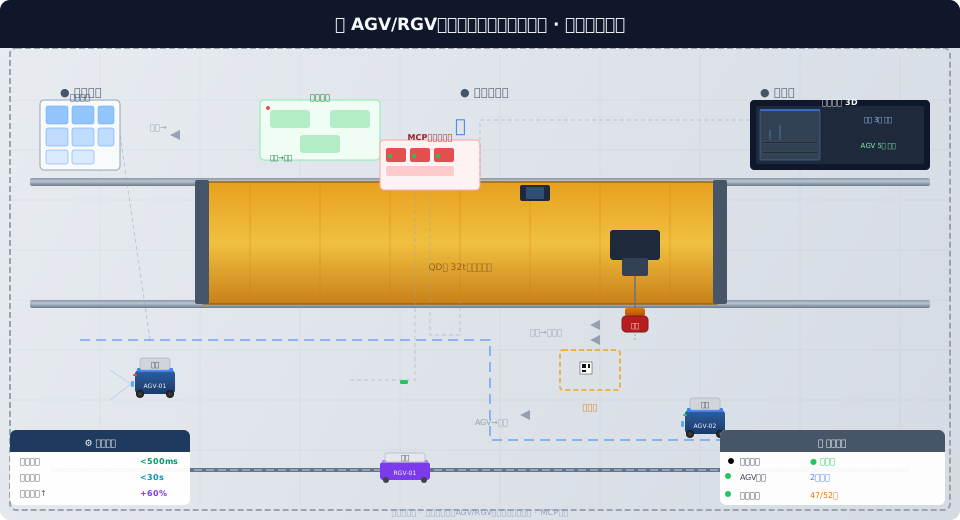
Multi-Vehicle Collaborative Dispatching System Architecture
Kelude's MCP platform adopts a layered architecture comprising four tiers from bottom to top: the equipment layer, communication layer, dispatching engine layer, and business integration layer.
Equipment Layer — This tier covers the overhead crane fleet (bridge and gantry cranes, typically 5–20 units) and the ground transport fleet (AGVs, RGVs, and shuttle carts, typically 10–50 units). Each piece of equipment connects to the dispatching network through an Edge Computing gateway, which handles equipment status acquisition (position, speed, load, and task state), command parsing and execution, as well as safety monitoring and link-break protection. Crane gateways and AGV gateways communicate over a 5G private network or WiFi 6 with millisecond-level latency, ensuring real-time delivery of coordination commands.
Communication Layer — This tier uses the MQTT protocol for publishing equipment status (at a frequency of 50 ms per publish cycle) and RESTful APIs for task assignment and status queries. For overhead crane control systems, OPC UA interfaces are retained for direct PLC integration, ensuring that control commands meeting SIL2 safety level requirements remain unaffected by network jitter.
Dispatching Engine Layer — This is the core of the MCP platform, comprising the task management module, path planning module, traffic control module, and exception handling module. The dispatching engine is deployed as a microservices architecture on on-premise edge servers or a private cloud. A single node can support real-time dispatching calculations for more than 50 devices, with task scheduling response latency kept under 500 ms.
Business Integration Layer — This tier connects to upstream MES/WMS/ERP systems through standard APIs, receiving production work orders and material requirement plans, then feeding task execution results back to close the business loop. It also supports a Digital Twin 3D visualization dashboard that displays real-time operating status and task progress for all cranes and AGVs across the workshop.
Hybrid Scheduling Algorithm: GA Global Optimization with DQN Real-Time Decision Making
The MCP platform's scheduling algorithm employs a hybrid strategy combining Genetic Algorithm (GA) and Deep Q-Network (DQN), balancing global optimality with real-time responsiveness.
GA Global Scheduling — A full rescheduling cycle runs every 5 minutes, with the optimization objective of minimizing the total makespan across all tasks. The encoding scheme uses "task–equipment" binary pair sequences, where each chromosome represents a task allocation plan. The fitness function weighs task completion time (weight 0.5), equipment load balancing (weight 0.3), and energy consumption (weight 0.2). The population size is set to 100, with a crossover probability of 0.8, mutation probability of 0.05, and 500 iterations. The optimal schedule produced by GA serves as the initial solution for DQN, ensuring the system begins real-time optimization from a near-global-optimal starting point.
| Scheduling Algorithm | Optimization Objective | Scheduling Cycle | Energy Saving Rate |
|---|---|---|---|
| GAGlobal Scheduling | minimum Minimize Total Completion Time | 5min/Scheduling Cycle | Global Optimum |
| DQNReal-time Scheduling | minimum Waiting+Deadheading | 500ms/Decision-making | Real-time Response |
| GA+DQNHybrid | Global+Real-time Trade-off | 5min+500ms | Shortening18% |
DQN Real-Time Dispatching builds on GA global scheduling by making decisions every 500 ms to respond to dynamic events (new task arrivals, equipment failures, path blockages, etc.). The state space captures the current position, task progress, and path occupancy of all equipment; the action space assigns pending tasks to available idle equipment; and the reward function is designed as a weighted sum of negative task waiting time and equipment deadhead distance. The DQN uses a three-layer fully connected network (128-64-32), trained with an experience replay buffer (capacity: 10,000 entries) and a target network (soft update τ=0.001) to improve training stability. In Kelude's simulation environment, the hybrid scheduling approach reduces task completion time by 18% in dynamic scenarios compared to pure GA scheduling, and improves energy efficiency by 12% in steady-state scenarios compared to pure DQN scheduling.
Deadlock Detection and Resolution is the foundational safeguard of the dispatching system. The MCP platform employs the Wait-Die graph algorithm for deadlock detection, checking the resource allocation graph for cycles after each task assignment. When a deadlock is detected, the Wound-Wait strategy selectively aborts lower-priority tasks to break the deadlock, and the aborted tasks are automatically requeued for rescheduling. In real-world operations, deadlock detection latency does not exceed 10 ms, and resolution time stays under 50 ms.
Overhead Crane-AGV Handoff Protocol at Transfer Points
The material handoff between overhead cranes and AGVs at spatial transfer points is the most critical link in the entire collaborative system. Kelude has designed a four-phase handoff protocol to ensure that crane-lifted materials are transferred safely and punctually onto the AGV loading platform:
Phase 1: Reservation. The MCP platform issues handoff tasks to both the overhead crane and the AGV 30 seconds in advance, based on the GA scheduling plan. The AGV autonomously navigates to the designated transfer position upon receiving the task, while the crane begins moving toward the same position. Once the AGV arrives, it sends a "position confirmed" signal to the MCP.
Phase 2: Alignment. After the crane reaches the position above the transfer point, its vision AI system (YOLOv8) identifies the alignment markers (QR codes/reflective stickers) on the AGV loading platform and automatically corrects the lifting spreader's positional deviation in the X/Y axes to within ±5 mm. Simultaneously, a laser distance sensor verifies that the lowering height of the suspended load is safe, preventing any collision with the AGV forks.
Phase 3: Transfer. The crane's hoisting mechanism lowers the load smoothly onto the AGV loading surface at low speed (10% of rated speed). When the load sensor reading drops to the empty-load value (indicating the load has fully settled on the AGV), the crane brake engages and the lifting spreader automatically releases the load. The AGV confirms material placement via its load detection sensor, locks the forks, and sends a "transfer complete" signal to the MCP.
Phase 4: Departure. Upon receiving the "transfer complete" signal, the crane raises the spreader to a safe height (above the tallest obstacle in the workshop) and proceeds to its next task. The AGV unlocks its forks upon receiving the confirmation signal and follows its planned path to the next destination. The entire handoff process is completed within 30 seconds: alignment takes 15 seconds, material transfer 10 seconds, and departure 5 seconds.
| Phase | Action | Duration | Acknowledgment Signal |
|---|---|---|---|
| Reservation | MCPAdvance30sDispatch, AGVNavigate to Handover Position | 30s | Position Confirmation |
| Alignment | YOLOv8Identification QR Code, Lifting spreader Adjust to±5mm | 15s | Visual Confirmation |
| Handover | Low-speed Lowering, Load Zero-position Unhook | 10s | Handover Complete |
| Retreat | overhead crane Hoist Lifting spreader, AGVNavigate to Next Station | 5s | Retreat Confirmation |
End-to-End Material Handling Across Warehouse and Assembly Line
Using a typical material flow scenario—raw material warehouse → production line workstation → finished goods warehouse—the MCP platform's dispatching system fully covers four handling modes:
Mode 1: AS/RS Retrieval via AGV.The WMS sends a material requisition to the MCP, which then assigns an AGV to the AS/RS output station. A multi-level shuttle delivers the palletized load to the output point, where the AGV picks it up and transports it to the overhead crane handover zone. The MCP coordinates timing windows across the entire process, ensuring materials are staged and ready by the time the AGV arrives.
Mode 2: AGV-to-Crane Transfer.Once the AGV reaches the crane handover zone, the load is transferred following a four-stage protocol. This mode is designed for heavy loads (single-piece weight > 1 ton) or scenarios where the AGV must cross production line obstacles—when the AGV cannot deliver directly to the workstation, the overhead crane handles the cross-zone transfer.
Mode 3: Crane Delivery to Workstation.The overhead crane lifts the material to a buffer area beside the workstation and places it onto the fixture table with precise positioning (±3 mm). For production lines requiring frequent material replenishment (e.g., welding or assembly lines), the MCP supports a "drop-off and pick-up" cycle—the crane delivers new material while retrieving the empty pallet on its return trip.
Mode 4: Finished Goods Transfer to Warehouse.After processing, an AGV or RGV transports finished goods to the crane handover zone. The overhead crane then lifts them to the finished goods warehouse entry point or directly onto a truck for shipment. This completes the full material loop: raw material → production line → finished goods.
Deployment Case Study and Measured Results
Kelude's MCP system has been deployed at a major construction machinery manufacturer, coordinating 5 bridge cranes, 12 AGVs, and 4 RGVs across its structural fabrication workshop. The project includes 1 MCP dispatching platform (running on an on-site edge server with 4-core CPU + 32 GB RAM + GPU acceleration), 5 crane edge gateways (Jetson Orin NX), and 16 AGV/RGV onboard controllers.
Six months of operational data show significant gains: material handling efficiency improved by 60% (daily handling cycles increased from 320 to 512), average crane/AGV waiting time dropped from 45 seconds to 8 seconds (an 82% reduction), and handover success rate rose from 92.3% to 99.7%. AGV idle travel was cut from 28% to 12%, while crane effective utilization increased from 65% to 83%. Based on an annual output of 50,000 machinery units, the system saves approximately 2,400 hours of material handling time per year, translating to roughly $532,000 in economic benefits. The system has passed third-party inspection and certification for functional safety and equipment coordination, in compliance with ISO 4301 crane design standards and ISO 5053-1:2020 industrial vehicle safety requirements.
Kelude has distilled key lessons from the implementation: First, communication latency between cranes and AGVs must be kept within 10 ms—a 5G private network with wired fiber backup is strongly recommended. Second, floor surface accuracy in handover zones directly impacts positioning success; AGV navigation QR code placement deviation should be held within ±1 mm. Third, deadlock detection rate is the core indicator of dispatching system maturity—it is advisable to run stress tests on a simulation platform with 1.5× peak task volume before go-live.
Frequently Asked Questions
Further Reading
Related articles: Crane Fleet Dispatching Algorithms: GA/DQN | 5G Remote Operation & Maintenance and Edge Computing | Equipment Health Management (PHM)
