

5G Remote O&M with Edge Computing: Kelude Overhead Crane Control
5G Remote Operation & Maintenance with Edge Computing: Kelude's End-to-End Overhead Crane Remote Control Solution. As smart factories push toward unmanned production, the ability to remotely operate and autonomously run overhead crane systems has become a key indicator of production-line intelligence. Kelude Heavy Industry has built a complete remote-control technology framework spanning the full "perception–computation–control–execution" chain, powered by a dedicated 5G network (SA mode with UPFsinking) and Multi-access Edge Computing (MEC).
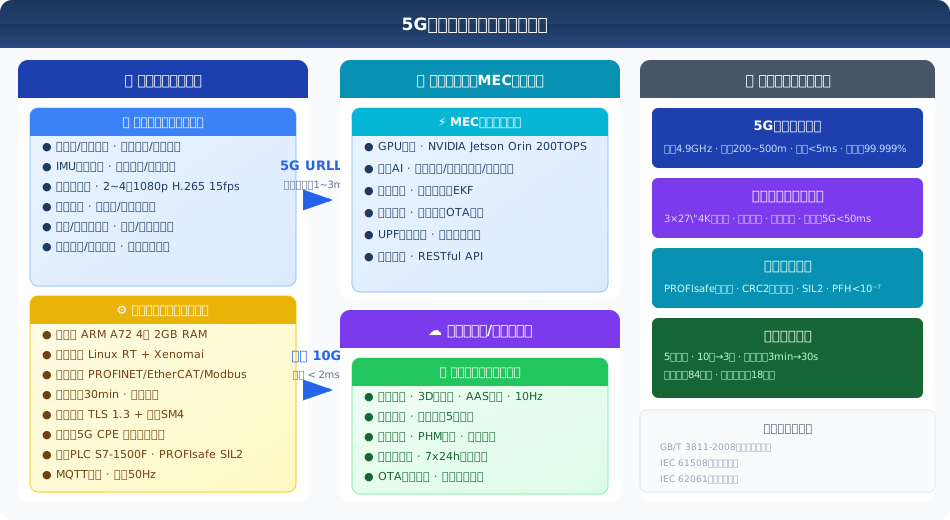
As smart factories push toward unmanned production, the ability to remotely operate and autonomously run overhead crane systems has become a key indicator of production-line intelligence. Kelude Heavy Industry has built a complete remote-control technology framework spanning the full "perception–computation–control–execution" chain, powered by a dedicated 5G network (SA mode with UPFDownlink) and Multi-access Edge Computing (MEC). This framework enables cross-workshop and cross-plant remote driving, AI-assisted autonomous operation, and predictive maintenance for overhead cranes, with end-to-end latency kept within 70ms (local control commands at ≤10ms) while meeting SIL2 functional safety requirements. This article examines Kelude's technical practice in 5G remote operation and edge computing for overhead cranes from five perspectives: 5G network architecture, MEC edge intelligence platform, remote driving cabin design, end-to-end secure communication, and engineering deployment cases.
5G Private Network Architecture: UPFDownlink and Local Traffic Offloading
Remote overhead crane control places extreme demands on wireless network latency, reliability, and security — control commands require end-to-end latency of ≤10ms (one-way), a packet loss rate of ≤10⁻⁶, and system availability of ≥99.999%. Traditional Wi-Fi 6 technology exhibits latency jitter of 20–50ms in non-line-of-sight (NLOS) scenarios, and co-channel interference makes it difficult to keep packet loss below 10⁻⁵, failing to meet SIL2 safety communication requirements. Kelude has adopted a dedicated 5G network (SA standalone architecture with UPFDownlink) as the core communication infrastructure.
The core principle of UPFDownlink is to deploy the User Plane Function of the 5G core network at the factory edge, so that crane control-plane traffic is processed by the carrier's 5G core network while data-plane traffic is offloaded locally at the factory's own UPF, avoiding a detour through the carrier's core network. Compared with public 5G solutions (end-to-end latency of 20–30ms), the UPFDownlink approach compresses one-way control command latency to 3–5ms while keeping data traffic within the campus, satisfying security and compliance requirements for local retention of industrial production data.
For spectrum, Kelude recommends the 4.9GHz band (4800–4900MHz), which has been designated by the Ministry of Industry and Information Technology as a dedicated band for industrial internet use. It offers good indoor penetration and a moderate coverage radius (200–500m per base station indoors / 500–1000m outdoors). Base station density should be planned at roughly one pRRU (picocell) per 2,000–3,000㎡ of coverage area to ensure signal strength of no less than -105dBm across the crane's full travel range, with RSRP (Reference Signal Received Power) fluctuation kept below 5dB. This aligns with the communication reliability requirements for crane electrical equipment in Chapter 7 of ISO 4301: Crane Design Standard — Key Clause Interpretation: Load / Structure / Mechanism / Electrical / Safety Systems.
MEC Edge Computing Platform Architecture and On-Site Intelligence
Multi-access Edge Computing (MEC) serves as the core computing engine for 5G-based remote control systems. Kelude's MEC platform adopts a three-tier computing architecture: an on-crane edge computing gateway (vehicle-mounted tier), a workshop-level MEC server (aggregation tier), and a plant-wide cloud-edge collaboration platform (management tier).
The vehicle-mounted edge computing gateway, housed inside the crane control cabinet, is built on an industrial-grade ARM-based industrial PC (4-core ARM A72 processor, 2GB RAM, 32GB eMMC) running a lightweight Linux operating system. The gateway collects real-time crane operating data — including lifting height, weight, speed, current, temperature, and vibration at a 50Hz sampling rate — along with video streams from 2 to 4 1080p cameras (H.265 encoding, 15–25fps) and safety-related signals such as emergency stop, limit switch, and brake status. After local preprocessing and protocol conversion, data is published to the MEC server via MQTT over a 5G CPE, while the most recent 30 minutes of critical data is cached locally to maintain operation during network interruptions.
The workshop-level MEC server, deployed in the plant's edge computing room, uses GPU-accelerated compute nodes (NVIDIA Jetson AGX Orin or equivalent, delivering 200 TOPS AI performance). This server handles the following core computing tasks: real-time AI inference on video streams (load identification, safety zone monitoring, personnel intrusion detection, with inference latency below 30ms). On the industrial security front, the MEC platform employs a three-layer defense mechanism: host hardening, application whitelisting, and network micro-segmentation. The operating system is installed with a minimal footprint and non-essential services are disabled, only signed containerized applications are permitted to run, and data flows between the MEC and crane control networks are strictly governed by firewall policies.
Remote Control Cabin Design and HMI for Overhead Cranes
The remote control cabin is the operator's primary interface with the overhead crane system, and its design directly determines the efficiency and safety of remote operation. Kelude's remote control cabin uses a "one cabin, multiple cranes" architecture, allowing a single cabin to sequentially control multiple cranes. An integrated intercom system provides synchronized audio-visual feedback with on-site personnel, delivering a truly remote material-handling experience.
The cabin hardware configuration includes: three 27-inch 4K industrial displays (the main screen shows front and rear crane camera views, a secondary screen displays operating parameters, and the third screen shows safety monitoring and alarm information), industrial-grade control grips (three-axis proportional joystick with integrated emergency stop button and mode selector switch, requiring 2–5N operating force), a foot switch that acts as an enable device — releasing the pedal automatically cuts remote control commands and triggers a safe shutdown sequence — and dual-redundant 5G communication terminals (two active 5G links operating simultaneously with automatic failover in under 50ms).
On the software side, the cabin HMI is built on web technologies (Vue3 + Three.js) and is accessible through any authorized browser, allowing operators to log in from any location. The HMI interface includes: a 3D digital twin view of the crane (real-time status mapping based on the Asset Administration Shell model, refreshed at 10Hz), multi-view picture-in-picture video layout, an operating parameter dashboard with real-time curves for lifting height, weight, speed, and current, a SIL safety status indicator, and an operation log with event history. All control commands and system events are timestamped with millisecond precision.
End-to-End Secure Communication: PROFINET over 5G with SIL2 Compliance
Carrying PROFINET, an industrial real-time Ethernet protocol, over 5G wireless networks for secure communication is the core technical challenge in remote crane control. PROFINET RT cycle times typically range from 1 to 8ms, while IRT cycles can be as short as 0.25 to 1ms, making the protocol highly sensitive to wireless network jitter and packet loss. Kelude achieves deterministic PROFINET-over-5G communication through three technical measures:
The first layer involves 5G network determinism enhancement. Using 5G TSN, air-interface latency jitter is kept within ±200μs. gNB scheduling optimization (pre-allocated uplink grants and dedicated URLLC time-frequency resources) combined with 5G LAN technology provides Layer 2 transparent transmission for the crane controller, eliminating additional latency jitter introduced by IP routing. The second layer focuses on PROFINET protocol adaptation. The PROFINET watchdog timeout is adjusted to 20ms, PROFIsafe's CRC2 secondary checksum is enabled to ensure data integrity over the wireless link, and the safety PLC's F-monitoring time is set to 80ms to accommodate 5G latency fluctuations. The third layer implements dual-link redundancy switching: when the primary link's latency exceeds 15ms or packet loss exceeds 10⁻⁴, the system automatically switches to the standby link with a switching delay under 50ms).
For SIL2 safety level compliance, Kelude's remote control system is designed in accordance with IEC 61508 and IEC 62061 standards. Remote control commands are encapsulated with PROFIsafe and transmitted over dual 5G links. The safety PLC cross-validates commands received on both links by comparing CRC2 checksums and sequence numbers, and only executes a command when both links carry identical data that passes integrity verification. If the 5G link is interrupted for more than 500ms, the crane's local safety PLC automatically triggers an emergency braking sequence — both safety brakes are applied simultaneously and the VFD cuts power output. The safety system achieves a PFH value below 10⁻⁷ and safety availability exceeding 99.99%, meeting SIL2 target requirements.
End-to-End Latency Budget and Field Test Results
The end-to-end latency of the remote crane control system is the cumulative sum of four sequential stages: sensing, transmission, computation, and control. Kelude has conducted systematic latency testing across multiple factory environments. The table below presents the latency breakdown under a typical configuration.
Kelude Heavy Industry: Your Trusted Partner in Industrial Lifting Solutions
Kelude Heavy Industry specializes in the design, engineering, and manufacturing of heavy-duty industrial cranes and hoisting equipment. With a strong focus on safety, reliability, and performance, we deliver tailored solutions for demanding applications across the United States and Europe.
Frequently Asked Questions about Kelude Cranes
Q: What is the typical lead time for a custom crane?
A: Lead times vary depending on the complexity and specifications of the crane. Generally, standard models can be delivered within 8-12 weeks, while fully customized systems may take 16-20 weeks. We provide a detailed project schedule upon request.
Q: Do you provide installation and commissioning services?
A: Yes, our expert service teams offer complete installation, testing, and commissioning services. We ensure your equipment is set up safely and operates at peak performance from day one. We also provide operator training and comprehensive after-sales support.
Q: How do you ensure the safety and reliability of your cranes?
A: Safety is our top priority. All our cranes are designed and manufactured in accordance with international standards such as ISO 4301 and ISO 12480. We use high-quality components, conduct rigorous testing throughout the production process, and equip our cranes with advanced safety features like overload limiters and anti-collision systems.
Q: Can you provide spare parts and maintenance services?
A: Absolutely. We maintain a comprehensive inventory of spare parts for all our products. Our global service network provides prompt maintenance, repair, and spare parts support to minimize your downtime and extend the lifespan of your equipment.
| Latency Segment | Component/Protocol | Typical Value | Optimized Value | Proportion |
|---|---|---|---|---|
| Perception Acquisition | Encoder+IMU+Camera | 5ms | 3ms | 10% |
| Edge Inference | Jetson Orin + Tensor RT | 10ms | 5ms | 20% |
| 5GAir Interface Uplink | 5G NR URLLC | 3ms | 1ms | 6% |
| UPFLocal Offload | UPF+MECnetwork switch | 2ms | 1ms | 4% |
| 5GAir Interface Downlink | 5G NR URLLC | 3ms | 1ms | 6% |
| Safety PLCProcessing | S7-1500F PROFIsafe | 10ms | 5ms | 20% |
| Actuator Action | Frequency Inverter / VFD+Motor+Brake | 20ms | 15ms | 34% |
| End-to-End Total | 64ms | 36ms | 100% |
A: In a real-world Kelude Heavy Industry retrofit project (a stamping workshop at an automotive plant with five overhead cranes converted to remote operation), the measured end-to-end control command latency — from joystick input to the overhead crane motor responding — was 42–68 ms, with video feedback latency at 85–110 ms. The 5G link availability over 7×24 continuous testing reached 99.9985%, fully meeting SIL2 safety-level requirements for uninterrupted operation.
Kelude 5G Crane Retrofit: Field Deployment & Lessons Learned
Kelude Heavy Industry recently completed a 5G remote-control retrofit on five overhead cranes at a major Chinese automotive manufacturer. The project ran for 10 weeks (2 weeks for system design, 3 weeks for hardware deployment, 3 weeks for commissioning and integration, and 2 weeks for acceptance testing). The scope covered remote driving cab deployment for five 32t bridge cranes in the stamping workshop, a dedicated 5G network build-out (including an UPFDownlink node server and eight pRRU base stations), and an MEC edge computing platform. After go-live, operators were able to control all five cranes simultaneously from a remote driving center located 2 km from the workshop. Task-switching time per crane dropped from the previous 3–5 minutes (requiring manual boarding) to under 30 seconds. Staffing in the workshop was reduced from 10 to 3 (two remote operators plus one on-site safety attendant), a 70% improvement in personnel efficiency. At an annual cost of ¥120,000 per worker, this translates to ¥840,000 in yearly labor savings, putting the estimated payback period at roughly 18 months.
Key lessons from the deployment: 5G coverage planning must include signal strength measurements at the extreme positions along the crane rail to guarantee full-travel coverage; PROFINET-over-5G parameter tuning has to be done individually for each PLC and VFD brand; and containerized applications on the MEC platform need to be coordinated with the customer's IT security policies — image registry, access control, and log auditing should all be planned in advance.
