

Crane No-Load Test & Linkage Commissioning: Key Checks
No-Load and Integrated Commissioning Tests for Cranes: Essential Checks You Can't Afford to Skip. The integrated commissioning test is the final verification stage in crane installation and commissioning, serving as a comprehensive functional assessment before the equipment is formally handed over to the customer.
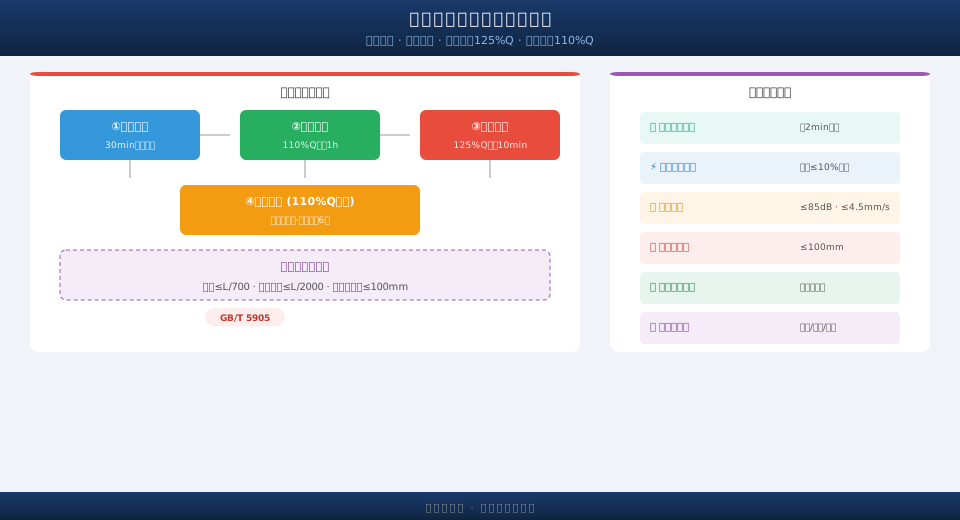
The integrated commissioning test is the final verification stage in crane installation and commissioning, and it functions as a full-scale functional assessment prior to formal equipment delivery. In accordance with ISO 4306 (Crane Test Codes and Procedures) and TSG Q7015 (Supervision and Inspection Rules for Installation, Retrofit, and Major Overhaul of Lifting Appliances), the commissioning test comprises four phases: No-Load Test, Rated Load Test (100% SWL), Static Load Test, and Dynamic Load Test. Kelude has compiled a complete commissioning procedure and inspection checklist.
No-Load Test: Verifying Crane Travel and Hoisting
The No-Load Test is conducted after all mechanisms have been individually adjusted and commissioned, marking the first stage of the integrated commissioning process. Kelude requires a minimum no-load running time of 30 minutes, during which the operating current of each mechanism is recorded as baseline data. Test requirements: 1) The crane bridge shall travel the full length of the runway at least 3 times to check running stability, abnormal noise, vibration, and signs of wheel rail gnawing or flange rubbing; 2) The trolley shall traverse the full length of the main girder at least 3 times to verify proper wheel-to-rail contact; 3) The hoisting mechanism shall complete at least 6 full lift/lower cycles to check hook travel smoothness, brake open/close timing, and stopping distance. Throughout the No-Load Test, record the operating current of each mechanism (serving as the baseline reference for subsequent load tests), verify that travel directions match control commands, and confirm the actuation logic of all limit switches and safety devices. Total no-load running time shall be no less than 30 minutes.
Rated Load Test: Lifting at 110% of Rated Capacity
Once the No-Load Test is passed, proceed with the Rated Load Test. Test method: Suspend a load equal to 110% of the rated load (the test load must consist of certified standard weights or calibrated test weights that have passed acceptance inspection) and operate the hoisting, bridge travel, and trolley travel mechanisms in a coordinated manner. The hoisting mechanism shall perform repeated lift/lower cycles (no fewer than 3), while the bridge and trolley shall each complete full travel runs (no fewer than 2). During the test, verify the smoothness of each mechanism's drive, the braking performance (with the allowable braking slip distance ≤ 100 mm), and the motor temperature rise and current draw (compared against no-load current values, the increase must remain within the rated range).
| Test Stage | Load | Operating Requirements | Acceptance Criteria |
|---|---|---|---|
| No-Load Test | None Load | Operation of All Mechanisms≥30min | None Abnormal noise/Wheel rail gnawing / flange rubbing/Vibration |
| Rated Load Test (100% SWL) | 110%Q | Three-Mechanism Interlocking Operation≥1h | Braking Droop≤100mm |
| Static load test | 125%Q | Hovering10min | Deflection≤L/700 |
| Dynamic Load Test | 110%Q | Hoisting/Lowering6Cycles+Travelling3Cycles | No Looseness/No Abnormalities |
Static Load Test Procedure for Overhead Cranes
The static load test is performed in accordance with ISO 4306. The test load is set at 125% of the rated load. The load is slowly lifted to a height of 100–200 mm above the ground and held in suspension for 10 minutes, with the main girder mid-span deflection recorded every 2 minutes during the hold period. After unloading, the residual deformation of the main girder is measured. All three acceptance criteria must be met simultaneously: 1) mid-span deflection ≤ L/700; 2) residual deformation ≤ 0.5‰ × L; 3) no loosening at any connection points and no cracking in weld seams after unloading. Standard weights must be rigged to ensure uniform load distribution without eccentric loading. For cranes with spans exceeding 30 m, deflection measurement points must be set at the mid-span of both main girders during the static load test.
Dynamic Load Test: Verifying Crane Performance Under Load
The dynamic load test is conducted at 110% of the rated load. During the test, all three mechanisms operate simultaneously: the hoisting mechanism performs no fewer than 6 full lift/lower cycles, and both the crane bridge and trolley complete no fewer than 3 full travel cycles each. The test verifies the braking function of each mechanism, the triggering reliability of limit switches, control system response sensitivity, and noise and vibration indicators (operator cabin noise ≤ 85 dB, vibration velocity ≤ 4.5 mm/s). Following the dynamic load test, all connection bolts must be checked for loosening, weld seams for cracking, electrical wiring for disconnection, and cables for wear.
Test Records and Handling of Non-Conforming Results
All test data must be documented in a standardized test record sheet, including load values, deflection measurements, current readings, temperature rise values, ambient temperature, and time stamps. In the event of test failure: if static load deflection or residual deformation exceeds allowable limits, the structural design department must propose a corrective action plan; if braking distance exceeds limits, the brake gap must be adjusted or brake linings replaced; if limit switches fail to actuate reliably, they must be re-calibrated or replaced. After all issues are rectified, the test must be repeated until all criteria are met.
