

Crane Acceptance & Handover Checklist: Inspection, Training
What Do You Need for Crane Acceptance & Handover? Full Checklist of As-Built Docs, Inspection Reports & Training Records. Once installation and commissioning are complete, compiling as-built documentation and carrying out the acceptance and handover process are critical final steps in any crane installation project. Complete as-built documentation is a legal prerequisite for putting the equipment into service. Kelude has compiled a full documentation checklist in line with TSG Q7015 and the ISO 4301 Crane Design Standard.
After crane installation and commissioning are finished, compiling as-built documentation and completing the acceptance and handover process are the legally required closing stages of an installation project. Complete as-built documentation is not only a prerequisite for lawful operation, but also serves as a vital archival record for future periodic inspections, maintenance management, and equipment transfers. Based on the requirements of TSG Q7015 (Rules for Supervision Inspection of Installation, Retrofit and Major Overhaul of Lifting Appliances), the ISO 4301 Crane Design Standard, and the FEM 1.001 Specification for Crane Testing and Test Procedures, Kelude has systematically organized a full documentation checklist and workflow for crane acceptance and handover.
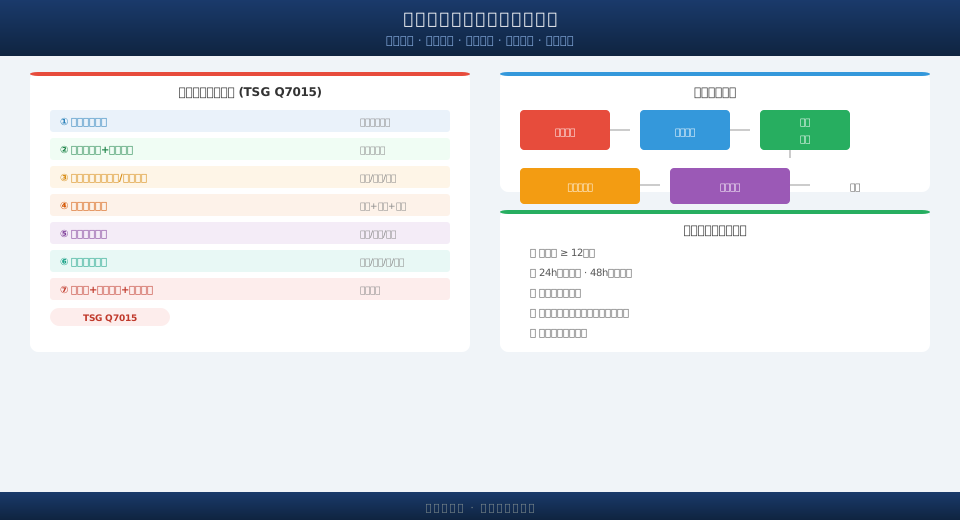
Prerequisites for Crane Acceptance & Handover
Before acceptance and handover can take place, the following conditions must be met: 1) All installation work is complete, including mechanical, electrical, and safety devices; 2) All commissioning tests have passed, including no-load, rated load, static load, and dynamic load tests; 3) The inspection body has completed installation supervision inspection and issued a qualified inspection report; 4) Operators and maintenance personnel have been trained and have passed their assessments; 5) All safety and environmental protection facilities — such as guardrails, walkways, anti-slip plates, and vibration pads — are fully in place.
Core As-Built Documentation Checklist
TSG Q7015 requires the installation unit to provide the following documents at handover. All documents should be bound into a volume and stamped with the official seal of the installation unit:
The comparison table below lists each item in detail:
| Document Category | Required Documents | Notes |
|---|---|---|
| Basic Information | Crane manufacturing license, product certificate, and instruction manual | Provided by the manufacturer |
| Installation Documentation | Installation contract, installation plan, and construction records | Includes welding records, bolt torque records, and electrical wiring records |
| Commissioning & Test Reports | No-load test report, rated load test report, static load test report, and dynamic load test report | All test reports must be signed by the responsible personnel |
| Inspection Reports | Installation supervision inspection report issued by the inspection body | Required for legal operation |
| Training & Qualification Records | Operator training records, maintenance training records, and assessment results | Personnel must pass assessments before operating the crane |
| Safety & Environmental Facilities | Safety device inspection records, guardrail and walkway acceptance records, and environmental protection facility records | All safety facilities must be fully installed and verified |
Acceptance & Handover Workflow
The acceptance and handover process typically follows these steps: 1) The installation unit submits the complete as-built documentation package to the user; 2) The user reviews the documentation and conducts a site inspection of the crane; 3) Both parties jointly verify that the crane meets all design specifications and safety requirements; 4) The user signs the acceptance certificate and the handover is formally completed; 5) The installation unit provides ongoing support, including warranty service and maintenance guidance.
Key Considerations for a Smooth Handover
To ensure a smooth acceptance and handover process, keep the following points in mind: ensure all documentation is complete and properly sealed; verify that all test reports are signed and dated; confirm that all safety devices are functional and inspected; and make sure that all personnel have completed their training and passed assessments. Proper preparation of these documents and procedures will help avoid delays and ensure the crane is ready for legal and safe operation.
| Document Category | Specific Content | Provider | Filing Requirement |
|---|---|---|---|
| Statutory Inspection | Supervision Inspection Report | inspection body | Original Archiving |
| Manufacturer's Documentation | Certificate of Conformity/Type Test/Material Certificate | Manufacturer | Original Document/Stamped Copy |
| Installation Record | Welding Record/Bolt Torque Tightening Record/Dimensional Measurement | Installation Unit | Fully Signed |
| Test Report | Load test/Electrical Test/Grounding Resistance | Installation Unit | Data Integritytraceable |
| Drawings & Manuals | As-Built Drawing/Operation Manual/Spare Parts List | Installation Unit+Manufacturer | As-Built Stamp Applied |
1) Supervision inspection report for installation, retrofit, or major repair (issued by a statutory inspection body, with the first page stamped and marked "Qualified"); 2) Factory Certificate and Type Test Certificate (supplied by the manufacturer); 3) Certificates of Conformity and material certificates for major components (including main girder, end carriage, wheels, drum, hook, wire rope, etc.); 4) Installation process records (including welding records, bolt tightening records, and dimensional measurement records); 5) Electrical test records (Insulation Resistance Test ≥1MΩ, dielectric test at 1500V/1min, Grounding Resistance test ≤4Ω); 6) Load Test Report (including measurement data and conclusions from No-Load Test, Rated Load Test (100% SWL), Static load test, and Dynamic Load Test); 7) As-built drawings (including General Arrangement Drawing, Electrical Schematic, wiring diagrams, and P&ID diagrams, stamped with the as-built seal, with all changes clearly annotated on the drawings); 8) Wear parts list and spare parts schedule; 9) Operation and Maintenance Manual (covering crane operating procedures, maintenance schedule, and a common fault troubleshooting guide, generally no fewer than 80 pages).
Operator Training and Handover Procedures
Before acceptance and handover, the installation contractor must provide comprehensive training to the user's operators and maintenance personnel. Kelude offers a full Operator Training program as part of the Acceptance & Handover process, including both written and practical assessments. Training content covers: 1) Crane structure and working principles (including the names and functions of major components); 2) Operation Panel and Remote Control functions (including the meaning of each button, switch, and indicator light); 3) Standard operating procedures (including pre-start inspection, startup, normal operation, shutdown sequence, and emergency procedures); 4) Daily functional checks of safety devices (self-inspection before each shift); 5) Routine inspection items (including lubrication, bolt tightening, Brake clearance checks, and visual inspection of Wire Rope). A written exam and a hands-on operating test must be completed at the end of training; only those who pass are permitted to operate independently. Training records and test results are archived as part of the acceptance documentation.
Equipment Handover and Warranty Service
Upon successful acceptance, the installation contractor and the user sign an Equipment Handover Sheet. This document records the following: equipment model and Serial Number, installation site and date, acceptance conclusion (Qualified / Qualified after rectification), and signatures and dates from both parties. Responsibility for equipment management formally transfers to the user upon handover. The Warranty Period generally starts from the handover date and lasts no less than 12 months. During the warranty period, the installation contractor must provide: 24-hour telephone technical support, on-site response within 48 hours for emergency faults, one free quarterly inspection, and free replacement of parts damaged due to manufacturing or installation defects. Maintenance services beyond the Warranty Period can be arranged through an annual maintenance contract.
This article is a core part of the Complete Guide to Crane Installation, Commissioning, and Acceptance series. For the next stage, see Crane Periodic Inspection and Maintenance Intervals: Annual Inspection, Full Inspection, and Wear Parts Replacement Guide.
Frequently Asked Questions (FAQ)
Q: What registration procedures must the user complete after equipment delivery?
A: The user must register the equipment with the local special equipment regulatory authority before commissioning, or within 30 days of commissioning, to obtain the Special Equipment Use Registration Certificate. Kelude provides a complete set of registration documents at delivery, including the supervision inspection report, Factory Certificate, and the installer's qualification certificate, to assist the user in completing the registration process.
Q: Which body performs the supervision inspection, and how long does it take?
A: Supervision inspection for the installation, retrofit, or major repair of lifting appliances is carried out by an accredited special equipment inspection body (typically the provincial special equipment inspection institute or an authorized third-party organization). The inspection must be applied for before installation begins. The inspection body conducts surveillance during installation and issues the inspection report upon completion. The timeline depends on the installation schedule, generally taking 15–30 days from application to report issuance.
Q: What should be done if the as-built drawings differ from the design drawings?
A: Any changes made during installation that deviate from the design drawings (e.g., cable routing adjustments, bracket position changes, or component model substitutions) must be accurately reflected in the as-built drawings. Changes to the original design drawings should be marked in red with a description of the change and the reference number of the change document. Major changes affecting safety performance or key parameters must be confirmed in writing by the original design unit and the inspection body.
Q: What level of proficiency is required for operators to pass the assessment?
A: Operators must be able to independently complete: pre-start inspection and logging, normal operating sequences (coordinated Hoisting / Lifting, Crane Bridge / Long Travel, and Trolley movements), Emergency Stop and Fault reset procedures, and self-testing of Limit Switches and safety devices. Assessment criteria: written exam score of 80 or above, no unsafe actions during the practical test (such as overspeeding, emergency stopping under load, or operating with safety devices not reset), and the ability to correctly describe response plans for three emergency scenarios presented by the examiner.
