

Cleanroom Crane Guide: ISO Class 5 & 6 for Semiconductor, Pharma
A cleanroom crane is far more than a standard overhead crane with a stainless steel finish—it's the convergence of materials science, sealing engineering, and validation protocols. Cleanliness demands vary drastically across semiconductors, pharmaceuticals, food processing, and precision manufacturing, spanning ISO Class 1 through Class 8. Each step up in classification represents a fundamental leap in crane design complexity.
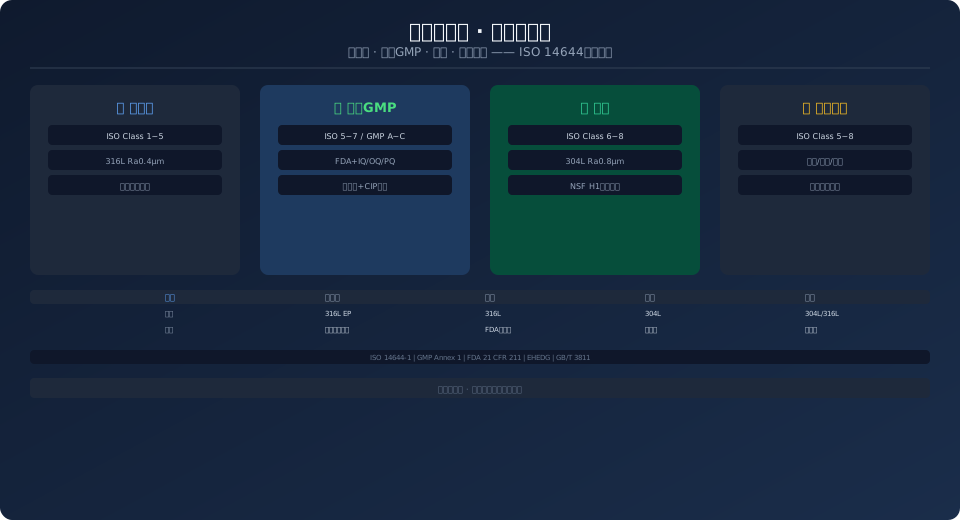
Cleanroom Crane Configurations by Industry: A Quick Reference
| Industry | Cleanliness Grade | Material | Sealing | Special Requirements |
|---|---|---|---|---|
| Semiconductor | ISO 1~5 | 316L EP Ra≤0.4μm | bellows Fully Enclosed | ESDAnti-Static, AMCControl |
| Pharmaceutical GMP | ISO Class 5~7 / GMP A~C | 316L Ra≤0.8μm | Fully Enclosed+CIPCompatibility | IQ/OQ/PQValidation Documentation Package |
| Food | ISO Class 6~8 | 304L Ra≤0.8μm | Semi-Enclosed | NSF H1Food-grade grease |
| Precision Manufacturing | ISO Class 5~8 | 304L/316L | Semi-Enclosed | Low Vibration & Micro-Amplitude Control |
ISO 14644 Cleanliness Classifications
ISO 14644-1 classifies cleanrooms from Class 1 to Class 9. Class 5 permits no more than 3,520 particles ≥0.5μm per m³, while Class 1 requires no more than 10 particles ≥0.1μm per m³—this order-of-magnitude difference dictates the design strategy: Class 6–8 can be achieved by controlling contamination sources, whereas Class 1–5 requires eliminating them entirely. Not only must the crane itself generate zero particles, but even airflow disturbances during operation must not stir up floor dust. In addition to meeting the ISO 4301 Crane Design Standard, cleanroom cranes must also comply with ISO 14644 and SEMI S2 requirements.
Five Critical Design Features for Cleanroom Cranes
1. Materials—Paint on a standard overhead crane is itself a particle source. All metal surfaces of a cleanroom crane must undergo electrolytic or mechanical polishing, with surface roughness (Ra) held between 0.4 and 0.8 μm.
2. Lubrication—Standard lithium grease has an evaporation rate of 3%–5%, and the vaporized oil mist becomes molecular contamination in the 0.01–0.1 μm range. PFPE (perfluoropolyether) grease must be used instead, with an evaporation rate of <0.01%.
3. Sealing—Standard crane mechanisms are open to the environment. Oil seepage from reducers, metallic micro-debris from gears, and fiber fragments from brake linings are all critical contamination sources in a cleanroom.
4. Static Control—Semiconductor and electronics industries have stringent ESD requirements. Crane wheels must be made of static-dissipative materials with resistance ≤10⁶Ω, and the entire crane must be grounded to <1Ω.
5. Validation—GMP and FDA regulations require a complete DQ/IQ/OQ/PQ validation documentation package.
The Non-Linear Relationship Between Cleanliness Class and Cost
Many facility owners specify "the cleaner, the better" in their tender documents—a vague requirement that can drive supplier quotations up by 3–5 times. The relationship between cleanliness class and cost is far from linear: moving from Class 8 to Class 5 raises the cleanliness requirement by three grades but increases crane manufacturing cost by roughly 2–3 times (primarily due to upgrading surface treatment from mechanical to electrolytic polishing). Going from Class 5 to Class 1—another four grades higher—multiplies manufacturing cost by an additional 3–5 times, involving CFD airflow simulation, material outgassing testing, fully enclosed bellows with slight positive pressure, and electrolytic polishing down to Ra ≤0.2 μm. This is why an open-ended requirement like "make it as clean as possible" creates a pricing trap at the tender stage—suppliers will quote for Class 1 compliance when you may only need Class 5. The correct approach is to have a process engineer or GMP consultant issue a cleanroom classification report that clearly designates the ISO class for each zone, then specify crane cleanliness accordingly for each area—rather than applying a single uniform cleanliness class across the entire facility.
Cleanroom Crane Technology Approaches Across Four Industries
| Technical Dimension | Semiconductor | Pharmaceutical GMP | Food | Precision Manufacturing |
|---|---|---|---|---|
| Core Focus | Particulate+AMC+ESD | Particulate+Microorganism+Validation | Particulate+Cleanability | Low Vibration+Micro-Amplitude |
| Standard System | SEMI S2/S8/S23 | FDA 21 CFR 211 | EHEDG Doc 8 | ISO 1940 Dynamic Balancing |
| Lubrication Solution | PFPEPerfluoroether Grease Evaporation<0.01% | PFPE + NSF H1Dual Certification | NSF H1Food-grade grease | Low-Volatility Synthetic Grease |
| Acceptance Standard | Particle Release+AMC+ESDThree-Point | IQ/OQ/PQFull Four-Phase | Particle+Microbial Sampling | vibration spectrum Analysis |
Cleanroom Crane Rails and Wheels: An Overlooked Source of Particles
Most discussions focus on the crane itself, overlooking the fact that the rails beneath it represent the largest contact surface. In the low-humidity environment of a cleanroom, standard carbon steel rails develop an ultra-thin layer of iron oxide ("flash rust") on their surface. Every time the overhead crane passes, the wheels crush this layer into sub-micron iron oxide particles—a continuous, invisible particle generation mechanism. Particle counters positioned at rail height (typically near the ceiling) may not detect these particles, but they settle onto work surfaces via laminar airflow. By the time elevated particle levels are detected at floor level, the flash rust on the rails has been grinding away for months. A cleanroom crane must be paired with cleanroom-grade rails: 304L stainless steel square rails or 316L steel rails with a mechanically polished surface finish of Ra ≤ 0.8 μm. Even with perfectly clean rails, micro-motion (fretting) between the wheels and rails generates metallic oxide particles—which is why cleanroom crane wheels should not have excessive surface hardness. The recommended range is HB 280–320 (compared to HB 300–380 for standard overhead crane wheels), deliberately trading some wear resistance for reduced particle generation.
Cleanroom Crane FAQs: Key Differences, Compliance & Maintenance
Q: What is the biggest difference between a cleanroom crane and a standard overhead crane?
A: It's not the stainless steel enclosure—it's systematic contamination control. A standard overhead crane focuses on lifting; a cleanroom crane must lift while generating zero particles, oil mist, fibers, or static electricity. This requires a complete overhaul of materials, surface treatment, lubrication, sealing, and validation documentation.
Q: Can the same cleanroom crane be used in both food and pharmaceutical workshops?
A: The structure can be shared, but compliance requirements differ. Pharmaceutical applications require GMP and FDA 21 CFR Part 211 compliance—including full IQ/OQ/PQ validation. Food applications require EHEDG and 3-A sanitary standards, which demand CIP (clean-in-place) with no dead zones. Lubrication also differs: pharmaceutical uses PFPE fluorinated grease, while food applications require NSF H1 food-grade grease.
Q: How often should particle detection be performed on a cleanroom crane?
A: For Class 1–5 cleanrooms, quarterly particle counting at a 1-meter distance under full-load operating conditions is recommended. For Class 6–8, semi-annual testing is sufficient. GMP facilities also require annual re-validation.
Q: Is there a dedicated cleanroom crane standard in China?
A: Currently, there is no dedicated national standard. Design typically references ISO 4301 in combination with ISO 14644, with additional requirements from EU GMP Annex 1 and FDA 21 CFR 211 for pharmaceutical applications, and SEMI S2 for semiconductor facilities. Users must explicitly list all applicable standards in their contract specifications.
For cleanroom crane design consultation, contact the Kelude Heavy Industry technical team.
