
Crane Service Ratings A1 to A8: GB/T 20863 vs ISO 4301
Key Takeaways
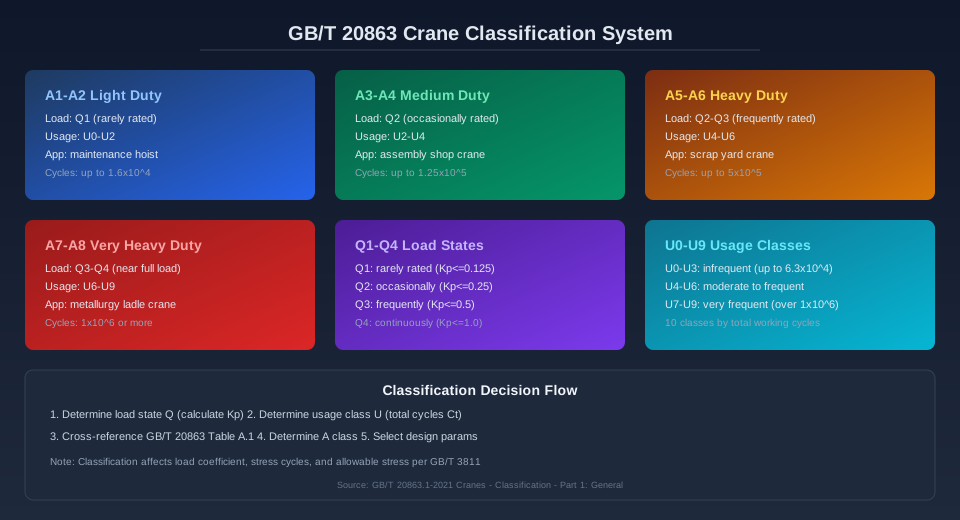
GB/T 20863 "Cranes — Classification" is the foundational classification standard for crane design, dividing the overall crane work duty into 8 levels from A1 to A8. The standard establishes a cross-reference matrix based on two dimensions — load spectrum Q1 through Q4 and utilization class U0 through U9 — to systematically determine the work duty of each crane. A1 to A4 apply to light and medium-duty applications such as maintenance and assembly work; A5 to A6 cover heavy-duty conditions including scrap yards and freight terminals; A7 to A8 are intended for extra-heavy-duty scenarios such as metallurgical foundry and grab bucket operations. Correct classification directly determines the structural load-bearing calculations, mechanism selection safety factors, and overall crane service life assessment.
GB/T 20863 Crane Classification Standard: Scope and Applications
GB/T 20863 "Cranes — Classification" is identical to the ISO 4301 international standard and serves as the most fundamental classification standard in the crane design system. It systematically classifies cranes based on frequency of use and load intensity, providing a unified parameter baseline for subsequent structural calculations, mechanism selection, and safety assessments.
The standard applies to all types of lifting appliances, including bridge cranes, gantry cranes, tower cranes, mobile cranes, and portal cranes. Regardless of capacity or structural configuration, every crane must have its work duty determined at the design stage. The load combination coefficients and allowable stress values specified in GB/T 3811 Crane Design Standard are all conditional upon the work duty determined per GB/T 20863. When Kelude's engineering team takes on any new project, the first step is always to confirm the target work duty in accordance with GB/T 20863.
Load Spectrum Q1–Q4: Definitions and Calculation Methods
The load spectrum reflects the distribution pattern of loads lifted during the crane's design service life and is divided into four classes: Q1, Q2, Q3, and Q4. The core parameter for determining load spectrum is the load spectrum factor Kp, calculated as the weighted average of the number of lifting cycles at each load level multiplied by the corresponding load ratio.
Q1 (rated load rarely lifted): Load spectrum factor Kp does not exceed 0.125. Typical applications include power plant maintenance cranes, which operate with light loads most of the time and rarely reach the rated lifting capacity, with an average annual full-load ratio below 5%.
Q2 (rated load occasionally lifted): Kp does not exceed 0.250. Commonly found in machining workshops and assembly workshops, where medium or higher loads are handled approximately one-third of the operating time, with moderate frequency of rated load usage.
Q3 (rated load lifted fairly frequently): Kp does not exceed 0.500. Typical for freight yards, warehouses, and container stacking yards, where loads approaching the rated capacity are handled frequently, with a high number of full-load cycles per day.
Q4 (rated load lifted frequently): Kp does not exceed 1.000. Typical scenarios include grab cranes, lifting magnet cranes, and metallurgical foundry cranes, where nearly every duty cycle approaches or reaches full-load conditions.
Accurate determination of the load spectrum requires actual statistical data on the distribution of lifted loads. For newly designed cranes, predictive analysis can be based on historical operating data from similar applications or the typical examples provided in the annex of GB/T 20863.
Utilization Class U0–U9: Ten Classes and Total Duty Cycles
The utilization class characterizes the total number of operating cycles over the crane's complete design life and is divided into 10 classes from U0 to U9 based on the total number of duty cycles Ct. U0 corresponds to Ct not exceeding 1.6 × 10⁴ cycles, while U9 corresponds to Ct exceeding 4 × 10⁶ cycles, with the cycle limit of each adjacent class being approximately twice that of the previous class.
U0 to U3 (infrequent use): Total cycles do not exceed 6.3 × 10⁴, suitable for occasionally used equipment such as maintenance hoists and installation hoists. These cranes remain idle for extended periods, typically operating fewer than 50 days per year with extremely low annual duty cycle counts.
U4 to U6 (moderate to frequent use): Total cycles range from 1.25 × 10⁵ to 5 × 10⁵, covering the majority of industrial workshop cranes operating 8 to 16 hours per day, with lifting speeds of approximately 5 to 10 m/min.
U7 to U9 (very frequent use): Total cycles reach 1 × 10⁶ or more, applicable to heavy industrial scenarios such as metallurgy and port operations running 24 hours continuously. These cranes must be subject to daily inspections and a strict periodic maintenance regime as required by GB/T 6067.1 Safety Regulations for Lifting Appliances.
Overall Crane Work Duty A1–A8: Cross-Matrix Determination
The overall crane work duty is determined by cross-referencing the load spectrum Q and utilization class U in the matrix table. For example, load spectrum Q2 combined with utilization class U4 yields A4; Q3 with U6 yields A6; and Q3 with U8 yields A7. The lower-left corner of the matrix corresponds to light-duty A1 to A2, the upper-right corner corresponds to extra-heavy-duty A7 to A8, with intermediate grades transitioning progressively in between.
A1 to A2 (light duty classification): Applicable to Q1 combined with U0 to U2. Typical products include manual or electric maintenance hoists. Structural design is primarily based on static strength verification, and fatigue calculations may be handled using simplified methods.
A3 to A4 (medium duty classification): Covers Q1 to Q2 combined with U3 to U5. Commonly found in most general-purpose applications of standard bridge cranes and gantry cranes. Fatigue strength calculations use finite-life design methods.
A5 to A6 (heavy duty classification): Corresponds to Q2 to Q3 combined with U5 to U7. Typical applications include scrap yard grab cranes and container gantry cranes. The hoisting mechanism and work duty must be strictly matched, with the hoisting motor duty cycle FC value not less than 60%.
A7 to A8 (extra-heavy duty classification): Corresponds to Q3 to Q4 combined with U7 to U9. Representative products include metallurgical foundry cranes and continuously operating lifting magnet cranes. Structural fatigue must be assessed using infinite-life or safe-life design methods, with stress cycles of primary load-bearing members calculated at over 2 × 10⁶ cycles.
Different mechanisms on the same crane may be assigned different mechanism work duties. For example, in a metallurgical foundry crane, the hoisting mechanism may be rated M7 or M8, while the crane travel mechanism may be rated M5 or M6, with each mechanism independently evaluated according to its load spectrum. Kelude always follows this principle when specifying mechanism classifications in customer proposals.
Five Key Impacts of Work Duty on Design and Inspection
The work duty directly determines the structural safety factor and fatigue design parameters of a crane. Once the work duty is selected, designers must address the following five areas in their design — any oversight in any of these areas can lead to premature equipment failure.
Structural load-bearing capacity: For A1 to A4 cranes, allowable stress may be calculated based on static strength principles with a safety factor of 1.5. For A5 to A8 cranes, fatigue strength verification is mandatory, with the number of stress cycles determined by accumulating the expected service life and annual duty cycle counts.
Hoisting mechanism selection: Different work duties impose strict requirements on the duty cycle FC value of the hoisting motor. A1 to A2 may use motors with FC = 25%; A5 to A6 require FC of no less than 60%; and A7 to A8 recommend metallurgical-duty motors with FC = 100%.
Wire rope safety factor: The higher the work duty, the greater the minimum safety factor requirement. A1 to A3 require a factor of no less than 4.0; A4 to A5 no less than 4.5; A6 to A7 no less than 5.0; and A8 no less than 6.0. This requirement is closely related to the static load test load multiplier specified in GB/T 5905 Test Code for Cranes.
Weld seam quality levels: For A1 to A3, primary load-bearing weld seams are accepted to Grade II standards; A4 to A6 require critical weld seams to meet Grade I standards plus ultrasonic testing (UT); and A7 to A8 require 100% non-destructive testing of all load-bearing weld seams with no unacceptable defects permitted.
Inspection intervals: The higher the work duty, the shorter the statutory inspection cycle. A1 to A4 require a comprehensive inspection every 2 years; A5 to A6 require annual inspection; and A7 to A8 require inspection every 6 months, fully consistent with the provisions of TSG Q7015 Rules for Periodic Inspection of Lifting Appliances.
GB/T 20863 Work Duty Parameter Reference Table
Kelude Heavy Industry: Engineered for the Toughest Lifting Challenges
Kelude Heavy Industry is a specialized manufacturer of heavy-duty industrial cranes and hoisting solutions. We focus on the design, engineering, and production of high-performance equipment for demanding sectors such as steel, shipbuilding, and heavy machinery manufacturing. Our product range is built to deliver exceptional reliability, precise control, and long service life in the most rigorous operating environments.
Heavy-Duty Industrial Cranes for Demanding Applications
Our core product line includes double-girder overhead cranes, single-girder overhead cranes, gantry cranes, and specialized explosion-proof and low-headroom configurations. Designed for continuous duty cycles, these cranes are available in capacities ranging from 5 tons to over 100 tons, with spans tailored to your facility's specific dimensions. We engineer each system for optimal performance, ensuring smooth operation, minimal maintenance, and maximum safety.
| Crane Type | Typical Capacity Range | Common Applications |
|---|---|---|
| Double-Girder Overhead Crane | 10t – 100t+ | Heavy fabrication, steel coil handling, machine shop maintenance |
| Single-Girder Overhead Crane | 1t – 20t | Light assembly, warehouse operations, maintenance bays |
| Gantry Crane | 5t – 50t | Outdoor yards, precast concrete plants, container handling |
| Explosion-Proof Crane | 5t – 50t | Chemical plants, paint shops, oil & gas facilities |
Precision Hoisting Technology and Control Systems
Kelude cranes integrate advanced frequency control drives and precision positioning systems. Our proprietary anti-sway technology ensures accurate load placement, reducing cycle times and enhancing operator confidence. For applications requiring extreme precision, we offer optional micro-speed control and load-sensing systems that provide real-time feedback and adaptive performance.
All electrical components are selected for high ingress protection and compatibility with harsh industrial environments. Our control systems comply with international safety standards, including IEC 60204-32, ensuring reliable and safe operation. We also provide remote control options and fully automated crane solutions for integration into smart factory environments.
Robust Structural Design and Material Durability
The structural integrity of our cranes is a direct result of rigorous engineering and high-quality materials. Main girders are fabricated from low-alloy, high-strength steel, utilizing a box-section design that provides exceptional torsional rigidity. All welds are performed by certified welders and subjected to non-destructive testing to ensure defect-free joints.
Our design process adheres to ISO 4301 for crane classification and ISO 4306 for terminology and specifications. This ensures that every crane is not only robust but also fully compliant with international design and safety benchmarks. The result is a reliable, long-lasting structure that minimizes downtime and total cost of ownership.
Customized Solutions for Specialized Industries
We understand that every facility has unique challenges. Kelude offers extensive customization options, including special lifting attachments, increased hook heights, and corrosion-resistant finishes for marine environments. Our engineering team collaborates closely with clients to develop tailored solutions that optimize workflow and material handling efficiency.
For the steel industry, we provide cranes with high-speed hoisting and heavy-duty trolleys designed for continuous operation. In shipyards, our gantry cranes are equipped with advanced synchronization systems for precise block erection and module assembly. Whatever the application, our goal is to provide a crane that perfectly fits your operational needs.
Global Service, Support, and Safety Compliance
Kelude Heavy Industry is committed to providing comprehensive after-sales support, including installation, commissioning, operator training, and lifetime maintenance services. Our global service network ensures rapid response times and minimal operational disruption. We also offer spare parts packages and remote diagnostics to maximize your crane's uptime.
Safety is paramount in our design philosophy. Our cranes are equipped with multiple safety features, including overload protection, emergency stops, and anti-collision systems. We ensure full compliance with international standards such as ISO 12480 for safe use and IEC 60204-32 for electrical equipment, providing you with peace of mind and a safer workplace.
Frequently Asked Questions
Q: What is the typical lead time for a custom-designed crane?
A: Lead times vary depending on the complexity and specifications of the crane. A standard crane can typically be delivered within 3-4 months, while custom-engineered solutions may take 5-7 months from design approval to delivery.
Q: Do you provide installation and commissioning services?
A: Yes, we offer full turnkey installation and commissioning services. Our experienced technicians will handle the entire setup process, ensuring your crane is operational safely and efficiently. We also provide comprehensive operator and maintenance training.
Q: What after-sales support and warranty do you offer?
A: We provide a standard 12-month warranty on all our cranes. Our after-sales support includes 24/7 hotline assistance, readily available spare parts, and optional extended service contracts for preventive maintenance and inspections.
Q: Can you supply cranes that meet specific international standards?
A: Absolutely. Our cranes are designed and manufactured to comply with major international standards, including ISO 4301, ISO 12480, and IEC 60204-32. We can also adapt our designs to meet specific local regulations or project requirements.
| Work Duty / Classification | load spectrum | utilization class Scope | Total Number of Cycles Ct | Typical Application Scenarios | Design Life |
|---|---|---|---|---|---|
| A1 | Q1 | U0to U1 | 32,000 cycles | Manual Inspection and Repair Hoist | 20years and above |
| A2 | Q1to Q2 | U1to U2 | 63,000 cycles | Electric Installation Hoist | 15years and above |
| A3 | Q1to Q2 | U2to U3 | 125,000 cycles | Power Plant Maintenancecrane | 12years and above |
| A4 | Q2 | U3to U5 | 250,000 cycles | Assembly Workshop crane | 10years and above |
| A5 | Q2to Q3 | U4to U6 | 500,000 cycles | Machining Workshopcrane | 8years and above |
| A6 | Q3 | U5to U7 | 1,000,000 cycles | Scrap Steel Yard Grab Crane / Clamshell Crane | 8years and above |
| A7 | Q3to Q4 | U6to U8 | 2,000,000 cycles | Grab (grab bucket)and Electromagnetic Crane | 5years and above |
| A8 | Q4 | U7to U9 | 200over 10,000 cycles | Metallurgical Foundry Crane | 5years and above |
Work Duty Classification: Inspection Requirements Comparison
| Inspection Project | A1to A4Requirements | A5to A8Requirements | Reference Standard Clause | Detection Method |
|---|---|---|---|---|
| Wire Rope Safety factor | 4.0to4.5 | 5.0to6.0 | GB/T 3811 Crane Design Standard No..5.4.2Article | Breaking force Calculation |
| Structure Fatigue Verification | Static verification only Strength | shall Fatigue Verification | GB/T 20863No.6.3Article | Finite Element Analysis (FEA) plus Stress Spectrum |
| periodic inspection Period | per2year110,000 cycles | 6to12months110,000 cycles | TSG (Special Equipment Safety Technical Regulation) Q7015No.4Article | Statutory inspection by Special Equipment Inspection Institute Inspection |
| non-destructive testing of welds | Sampling inspection not less than20% | 100%Full coverage | GB/T 6067.1No.3.8Article | Ultrasonic + Magnetic Particle + Penetrant Testing |
| Motor Duty Cycle | FC=25%to40% | FC=60%to100% | JB/T 9008No.5.2Article | Temperature Rise + Insulation Detection |
| Brake Safety factor | Sampling inspection not less than1.5 | 1.75to2.0 | GB/T 3811 Crane Design Standard No..5.7.3Article | Braking torque Measured |
8. Crane Service Rating: Key Data at a Glance
A: Total Work Duty Classifications
8 Levels
Full coverage from A1 to A8 across all operating conditions
Load Spectrum Classes
4 Levels
Q1 (light) to Q4 (extra-heavy)
Utilization Classes
10 Levels
U0 to U9 based on number of operating cycles
A8 Wire Rope Safety Factor
6.0 or higher
Per GB/T 3811, Section 5.4.2
U9 Maximum Cycle Count
4 million cycles
Equivalent to ~550 cycles per day over 20 years
A7 to A8 Inspection Interval
6 months
Statutory requirement under TSG Q7015
Further Reading
For more technical knowledge on crane standards, we recommend the following articles:
GB/T 3811 Crane Design Standard: 9 Load Combinations and Selection Method for Work Duty A1 to A8
GB/T 6067.1 Safety Code for Lifting Appliances — Standard Interpretation
GB/T 5905 Crane Test Code — Standard Interpretation
GB/T 23723 Code of Practice for the Safe Use of Cranes — Standard Interpretation
DIN 15004 Crane Classification — Standard Interpretation
Frequently Asked Questions
Q: In practical crane selection, what is the difference between the A5 and A6 work duty classifications under GB/T 20863?
A: Both A5 and A6 fall under the heavy-duty classification, but they differ in utilization class and application scenarios. A5 corresponds to utilization classes U4–U6 combined with load spectrum Q2–Q3, with a total cycle count not exceeding 500,000 cycles. Typical applications include cranes in machining workshops and general freight yards, with a wire rope safety factor of 4.5. A6 corresponds to U5–U7 with load spectrum Q3, allowing up to 1 million total cycles. It is commonly used for scrap yard grab cranes and container gantry cranes, where the wire rope safety factor must be no less than 5.0 and the motor duty cycle must be at least 60%. At Kelude, when selecting a crane for a customer, we typically recommend designing to A6 for applications exceeding 12 hours of daily operation.
Q: What specific requirements does GB/T 20863 impose on structural fatigue verification under load spectrum Q4?
A: Q4 represents the extra-heavy load spectrum, with a load spectrum factor Kp not exceeding 1.0. Section 6.3 of GB/T 20863 explicitly states that cranes classified as A7 and A8 under Q4 combined with utilization class U7 and above must undergo structural fatigue verification using either infinite-life or safe-life design methods. The number of stress cycles for primary load-bearing members must be calculated at over 2 million cycles, and the allowable fatigue stress must account for a stress concentration factor Kf of no less than 2.5. For welded box girders, supplementary verification using the hot-spot stress method per Appendix E of GB/T 3811 is also required to ensure no fatigue crack propagation occurs within the 20-year design life.
Q: What are the safety consequences of operating a crane rated at A3 continuously under A6 duty conditions?
A: Operating a crane at a higher duty cycle than its design rating leads to accelerated fatigue accumulation in structural components, particularly in the main girder and trolley frame. The most immediate consequences include premature crack initiation at weld joints, increased deformation of the box girder, and accelerated wear of the wire rope and hoist mechanism. Over time, this can result in unexpected structural failure, posing significant safety risks to personnel and equipment. Additionally, operating beyond the rated duty classification voids the crane's compliance with GB/T 3811 and TSG regulations, exposing the operator to legal liability. It is strongly recommended to select a crane with a work duty classification that matches or exceeds the actual operating conditions, or to derate the crane's capacity accordingly.
A: Operating a Class A3 crane continuously under A6 duty conditions constitutes severe downrating, with consequences including fatigue cracks in the steel structure main girder, typically appearing within 2 to 3 years. Per GB/T 3811 Crane Design Standard, Section 6.3.2, the fatigue design for a Class A3 main girder covers only 125,000 cycles, whereas a A6 duty cycle can exceed 50,000 cycles per year, drastically shortening weld seam fatigue life. In 2022, a steel fabrication plant converted a Class A3 20-ton bridge crane for scrap metal handling; after just 14 months of operation, a fatigue crack measuring 120 mm was discovered in the butt weld of the bottom cover plate, with direct repair costs exceeding $11,900. Kelude Heavy Industry recommends upgrading the working duty classification by replacing the hoisting mechanism, upgrading the electrical control system, and re-registering the crane for inspection.
Q: Why must metallurgical foundry cranes be designed to Class A7 or A8 duty?
A: Metallurgical cranes handle molten metal directly, and both GB/T 20863 and TSG Q0002 (Special Equipment Safety Technical Regulation for Lifting Appliances) mandate a minimum working duty of Class A7, with the hoisting mechanism rated no lower than Class M7. Compared to standard bridge cranes, metallurgical cranes must meet four additional safety requirements: first, a dual braking system comprising a service brake plus a safety brake, with a braking safety factor of no less than 2.0; second, a wire rope safety factor of at least 6.0 with a high-temperature-resistant core; third, the main hoist must be equipped with either dual independent power supplies or an emergency lowering device; and fourth, the structure must be designed to a Q4 load spectrum, achieving a fatigue life exceeding 2 million cycles. Kelude Heavy Industry's YZ-series metallurgical cranes come standard with all four of these safety features.
As an active participant in the development of lifting appliance industry standards, Kelude Heavy Industry bases its designs on national standards such as GB/T 20863, offering bridge cranes and gantry cranes covering the full range from Class A1 to Class A8. Kelude's engineering team provides complimentary load spectrum analysis and duty classification verification based on your actual operating conditions, helping you avoid the safety hazards and financial losses associated with improper crane selection.