

Overhead Crane Control System 4-Layer Architecture: PLC & Data Flow
The overhead crane control system is the core technology enabling automated, remote, and intelligent operation of unmanned overhead cranes. This article breaks down the four-layer architecture—field, control, communication, and management—covering PLC controller selection, communication protocol comparisons, and the complete design of upstream/downstream and safety data flows.
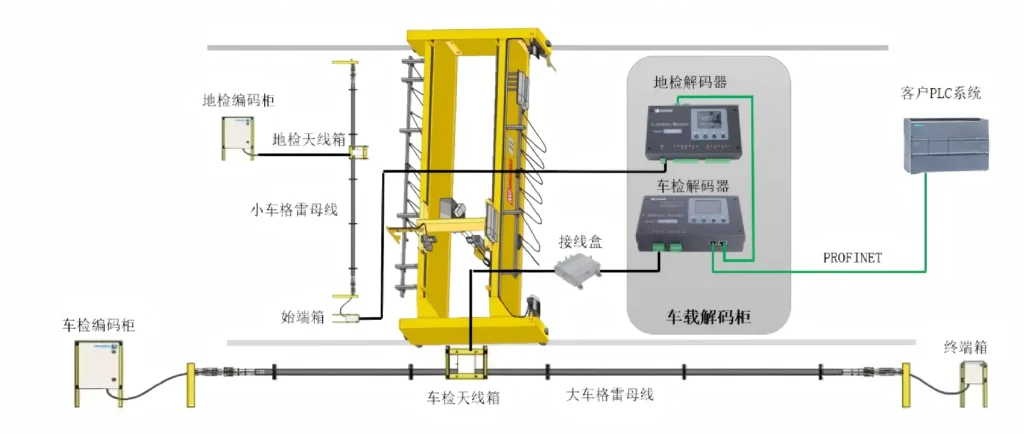
Four-Layer Architecture Overview
Modern overhead crane control systems adopt a layered, decoupled architecture consisting of the enterprise layer, coordination layer, control layer, and drive/sensor layer. This design balances the high determinism required for real-time control with the flexibility needed for upper-level information systems.
| Layer | Primary Function | Typical Components |
|---|---|---|
| Enterprise | Production scheduling, fleet management, data analytics | MES, ERP, cloud platforms |
| Coordination | Task assignment, path planning, inter-crane coordination | Fleet management servers, scheduling algorithms |
| Control | Real-time motion control, safety logic, I/O processing | PLC Controller (e.g., Siemens S7-1500), safety relays |
| Drive/Sensor | Motor drives, encoders, limit switches, load cells | VFDs, servo drives, proximity sensors |
PLC Controller Selection for Overhead Cranes
Selecting the right PLC Controller is critical for ensuring reliable and safe crane operation. For most overhead crane applications, Siemens S7-1200 and S7-1500 series controllers are the industry standard. The choice between them depends on the complexity of the crane, the number of I/O points, and the required communication interfaces.
For smaller, less complex cranes, the S7-1200 offers a cost-effective solution with integrated Ethernet and sufficient processing power. For larger, high-speed, or multi-crane systems, the S7-1500 provides superior performance, advanced diagnostics, and enhanced safety features, making it the preferred choice for demanding unmanned overhead crane applications.
Communication Protocols: PROFINET, EtherNet/IP, and More
The communication layer is the backbone of the control system, connecting the PLC Controller to drives, sensors, and the upper-level management system. The most common protocols used in overhead crane control systems include:
| Protocol | Typical Use Case | Key Advantage |
|---|---|---|
| PROFINET | Real-time control between PLC and drives/I/O | High speed, deterministic, widely supported |
| Ether Net/IP | Integration with Rockwell Automation environments | Seamless integration with Allen-Bradley PLCs |
| PROFIBUS DP | Legacy systems, field device networking | Mature, reliable, cost-effective for simple networks |
| OPC UA | Data exchange between control layer and enterprise layer | Platform-independent, secure, scalable |
Data Flow Design: Upstream, Downstream, and Safety
A well-designed data flow architecture ensures that the right data reaches the right destination at the right time. In an overhead crane control system, data flows can be categorized into three main types:
Upstream data flow refers to information traveling from the field devices (drives, sensors) up to the PLC Controller and then to the coordination or enterprise layer. This includes status data, diagnostic information, and production counts.
Downstream data flow involves commands and setpoints traveling from the enterprise or coordination layer down to the PLC Controller and ultimately to the drives and actuators. This includes task assignments, target positions, and speed commands.
Safety data flow is a dedicated, independent path designed to handle safety-critical signals such as emergency stops, overload protection, and limit switch states. This flow typically uses safety-rated PLCs and protocols (e.g., PROFIsafe) to ensure fail-safe operation, meeting standards like IEC 60204-32.
Designing for Unmanned Overhead Crane Systems
For unmanned overhead crane systems, the architecture must support advanced features such as anti-sway control, automatic positioning, and remote monitoring. The four-layer architecture provides the necessary framework to integrate these features seamlessly.
The coordination layer plays a particularly important role in unmanned systems, handling complex tasks like path planning and collision avoidance between multiple cranes. The control layer must execute these commands with high precision and reliability, while the enterprise layer provides the user interface for remote supervision and data analytics.
Frequently Asked Questions
Q: What is the typical response time for the control layer in an overhead crane system?
A: The control layer typically operates with cycle times in the range of 1 to 10 milliseconds, depending on the PLC Controller and the complexity of the control logic. This ensures real-time responsiveness for critical motion control tasks.
Q: Can the four-layer architecture be applied to existing overhead cranes?
A: Yes, existing cranes can be retrofitted with this architecture. The process involves upgrading the control layer with a modern PLC Controller, adding necessary sensors and drives, and implementing the communication infrastructure to connect to the upper layers.
Q: What are the main benefits of using a four-layer architecture?
A: The primary benefits include improved system reliability, easier troubleshooting, enhanced scalability, and the ability to integrate advanced features like predictive maintenance and remote diagnostics. It also simplifies the process of upgrading individual components without disrupting the entire system.
| Level | Typical Hardware | Core Functions | Communication Cycle | Real-time Requirements |
|---|---|---|---|---|
| Layer4Layer Enterprise Layer | ERP / MES / WMS server | Production Planning, Order Management, Inventory Analysis | 500ms~1s | None |
| Layer3Layer Coordination Layer | dispatching system / Multi-machine Coordination Platform | Task Allocation, Path Planning, Remote Operation | 100ms~500ms | Soft Real-time |
| Layer2Layer Control Layer | PLC S7-1500F(Safety-rated) | Motion Control, Positioning Anti-sway, Safety Logic | 1~10ms | Hard Real-time |
| Layer1Layer Drive/Sensor Layer | G120Frequency Inverter / VFD, Encoder, Li DAR | Motor Drive, Position Detection, Safety-related Acquisition | 0.25~2ms | Hard Real-time |
| Layer | Communication Protocol | Application Scenario |
| Management Layer | OPC UA | Data exchange with MES/ERP systems |
| Control Layer | PROFINET | PLC-to-drive and PLC-to-sensor communication |
| Device Layer | PROFIsafe / IO-Link | Safety relays, limit switches, and smart sensors |
A: The control layer is the core hub: the PLC receives dispatch commands, drives the VFDs and sensors via PROFINET, and exchanges data with upper-level systems through OPC UA.
PLC Selection Strategy: Why Choose the S7-1500F
For the control layer in unmanned overhead crane projects, the Siemens S7-1500F is the industry-standard choice for several key reasons:
- Integrated Safety: The 1500F features a built-in PROFIsafe protocol stack, supporting SIL3 safety functions (emergency stop, limit switches, light curtains) without requiring additional safety relays, meeting SIL3 safety monitoring requirements.
- Motion Control: Native support for PROFINET IRT enables closed-loop control of crane VFD speed control within 1 ms, delivering optimal response when paired with S120/G120 drives.
- OPC UA Integration: The 1500F firmware includes an OPC UA Server with Basic256Sha256 encryption and X.509 certification, eliminating the need for a separate gateway.
- TIA Portal Platform: PLC programming, HMI design, and drive configuration are all managed within TIA Portal, significantly reducing engineering and commissioning time.
Communication Protocol Selection and Comparison
In the four-layer architecture, communication requirements vary significantly across layers. Selecting the right protocol is critical to the overall design.
| Communication Scenario | Recommended Protocol | Alternative Protocol | Selection Rationale |
|---|---|---|---|
| PLC Frequency Inverter / VFD | PROFINET RT | Ether CAT | SIEMENSBest Ecosystem Compatibility, Drive Cycle≤1ms |
| PLC Safety I/O | PROFIsafe | — | SIL3Mandatory Requirement, Black Channel Principle |
| Scheduling PLC | OPC UA | Modbus TCP | Rich Data Model, X.509+TLSEncryption |
| Vision AI PLC | MQTT | OPC UA Pub Sub | Flexible Edge Deployment, JSONEasily Parsable Structure |
| Scheduling ERP | REST API | SOAP | Standard HTTP/HTTPSInterface, Rich Ecosystem |
| Remote Operation | Web RTC+MQTT | RTSP+MQTT | Unified Video and Control Link, Low Latency |
| Multi-vehicle Coordination | UDPBroadcast | OPC UA | Lowest-latency Broadcast, Suitable for Anti-collision Communication |
Protocol Stack Summary: PROFINET RT/PROFIsafe handles real-time control and safety communication; OPC UA carries command dispatch and status reporting; MQTT enables flexible edge decoupling; UDP broadcast ensures rapid response for the three-level anti-collision strategy.
Data Flow Architecture: From Dispatching to Actuators
The data flow design is what keeps an overhead crane control system running reliably. Take the example of moving a steel coil from A3-12 to B2-05:
- T+0ms: The dispatching system writes task parameters via OPC UA, and the PLC returns an Ack.
- T+10ms: The PLC main cycle detects the new task and sends speed commands to the G120 via PROFINET.
- T+21ms: The travel motor starts, and encoder pulses are transmitted back via PROFINET.
- T+25ms: The PLC fuses laser and encoder data, calculates the position, and sends it to the dispatching system.
- T+30ms: Anti-sway control activates, and the inclination sensor compensation values adjust the speed.
- T+5000ms: The crane reaches the target, and the vision AI sends deviation data (-2mm, +3mm) via MQTT; the PLC performs fine adjustments.
- T+5200ms: Vision confirms the final position, and the task status is reported back to the dispatching system.
Data flows are separated into three independent channels:
- Downlink (Dispatching → PLC → Actuators): Task commands, path planning points, and vision-guided offsets, with a 100 ms cycle.
- Uplink (Sensors → PLC → Dispatching): Real-time position, equipment diagnostics, and VFD status, with a cycle of 100 ms to 1 s.
- Safety Data Flow (Safety Sensors → Safety PLC → Safety Actuators): Emergency stop, limit switches, door interlocks, and light curtains are transmitted independently via PROFIsafe dual-channel, isolated from standard control logic but sharing the same physical network.
Safety Data Flow and SIL3 Design
The safety data flow is the most critical design element in the four-layer architecture. PROFIsafe operates on the "black channel principle": non-safety devices cannot influence safety communication. The safety PLC reads emergency stop and light curtain signals through dual-channel redundant F-DI inputs, processes them via F-Logic, and controls contactors and brakes—achieving SIL3 across the entire chain.
Network Deployment Options
Depending on factory conditions and budget, we recommend the following options:
- Ring Fiber Optic (Recommended): The overhead crane connects via SCALANCE XC216 to form an MRP ring network, with self-healing time under 200 ms for a single point of failure—ideal for new plants and large factory buildings.
- WiFi 6 Star Topology: No fiber cabling required; the crane joins the dispatching network via WiFi 6 with roaming packet loss below 3—suitable for retrofitting existing production lines.
- Hybrid Approach: East and west zones form separate ring networks, interconnected via OPC UA over industrial Ethernet, balancing reliability and scalability.
Regardless of the topology chosen, we recommend enabling MRP management on the core network switch and configuring a standby controller on the PLC side for OPC UA failover.
Conclusion
The four-layer architecture of the overhead crane control system is the foundation for safe, efficient, and intelligent unmanned crane operation. Kelude's overhead crane control system supports the full range of Siemens S7-1500F PLCs and integrates the complete PROFINET/OPC UA/MQTT protocol stack. With dozens of successfully delivered unmanned crane projects across steel, warehousing, and port applications, we offer free solution assessments and PLC programming services.
