

Overhead Crane Steel Structure Anti-Corrosion & Noise Control
Crane Steel Structure Anti-Corrosion & Noise Control: Per ISO 12944, a C3-grade coating system with a total DFT of 120–160 μm delivers 5–8 years of service life, while C5-grade requires thermal-sprayed zinc plus sealer and topcoat at 300–400 μm for 15–20 years. Wheel-to-rail friction accounts for 40% of noise; elastic wheels cut 3–5 dB. Reducer gear noise contributes 20%; spiral bevel gears replace spur gears to reduce 5–8 dB. The recommended combined solution achieves 8–12 dB noise reduction.
Summary: Anti-corrosion for crane steel structures is critical to long-term safe operation. This article classifies corrosion environments and coating systems per ISO 12944, analyzes dominant crane noise sources and their frequency spectra, and proposes integrated mitigation using elastic wheels and gearbox refinements. Drawing on Kelude’s field experience, it offers actionable anti-corrosion and noise-control guidance for steel mills, chemical plants, and ports. For installation-related acceptance details, see Installation & Commissioning and Acceptance Procedures.
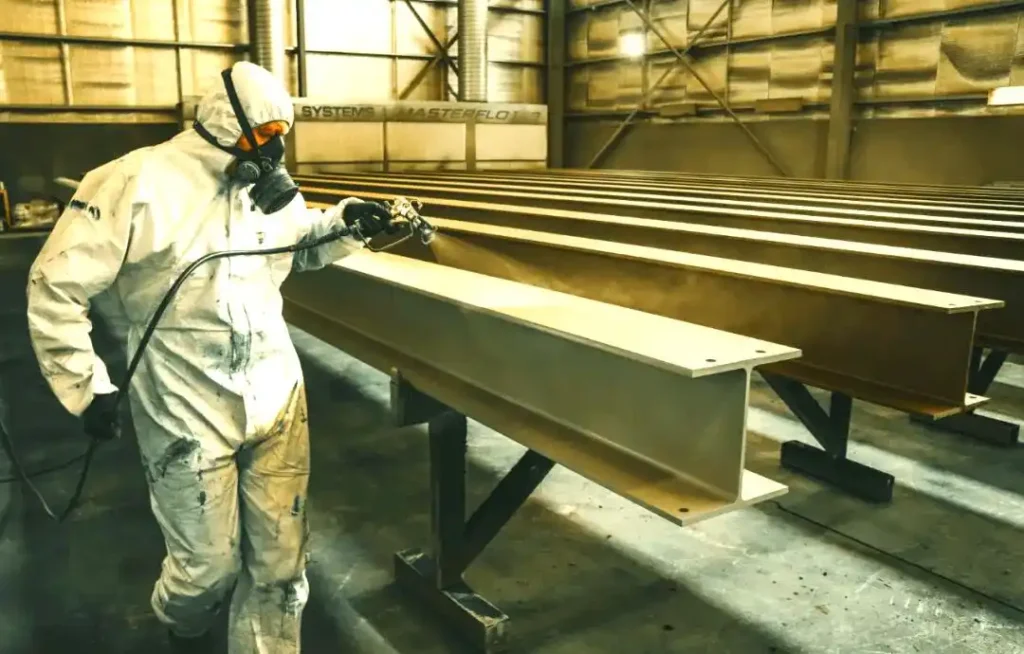
Corrosion Environments & Protective Coating Systems for Overhead Cranes
Overhead cranes operate in demanding industrial settings where steel structures are exposed to high temperatures, humidity, chemical fumes, and salt spray. Selecting the right coating system is the most effective way to extend service life and reduce total lifecycle cost. The following classification and coating recommendations follow ISO 12944-2 / GB/T 30790-2014.
1.1 ISO 12944 Corrosion Categories & Coating Specifications
ISO 12944 defines six atmospheric corrosivity categories—C1 through CX—ranging from “heated interiors” to “extreme industrial/marine splash zones,” covering typical crane operating conditions. Selection should factor in shop-floor temperature and humidity, corrosive gas concentration, dust type, and maintenance intervals.
| Corrosion Grade | Typical Environment | Recommended Coating / painting System | Total Dry Film Thickness | Design Life |
|---|---|---|---|---|
| C2(Low) | Indoor General Purpose Factory building, Occasional Condensation | Anti-rust Primer1Coat+Topcoat1Coat | 80-120μm | 3-5Years |
| C3(Medium) | General Industrial Factory building, Urban Atmosphere | Epoxy Primer1Coat+Polyurethane Topcoat1Coat | 120-160μm | 5-8Years |
| C4(High) | Steel Mill Hot Rolling/Chemical Plant, High Humidity+Corrosion Gaseous | Epoxy Zinc-Rich Primer+Epoxy Intermediate Coat+Polyurethane Topcoat | 200-280μm | 8-12Years |
| C5(Very High) | Coastal Port/Outdoor, Continuous Salt Spray Exposure | Thermal Sprayed Zinc(100μm)+Epoxy Sealer+Polyurethane Topcoat | 300-400μm | 15-20Years |
1.2 Key Coating Specifications for Critical Components
The crane main girder and end carriage are the primary load-bearing structures and must be prepared by sandblasting to Sa 2.5. The specified three-coat system consists of an epoxy zinc-rich primer (80 μm), an epoxy MIO intermediate coat (80 μm), and an acrylic polyurethane topcoat (60–80 μm), achieving a total dry film thickness of 220–240 μm. For the trolley frame, walkway, and guardrail, hot-dip galvanizing per ISO 1461 is an acceptable alternative, with a minimum coating thickness of 70 μm for outdoor exposure, providing 15–20 years of maintenance-free service life. High-strength bolt connection surfaces and conductor rail/busbar contact areas must remain free of any paint to ensure proper conductivity and clamping force.
Overhead Crane Noise Sources and Effective Noise Control
Excessive noise from an overhead crane not only affects operator health but also serves as an early indicator of component wear or misalignment. Per ISO 11201 noise limits for cranes, the sound level inside the operator cab should not exceed 80–85 dB(A), while the ground-level noise measured 1 m directly below the crane should stay within 85–95 dB(A). Identifying the root cause of each noise source is the first step toward an effective mitigation strategy.
2.1 Noise Source Identification and Spectrum Analysis
| Noise Source | Spectral Characteristics | Sound pressure level d B(A) | Proportion of Total | Mitigation Difficulty |
|---|---|---|---|---|
| Wheel-to-Crane Rail Friction | 200-2000Hz | 75-90 | 40% | |
| Reducer Gear Meshing | 500-4000Hz | 70-85 | 20% | |
| Motor Operation | 500-3000Hz | 65-80 | 15% | |
| Coupling Transmission | 500-2000Hz | 60-75 | 10% | |
| Brake Motion | 500-2000Hz | 70-85 | 10% | |
| hydraulic system | 50-500Hz | 60-75 | 5% |
Field data shows that wheel-to-rail friction is the largest noise contributor (accounting for 40% of the total), making it the most cost-effective area to address. Although reducer gear noise accounts for only 20%, its high-frequency components are the most perceptible to the human ear, making it the primary target for operator cab soundproofing.
2.2 Elastic Wheel Noise Reduction Solution
Elastic wheels are currently the most direct and cost-controllable proven solution for noise reduction. The design features a steel wheel core (∅400-700mm) with a polyurethane/rubber elastic ring (20-30mm thick) bonded to the outer circumference. The compression deformation of this ring cushions wheel-rail impact, reducing noise at the source by 3-5dB while also minimizing rail wear and protecting bearings. This solution is particularly well-suited for noise-sensitive indoor factory environments. However, note that the elastic ring is not high-temperature resistant (<80°C) and should not be used in steel mill hot zones or foundry shops. The elastic ring typically requires replacement every 1-2 years, with overall costs 30-50% higher than standard wheels.
2.3 Comparison of Comprehensive Noise Reduction Measures
Beyond elastic wheels, reducer noise can be addressed by replacing straight gears with spiral bevel gears (reducing noise by 5-8dB) combined with a soundproof enclosure (further reduction of 10-15dB). For the motor side, we recommend replacing two-speed motors with variable-frequency motors (3-5dB reduction) paired with a silenced cooling fan cover for enhanced performance. Grinding uneven rail joints can yield a 2-3dB reduction, while an operator cab with double-glazed windows and sealed acoustic insulation can achieve 20-30dB of interior noise reduction. The recommended combined approach can lower overall crane noise by 8-12dB.
Corrosion Protection and Noise Reduction: A Unified Design Approach
In engineering practice, corrosion protection and noise reduction are not isolated subsystems. For instance, when elastic wheels are selected, the wheel surface coating system must account for the durability of the area where the elastic ring is secured to the steel core. Similarly, a reducer soundproof enclosure serves the dual purpose of damping noise and shielding against corrosive gas attack. We recommend incorporating a joint corrosion-and-noise review during the project design phase rather than relying on retrofits later. If you encounter issues related to crane rail gnawing diagnosis or crane VFD speed control, please refer to the corresponding in-depth articles for detailed solutions.
Kelude Heavy Industry: Crane Corrosion Protection and Noise Control Solutions
Kelude Heavy Industry has specialized in crane manufacturing and retrofitting for over two decades. Based on ISO 12944 and GB/T 3766 standards, we deliver end-to-end technical solutions covering corrosion environment assessment, coating system design, noise source diagnosis, and elastic wheel selection. We provide customized C3 to C5 grade anti-corrosion coating systems and multi-condition noise reduction retrofits for clients in the steel, chemical, port, and power generation industries, helping them reduce equipment failure rates by over 30% and annual maintenance costs by 40%. Contact us today for a tailored technical solution and project quotation.
Frequently Asked Questions
Q: How should the anti-corrosion coating system for overhead crane steel structures be selected?
A: For outdoor cranes, we recommend an epoxy zinc-rich primer + epoxy MIO intermediate coat + acrylic polyurethane topcoat system with a total dry film thickness of ≥240μm. For indoor cranes, an epoxy primer + polyurethane topcoat is typically sufficient. In coastal or corrosive environments, increase the coating thickness or opt for a high-durability system.
Q: What are the most effective noise reduction measures for overhead cranes?
A: Key measures include: elastic wheels to reduce wheel-rail noise (8-15dB reduction), grinding of rail joints, VFD speed control on the crane bridge to minimize start/stop impact, elastic isolation pads to block structural-borne sound, and installation of soundproof enclosures.
Q: Which standards apply to steel structure corrosion protection?
A: Surface preparation before coating follows GB/T 8923, coating quality is accepted per JB/T 5000.12, and outdoor corrosion protection service life references the ISO 12944 standard.
Related Reading: Crane Rail Gnawing: Diagnosis and Solutions | Crane VFD Speed Control: A Technical Guide
