

Overhead Crane Hoist Motor Burnout: 7 Causes & Temperature Limits
Quick Diagnostic Summary
Hoist motor overheating and burnout is one of the most frequent failure modes on industrial sites. Typical symptoms include motor housing temperatures exceeding 90°C, discolored insulation varnish, winding short circuits, and even smoke or fire. Root causes fall into seven categories: overload and overcurrent, abnormal power supply voltage, poor heat dissipation, brake drag, excessive inching/jogging, winding aging or moisture ingress, and bearing seizure. The three core preventive measures are: selecting the correct duty classification per ISO 4301 Crane Design Standard, regularly checking three-phase current balance (deviation not exceeding 10%), and controlling winding temperature rise (F-class insulation: max 105K).
7 Common Causes of Crane Hoist Motor Burnout and How to Diagnose Them
Crane hoist motor burnout is rarely caused by a single factor — it is typically the result of multiple abnormal operating conditions stacking up. Based on field maintenance statistics, the following seven causes account for over 90% of motor failure cases:
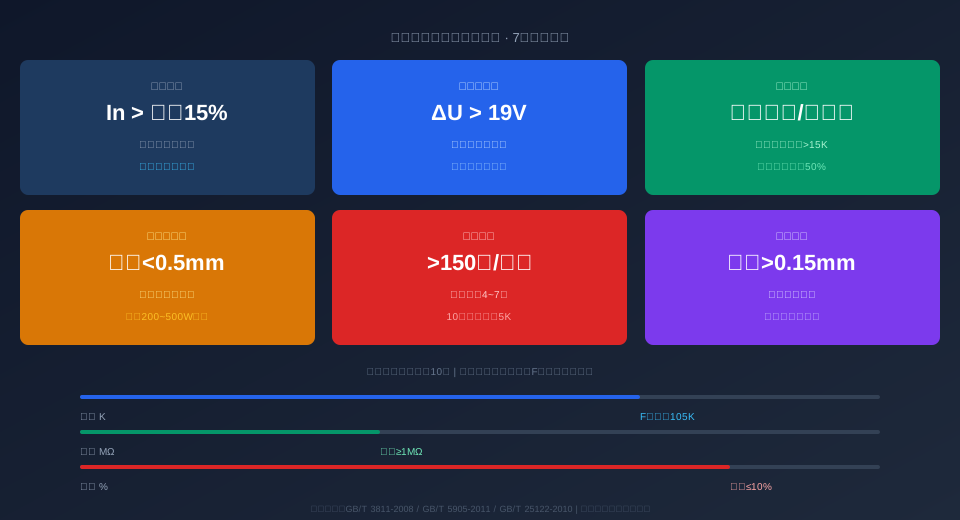
1. Overload and Overcurrent Burnout: When the lifting capacity exceeds the rated load or the duty classification is mismatched, the motor runs continuously at 1.2 to 1.5 times its rated current, driving winding temperature rise rapidly beyond insulation limits. Diagnosis: Measure three-phase current. If current consistently exceeds the nameplate rated current by 15% and returns to normal after load reduction, overload is confirmed.
2. Abnormal Power Supply Voltage: Three-phase voltage unbalance exceeding 5% generates negative-sequence current, causing severe rotor heating. Field data from a steel plant: when voltage unbalance increased from 2% to 8%, motor temperature rise jumped from 65K to 118K, ultimately burning out the windings. Diagnosis: Use a multimeter to measure three-phase line voltage. A deviation exceeding 19V between any two phases (on a 380V system) indicates a fault.
3. Blocked Cooling Airflow: Dust accumulation on the motor fan cover, broken fan blades, or ambient temperatures above 40°C can reduce heat dissipation capacity by 30% to 50%. Diagnosis: Scan the motor surface with a thermal imager. If local temperature differences exceed 15K and no airflow is felt at the fan outlet, cooling failure is confirmed.
4. Brake Drag or Seizure: Incorrect brake gap adjustment (standard: 0.5 to 1.5 mm) causes continuous friction between the brake pads and brake wheel, generating an additional 200 to 500W of heat. Diagnosis: After power-off, manually rotate the shaft. Noticeable resistance or a bluish discoloration on the brake wheel surface indicates brake drag.
5. Excessive Inching/Jogging: More than 150 inching operations per hour subjects the windings to repeated starting currents (4 to 7 times rated value), and accumulated heat cannot dissipate. Diagnosis: Track operating frequency and correlate with motor temperature rise curves (each 10 inching cycles adds approximately 3 to 5K).
6. Winding Aging and Moisture Ingress: F-class insulation has a theoretical service life of about 20,000 hours (at 155°C). In persistently humid environments (relative humidity above 90%), insulation resistance dropping below 0.5MΩ is a critical warning. Diagnosis: Measure winding-to-ground insulation with a 500V megohmmeter. Do not energize if resistance is below 1MΩ.
7. Bearing Seizure and Wear: Bearing clearance exceeding 0.15 mm or dried-out grease causes rotor-stator rub, generating massive frictional heat that can destroy windings within minutes. Diagnosis: Listen to bearing operation with a stethoscope. Periodic clicking or whining sounds are early warning signs.
Hoist motor selection should strictly follow the duty classification system in ISO 4301 Crane Design Standard, from A1 to A8: light duty (A1 to A3) calls for S3-25% duty motors; medium duty (A4 to A5) requires S3-40%; heavy duty and above (A6 to A8) mandates S1 continuous running or S4-40% brake motors. Incorrect selection is the root cause of motor burnout. Kelude's pre-sales engineering team offers free duty classification and motor matching consultations for customers.
Motor Winding Temperature Rise Limits and Insulation Class Standards
Winding temperature rise is the most direct indicator of how close a motor is to burnout. Per GB/T 25122-2010 Motors for Lifting Appliances and IEC 60034-1 (Rotating Electrical Machines — Temperature Rise Standards), the relationship between insulation class and allowable temperature rise for crane motors is as follows:
Class A (105°C): Allowable winding temperature rise of 60K (resistance method). Largely obsolete, found only in older equipment. Class E (120°C): Allowable rise of 75K, still used in some small electric hoists. Class B (130°C): Allowable rise of 80K, used for travel motors on standard-environment bridge cranes. Class F (155°C): Allowable rise of 105K — the current mainstream standard for hoisting motors and the factory default across Kelude's entire product line. Class H (180°C): Allowable rise of 125K, specified for cranes in high-temperature environments such as metallurgy and foundries.
Temperature rise measurement follows FEM 1.001 Crane Test Specification and Procedures: the resistance method offers the highest accuracy, deriving temperature rise from winding resistance change measured within 15 seconds of shutdown; the thermometer method is suitable for surface measurement but reads 10 to 15K lower; embedded temperature detector (ETD) sensors enable real-time monitoring but must be installed at the factory. Quick field reference: if you can hold the back of your hand against the motor housing for 5+ seconds, temperature rise is approximately 60K or less; if you cannot touch it, rise exceeds 80K; if you smell burning insulation varnish, the 105K critical threshold has been exceeded.
Kelude hoisting motors undergo factory testing with continuous lifting at 1.3 times rated load for 30 minutes; winding temperature rise must not exceed 85K (F-class insulation). Each motor ships with an individual temperature rise test report, ensuring ample thermal margin for field operation.
6 Critical Data Points for Crane Motor Burnout Protection
F-Class Insulation Limit
155°C
Maximum allowable winding temperature. Above this, insulation aging accelerates — every 10°C increase halves service life.
Allowable Winding Rise
105K
F-class allowable temperature rise (resistance method). At 40°C ambient, this corresponds to a measured winding temperature of 145°C.
Three-Phase Current Deviation
≤10%
If any phase deviates more than 10% from the average, shut down and investigate — typically indicates turn-to-turn short circuit or phase loss.
Minimum Insulation Resistance
≥1MΩ
Measured with a 500V megohmmeter between winding and ground. Below 1MΩ, do not energize — bake dry or rewind required.
Brake Gap Standard
0.5 to 1.5 mm
Standard clearance for cone rotor brakes. Excessive clearance causes braking failure; insufficient clearance leads to dragging, overheating, and motor burnout.
Bearing Clearance Limit
0.15 mm
Replace rolling bearings when radial clearance exceeds 0.15 mm; otherwise, rotor-to-stator contact can burn out the windings within minutes.
Crane Motor Insulation Classes: Parameter Comparison & Selection Guide
| Insulation Class | Temperature Resistancelimit | permissible temperature rise | Application Scenarios |
|---|---|---|---|
| Aclass | 105degree | 60K | obsolete, legacy equipment only |
| Eclass | 120degree | 75K | light-duty Electric Hoist, light-duty intermittent |
| Bclass | 130degree | 80K | Standardoverhead Travel Motor |
| Fclass | 155degree | 105K | mainstream Hoisting Motor, recommended Standard |
| Hclass | 180degree | 125K | metallurgical Casting High-Temperature Environment |
Crane Motor Burnout: 7 Fault Detection Methods & Standard Clause Reference
| fault type | Detectionmethod | diagnosis Standard |
|---|---|---|
| overload overcurrent | clamp metermeasure three-phase Current | Currentabove nameplate value15%and sustained |
| Voltageunbalance | multimetermeasure three-phase lines Voltage | Optionalphase-to-phase difference exceeding19V(380V) |
| poor heat dissipation | infraredthermal imagersurface scan | local temperature difference exceeding15Kor blocked air duct |
| Brakingdragging | de-energized Manualmanual rotation | resistance or Brake wheelbluing |
| frequent Inching / Jog Mode | count Inching / Jog Modecycles | phase-to-phase difference exceeding150times/hours derating required |
| insulation Aging | 500VMegohmmeter (Insulation Tester)insulation test | below1Mdo not energize |
| Bearingseizure | stethoscope and clearance check Detection | radial clearance exceeding0.15mmreplace |
5 Proven Preventive Measures Against Crane Hoisting Motor Burnout & Daily Inspection Checklist
Preventing motor burnout costs at least 10 times less than repairing one after failure. Replacing a burned-out 15kW hoisting motor costs roughly $890 to $1,190, plus downtime losses that can reach thousands of RMB per hour. Here are five field-validated preventive measures:
1. Establish a routine current monitoring program. Measure three-phase running current with a clamp meter at least once a week and log the readings. If current deviation exceeds 10%, stop the crane immediately and investigate. Kelude recommends smart ammeters with RS485 communication for remote real-time alarming.
2. Strictly follow the insulation resistance testing schedule. Per ISO 4301 Crane Design Standard, test winding-to-ground insulation resistance quarterly using a 500V megohmmeter. If readings fall below 2 MΩ, bake the winding dry; below 1 MΩ, rewind is required. During humid seasons (relative humidity above 85%), increase testing frequency to monthly.
3. Check and adjust brake clearance every 500 operating hours. Use a feeler gauge to maintain brake clearance between 0.5 and 1.5 mm. Replace brake pads when worn to less than 3 mm thickness. Also inspect brake wheel surface temperature — it should not exceed 70°C (158°F).
4. Relubricate bearings every 2,000 hours or 3 months with No. 2 lithium grease,000 hours or 3 months with No. 2 lithium grease. Add grease until fresh grease purges from the relief port — over-greasing causes bearing overheating. Listen for abnormal bearing noise before each lubrication; replace immediately if any is detected.
5. Control inching frequency. For applications requiring frequent jogging, select an S4 duty-rated motor with a VFD for soft start, limiting starting current to twice the rated value. Kelude offers custom variable-frequency hoisting motors that cut starting current by 60%, fundamentally eliminating inching-related burnout.
Recommended Technical References for Crane Motor Fault Diagnosis
Related reading: ISO 4301 Crane Design Standard: 9 Load Combinations & Work Duty Selection from M1 to M8 — The foundation for motor selection; duty classification directly determines motor duty type and thermal capacity requirements. Also refer to FEM 1.001 Crane Test Specification: 3 Load Test Procedures & 6 Acceptance Criteria — Temperature rise testing methods for factory acceptance and periodic inspection, ensuring thermal safety throughout the motor's service life. Additionally, see Brake for Electric Hoist Standard Interpretation (JB/T 10227) — Brake drag is a major cause of motor overheating; understanding brake standards helps systematically troubleshoot failures. Also recommended: Crane Hoisting Motor Overheating & Burnout Troubleshooting: 7 Failure Causes, Temperature Rise Limits & Protection Solutions — An in-depth look at the same topic with more field case studies and electrical diagnostic methods.
4 Common Questions About Crane Motor Overheating & Burnout — Expert Answers
Q: How significant is the practical difference between Class F and Class H insulation in crane motors?
A: Class F insulation (155°C) and Class H insulation (180°C) differ by 25°C in thermal margin — a difference that translates to 8–10 additional years of service life in metallurgical crane applications. Using a foundry with 55°C ambient temperature as an example: the allowable winding temperature rise for a Class F motor is 155 − 55 = 100 K, while Class H allows 180 − 55 = 125 K — a 25% greater thermal capacity. However, Class H motors cost 40–60% more, so they are only recommended when ambient temperature consistently exceeds 40°C or when load factor exceeds 80%. For typical industrial environments, Kelude's standard Class F motors meet full lifecycle requirements.
Q: What duty cycle requirements does ISO 4301 impose on hoisting motors?
A: ISO 4301 specifies that the duty cycle (ED%) of hoisting mechanism motors must be selected based on work duty classification: M3–M4 → ED = 15%, M5–M6 → ED = 25%, M7 → ED = 40%, M8 → ED = 60%, and M9–M10 → ED = 100% (S1 continuous duty). Selecting too low an ED% leads to frequent overheating and burnout. A simple field check: measure cumulative motor energized time over a 10-minute window. If the motor runs more than 4 minutes (ED = 40%) and surface temperature exceeds 85°C, the ED% rating is undersized and requires an upgrade.
Q: If a crane motor smells like burning but still rotates, should it be shut down immediately?
A: A burning odor means the winding insulation varnish has begun thermal decomposition (Class F varnish degrades above 160°C, producing a burnt smell). The motor must be shut down and de-energized immediately — do not continue operating. Even if the motor still turns, carbonized insulation is irreversibly damaged, and continued operation will lead to turn-to-turn short circuit and burnout within hours. Correct procedure: 1) Shut down and disconnect power immediately; 2) After natural cooling, measure insulation resistance with a 500V megohmmeter; 3) If resistance is ≥ 2 MΩ, dry the winding and resume monitoring; if below 1 MΩ, rewind is required; 4) Identify and rectify the root cause of overheating.
Q: What happens if a standard Y-series motor replaces a dedicated crane motor?
A: This substitution is strictly prohibited. Key differences between dedicated crane motors (YZR/YZP series) and standard Y-series motors: 1) Crane motors are designed for ED = 25–100% duty cycles; Y-series motors are rated for S1 continuous duty but cannot withstand frequent starts; 2) Crane motors offer 2.5–3.2× overload capacity versus 1.8–2.0× for Y-series; 3) Crane motors have optimized rotor inertia for high starting torque, while Y-series starting torque is significantly lower; 4) Crane motors feature reinforced insulation for moisture and vibration resistance. A Y-series replacement will inevitably burn out within 1–3 months and voids warranty coverage due to non-specification use. Kelude crane motors come standard with YZP variable-frequency dedicated crane motor construction.
