

GB/T 5905 Crane Load Testing: 3 Procedures & 6 Criteria
GB/T 5905-2011, "Cranes — Test Code and Procedures," is the core testing standard for the crane industry, equivalent to ISO 10245:2008. It applies to all six crane categories: bridge, gantry, tower, mobile, railway, and floating cranes. The standard specifies complete procedures for three types of load tests — static load test (1.25 × rated load, held for 10 minutes), dynamic load test (1.1 × rated load, continuous operation over full travel), and stability test — along with six quantitative acceptance criteria. Pre-test conditions include wind speed ≤ 8.3 m/s, ambient temperature between -20 °C and +40 °C, measuring instrument accuracy ≤ ±1% FS, and calibration validity ≤ 12 months. This article provides a clause-by-clause breakdown of the test procedures, parameter requirements, and acceptance criteria.
Core standards referenced in this article include GB/T 3811-2008 "Crane Design Standard" (governing load combinations and work duty classification) and GB/T 28264-2012 "Safety Monitoring and Management System for Lifting Appliances" (defining monitoring parameters during testing). Together with GB/T 5905, these three standards form a complete technical loop of "design — testing — monitoring." Additionally, mandatory requirements for supervision inspection and periodic inspection under TSG 51-2023 Crane Safety Technical Supervision Regulation must be observed.
GB/T 5905 Scope and Classification of the Three Test Types
GB/T 5905-2011 applies to testing of all crane types, including bridge cranes, gantry cranes, tower cranes, mobile cranes, railway cranes, floating cranes, and various cantilever cranes. The standard classifies testing into three categories: type tests (for new products or when production is transferred to a new facility), routine tests (for every unit before leaving the factory), and in-service tests (after installation, major repair, or at periodic inspection intervals).
Each test category has a distinct focus: type tests are the most comprehensive, covering static load, dynamic load, stability, and verification of all safety devices; routine tests emphasize functional verification and basic performance checks; in-service tests adjust load coefficients based on the equipment's service condition. Kelude Heavy Industry performs 1.25 × static load and 1.1 × dynamic load tests on every bridge and gantry crane it produces, in accordance with GB/T 5905.
The standard also defines five specific test occasions:
① First unit of a new model or when production is transferred to a new facility (type test)
② Every unit before delivery from the factory (routine test)
③ Before first use after new installation or relocation to a new site (post-installation test)
④ Before first use after major repair or retrofit (post-repair test)
⑤ When the periodic inspection interval is reached (periodic inspection test, every 2 years per TSG 51-2023)
Static Load Test Procedure: 1.25 × Rated Load Held for 10 Minutes
The static load test is the core verification of the crane's metal structure load-bearing capacity and stiffness. Per GB/T 5905, the static test load is 1.25 × rated lifting capacity (excluding the lifting spreader's dead weight). The load is slowly lifted to a height of 100 mm–200 mm above the ground and held suspended for no less than 10 minutes, during which structural deformation and weld seam condition are observed.
Three hard acceptance criteria apply:
First, after unloading, primary load-bearing members must show no permanent deformation. Camber at mid-span of the main girder is measured with a theodolite or total station; the change before and after unloading must be ≤ 2 mm.
Second, visual inspection of weld seams and connections must show no cracks; magnetic particle inspection (MPI) or penetrant testing (PT) is used as a supplement when necessary.
Third, no abnormal sounds or structural movement during the suspended-load period.
For bridge cranes, the static load test also requires measuring elastic deflection of the main girder. GB/T 3811-2008 specifies that under rated load, mid-span deflection of the main girder shall be ≤ L/800 (L = span), and no plastic deformation shall occur under 1.25 × static load. Kelude Heavy Industry uses both laser distance sensors and dial indicators for redundant measurement to ensure data accuracy.
Dynamic Load Test Procedure: 1.1 × Load with Repeated Full-Travel Operation
The dynamic load test uses 1.1 × rated lifting capacity to verify the operational reliability of all mechanisms (hoisting, long travel, cross travel, slewing, luffing, etc.) and their brakes under dynamic load rating. The test requires repeated hoisting, lowering, and travel over the full range of motion, with each action repeated no fewer than 3 times and combined mechanism operations no fewer than 2 times.
Acceptance for the dynamic load test focuses on three areas:
First, braking distance must meet design requirements. When the load is suspended, the drop must be ≤ 80 mm for the hoisting mechanism, or ≤ the distance corresponding to 1% of rated travel speed for travel mechanisms.
Second, all limit switches and interlock protection devices must operate accurately and reliably. The lifting height limit switch must trigger when the hook is at a distance from the drum of ≥ 3 × wire rope diameter.
Third, temperature rise of the motor and reducer must not exceed the manufacturer's specified values.
Kelude Heavy Industry adds comparative testing of no-load full travel and rated-load full travel during dynamic load tests. Torque sensors monitor the hoisting motor current curve in real time; any abnormal fluctuation immediately halts the test for investigation. Test data is simultaneously uploaded to the GB/T 28264 Safety Monitoring System black box.
Pre-Test Conditions and Six Measuring Instrument Requirements
GB/T 5905 imposes strict environmental conditions for testing: on-site wind speed must not exceed 8.3 m/s (approximately force 5 on the Beaufort scale, equivalent to 30 km/h), ambient temperature must be between -20 °C and +40 °C, and the test site foundation must be firm and level. All test loads must use metrologically certified standard weights or load cells verified with a force sensor, with load deviation ≤ ±1%.
For measuring instruments, the standard specifies six accuracy requirements:
① Load measuring device accuracy ≤ ±1% FS (full scale)
② Displacement measuring instrument accuracy ≤ ±0.1 mm (for structural deformation measurement)
③ Angle measuring instrument accuracy ≤ ±0.1° (for boom luffing angle measurement)
④ Rotational speed measuring instrument accuracy ≤ ±1 r/min
⑤ Current and voltage meters accuracy class ≤ 0.5
⑥ Timer accuracy ≤ ±0.1 s. Calibration certificates for all instruments must be valid for no more than 12 months.
Test wire ropes and lifting spreaders must also comply with GB/T 5972-2016: before testing, the number of broken wires within one rope lay length must not exceed 5% of the total wire count, rope diameter wear must not exceed 7% of nominal diameter, and there must be no kinking, flattening, or severe corrosion. Kelude Heavy Industry recommends MPI non-destructive testing of lifting spreaders before each test.
Six Acceptance Criteria and Test Report Preparation
Annex A of GB/T 5905 provides a complete test report template. The report must include at least the following:
Name, model, and key parameters of the crane under test
Test date and location
Environmental condition records
Description of test loads and test procedures
Raw measurement data records
Acceptance conclusions. Signed test reports must be archived for no less than 10 years.
Acceptance follows an "all-items-pass" rule — all six criteria must be met:
① Structural static load deformation — no plastic deformation under 1.25 × load; residual deformation after unloading ≤ 2 mm
② Dynamic load functional operation — all mechanisms operate normally under 1.1 × load; brakes are reliable
③ Safety device operation — limit switches, load moment limiters (LML), buffers, and all other devices pass functional verification
④ Electrical system insulation — insulation resistance of the main circuit ≥ 1 MΩ (measured with a 500 V megohmmeter)
⑤ Noise control — cabin noise ≤ 85 dB(A); external radiated noise limited by power classification
⑥ Sealing and leakage — no hydraulic system leakage; no oil drip from reducer oil seals
Comparison Table: Three Test Types — Loads and Procedures
| Test Type | Test Load | Duration/Cycles |
|---|---|---|
| Static load test | 1.25×Rated Lifting Capacity | ≥10Minute Suspension Hold |
| Dynamic Load Test | 1.1×Rated Lifting Capacity | Individual Motions≥3Times, Combined≥2Times |
| stability test | 1.25×Rated Lifting Capacity | Slow Loading under Most Adverse Conditions |
| Type Test | Static1.25+Dynamic1.1Times (Multiplier) | Full Scope+Safety Device Verification |
| Factory Test | Static1.25+Dynamic1.1Times (Multiplier) | Basic Performance+No-Load Function |
| periodic inspection | rated load | Per TSG (Special Equipment Safety Technical Regulation) 51 Safety Technical Specification for Special Equipment-2023 Crane Safety Technical Supervision Regulation Execute |
GB/T 5905 vs. Related Standards: Clause-by-Clause Comparison
| Standard No.. | Clause Scope | Related Content |
|---|---|---|
| GB/T 3811 Crane Design Standard-2008 | Section6Chapter Load And Load combination | Provide Test Load Coefficient Design Basis |
| TSG (Special Equipment Safety Technical Regulation) 51 Safety Technical Specification for Special Equipment-2023 Crane Safety Technical Supervision Regulation | Section4Chapter Supervision Inspection | Stipulated for New Installationcrane Mandatory Inspection Items |
| GB/T 28264 Safety Monitoring and Management System-2012 | Section5Chapter Monitoring Parameter | Test Process Data Acquisition and Recording Requirements |
| GB/T 5972-2016 | Section3Chapter Inspectionand Retirement | Test Before and After Wire Rope Inspection Standard |
| ISO 10245:2008 | Textually Equivalent | GB/T 5905International Standard Source Model |
| FEM (Fédération Européenne de la Manutention) 1.001 | Section8Volume Test | Europeancrane Test Equivalence Rules |
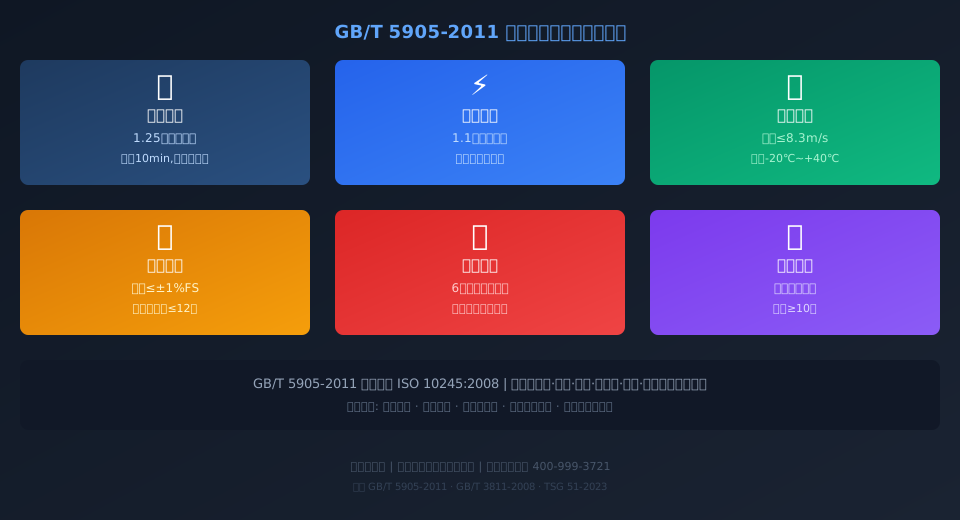
GB/T 5905 Load Test Key Data at a Glance
1.25×
Static Load Test Factor
Multiple of rated lifting capacity
Sustained for ≥10 min
1.1×
Dynamic Load Test Factor
Multiple of rated lifting capacity
Repeated cycles ≥3 times
≤8.3m/s
Maximum Wind Speed
Approx. Beaufort force 5
30 km/h
≤±1%FS
Load Measurement Accuracy
Accuracy class of measuring device
Incl. sensor + digital display
≤L/800
Main Girder Deflection
Elastic deformation at rated load
Limit for bridge cranes
≥10 years
Report Retention Period
After test report sign-off
Incl. raw data records
Related Reading
If you're selecting or maintaining a crane, the following articles may be helpful:
- GB/T 3811 Crane Design Standard: 9 Load Combinations and A1~A8 Duty Classification Selection Guide
- GB/T 32071 Buffer Standard Explained: 6 Types, Selection Parameters, 4 Test Methods, and 3-Level Energy Calculation
- GB/T 28264 Safety Monitoring and Management System for Lifting Appliances: 7 Functional Modules and 4-Level Architecture
- JB/T 10227 Brake for Electric Hoist — Standard Interpretation
Frequently Asked Questions
Q: What are the load factor requirements for static and dynamic load tests under GB/T 5905?
A: The static load test applies 1.25 times the rated lifting capacity and holds the load suspended for at least 10 minutes to verify the structural strength and stiffness of the metal framework. The test passes only if no permanent deformation remains after unloading. The dynamic load test applies 1.1 times the rated lifting capacity, with each mechanism cycled at least 3 times over its full travel range to verify functional performance and brake reliability. Static testing focuses on structural integrity, while dynamic testing verifies operational reliability — neither can substitute for the other. Both tests must be passed during factory acceptance.
Q: What load test factors does TSG 51-2023 specify for cranes after installation?
A: Clause 4.3.2 of TSG 51-2023 Crane Safety Technical Supervision Regulation requires that newly installed cranes undergo a Rated Load Test (100% SWL) during supervisory inspection. Static load testing is performed at 1.25 times the rated lifting capacity, and dynamic load testing at 1.1 times, referencing GB/T 5905-2011. Additionally, TSG 51-2023 introduces a No-Load Test requirement: the crane bridge must travel the full length at least 2 times in each direction, the trolley must traverse its full range at least 2 times, and the hoist must complete at least 2 full up-and-down cycles.
Q: How much does a full-load test cost for a newly installed 10-ton overhead crane?
A: The load test for a 10-ton overhead crane typically costs between $450 and $1,200. This includes test weight rental (a 12.5-ton standard weight runs about $300–$600 per day), technician labor (2–3 people × 1 day), measuring instrument usage, and preparation of the formal test report. If a supervisory inspection report from the Special Equipment Inspection Institute is required, add roughly $300 in inspection fees. Kelude Heavy Industry offers a one-stop "factory + installation" testing service, delivering all documentation required for TSG 51-2023 supervisory inspection alongside the test data.
Q: Why does periodic crane inspection require a 1.25× static load test instead of 1.1×?
A: The 1.25× static load test is based on the safety factor design principles of GB/T 3811-2008: the design safety factor for crane steel structures is typically 1.33–1.5 (based on material yield strength). A 1.25× load test verifies that actual load-bearing capacity reaches at least 75% of the design margin. A 1.1× load only covers the dynamic impact allowance encountered in normal operation and cannot reveal structural fatigue damage or hidden cracks. That's why even during periodic inspections, the standard maintains the 1.25× static load as the acceptance threshold.
As a specialized manufacturer of electric hoists and bridge/gantry cranes in China, Kelude Heavy Industry strictly performs 1.25× static load tests and 1.1× dynamic load tests on every product before shipment, in accordance with GB/T 5905-2011. All test data is recorded throughout by the GB/T 28264 Safety Monitoring System. Kelude Heavy Industry operates a CNAS-accredited testing and inspection center equipped with laser distance sensors, digital strain gauges, torque sensors, and a full range of measuring instruments with accuracy of ≤±1% FS. We provide complete test reports that meet TSG 51-2023 supervisory inspection requirements. For any lifting appliance testing or inspection needs, feel free to contact Kelude Heavy Industry for technical support.
