

AI in Semi-Automatic Workshops: Human-Machine Collaboration
📋 Key Summary
The reality of a semi-automatic workshop is not AI replacing crane operators, but AI taking over the tasks it does best: anti-sway control, precise positioning, and safety monitoring—the "steady, accurate, watchful" work. On-the-spot judgment and safety decisions remain with the operator. This article breaks down which tasks AI should take on, where the handover boundaries lie, and how to roll out the deployment step by step—while highlighting the most common human-machine collaboration mistakes.
Before deciding whether to add AI assistance to a semi-automatic workshop, it's worth thinking through a few questions:
① Which task wears operators out the most and is most prone to error?
② Where should the boundary be drawn for AI to take over a task safely?
③ Should AI start as an assistant, or go straight to full control?
④ What tasks should never be handed over to AI?
The answers to these questions determine how human-machine collaboration should be set up. Let's break them down one by one.
Prerequisites for Human-Machine Collaboration: Which Tasks Fit AI
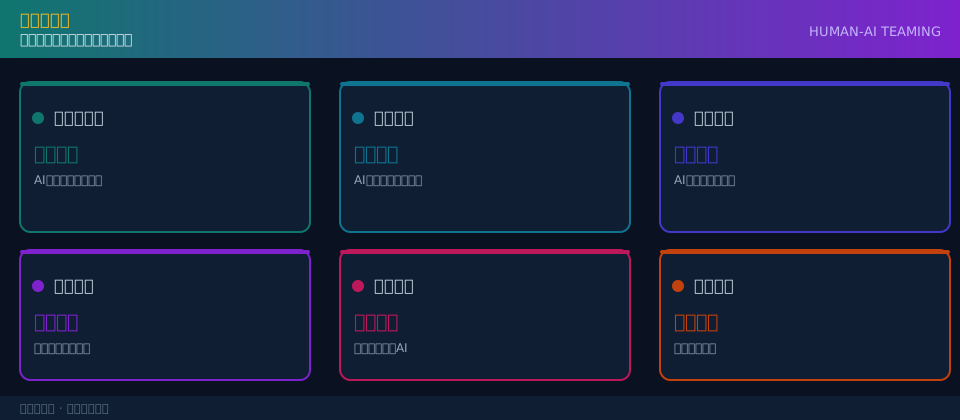
The first step in human-machine collaboration is to break down the operator's job and see which tasks AI can do better. The judgment criteria are simple: AI excels at "steady, accurate, watchful" work, while humans excel at "seeing, thinking, deciding."
Three tasks are well suited for AI. The first is anti-sway control, which keeps the load from swinging and allows lowering the hook to land in one go. This requires high-frequency, fine-grained control that's difficult to achieve by feel alone—AI handles it reliably using VFDs and sensors.
The second is precise positioning. For repetitive alignment tasks, AI using encoders and laser positioning can achieve accuracy of ±2 to 5 mm, which is more accurate and less labor-intensive than repeated visual checks by an operator.
The third is safety monitoring. Watching for personnel entering the lifting path or other abnormal conditions can cause fatigue and distraction in humans. AI using vision and radar provides round-the-clock monitoring with greater reliability. GB/T 28264-2017 Safety Monitoring and Management System for Lifting Appliances sets requirements for monitoring and traceability. In Kelude's solutions, these three "steady-accurate-watchful" tasks are assigned to AI assistance by default.
Setting Parameters for AI Handover: Defining the Boundaries
AI taking over doesn't mean AI has the final say—boundaries must be clearly defined. The core principle: AI handles the "steady, accurate, watchful" work, while humans handle "judgment and decision-making."
For anti-sway control and precise positioning, AI performs fine-grained control at the execution level. The boundary is drawn at "how to move," with ISO 24617 Intelligent Control System for Cranes providing the intelligent control framework. Decisions about what to lift, where to lift it, and whether it's safe to lift—the "what to do" judgments—remain with the operator.
For safety monitoring, AI detects and alerts. The boundary is drawn at "notification." Whether to stop the crane and how to respond are safety decisions made by the operator or per safety regulations. AI only provides information.
Scenarios requiring on-the-spot judgment—irregular loads, complex operating conditions, or sudden anomalies—are beyond AI's experience and must stay with the operator. With clear boundaries, human-machine collaboration won't devolve into "AI running wild" or "operators checking out."
Step-by-Step Process for Deploying Human-Machine Collaboration
Human-machine collaboration can't start with AI taking full control. It needs to be rolled out in stages.
Step one: AI starts in an assistive role only. Anti-sway, positioning, and monitoring are introduced as "assistive prompts." The operator retains full control, and AI simply makes the job easier.
Step two: Validate AI reliability. Data is accumulated in assistive mode to verify that AI's anti-sway, positioning, and alarm functions are stable and reliable, and that the operator builds trust in AI.
Step three: Gradual handover. Tasks that the operator has validated as genuinely more efficient are progressively switched to AI automatic execution, with the operator moving to a supervisory role. Kelude follows this three-step approach—assist, validate, hand over—so that operators and AI build trust through working together, rather than through an abrupt role change.
The Most Common Human-Machine Collaboration Mistakes
Mistake one: letting AI handle on-the-spot judgment. Tasks involving irregular loads or complex operating conditions require experience and judgment that AI models can't cover. Forcing AI to take these over can lead to accidents. These tasks must remain with the operator.
Mistake two: skipping the assistive phase and jumping straight to full control. If the operator hasn't built trust in AI, a single AI error will cause them to abandon it immediately, and the collaboration falls apart. Gradual handover is a prerequisite for building trust.
Mistake three: operators completely letting go once AI takes over. Human-machine collaboration is about division of labor, not replacement. Moving to a supervisory role doesn't mean stopping oversight—anomalies and emergencies still require human intervention. Kelude's solutions clearly define the operator's supervisory responsibilities to prevent "AI takes over, human checks out."
Human-Machine Collaboration: Task Division at a Glance
| Stage | AICapability | Operator Responsibility | Boundary Definition | Handover Mode |
|---|---|---|---|---|
| Anti-Sway Control | Fine Anti-Sway Control | DecisionLifting and transportRoute | AILoad Movement Control | Assisted Handover |
| Precise Positioning | Repeatable Precise Positioning | Landing Point Assessment | AILoad Alignment | Assisted Handover |
| safety monitoring | Continuous Monitoring | Abnormal Shutdown Handling | AIDetection and Alert | Assist-Only (No Takeover) |
| On-the-Spot Judgment | Not Applicable | Full Authority | Operator Keeps Control | Assist-Only (No Takeover) |
Acceptance Standard Checklist for Human-Machine Collaboration Deployment
| AcceptanceItem | standard basis | Key Criteria | CommonDefect |
|---|---|---|---|
| Assist Mode | Contractual Agreement | AIAssist Operator Full Authority | Direct Takeover (Skip Assist) |
| Takeover Boundary | Contractual Agreement | Stable, Accurate, Monitored HandoverAI | Judgment Delegated On-SiteAI |
| Safety Decision | TSG (Special Equipment Safety Technical Regulation) 51 Safety Technical Specification for Special Equipment-2023 Crane Safety Technical Supervision Regulation | Human Decision Authority | AIautomatic shutdownSafety Decision |
| Operator Supervision | Contractual Agreement | Supervision Withdrawn, Monitoring Continues | AIReceiver Releases Control |
Human-Machine Collaboration: Frequently Asked Questions
Q: What standards apply to human-machine collaboration?
A: For intelligent control, refer to ISO 24617; for safety monitoring and traceability, GB/T 28264 Safety Monitoring and Management System (GB/T 28264-2017); and for safety interlock inspection requirements, TSG 51 Safety Technical Specification for Special Equipment (TSG 51-2023). These standards define the boundaries of AI assistance, particularly keeping safety-critical decisions with the operator. There is no single mandatory standard for human-machine collaboration; in practice, the division of labor—"AI handles stability, precision, and monitoring; humans handle judgment and final calls"—guides implementation.
Q: With a limited budget, which task should AI take over first?
A: Start with anti-sway control—it is the most physically demanding task for operators, the hardest to do well manually, and where AI delivers the most immediate return on investment. Next, implement precise positioning to eliminate the time and effort spent on repetitive load alignment. Safety monitoring comes third, as it improves safety rather than productivity. The recommended sequence is anti-sway first, positioning second, and monitoring third, prioritized by the greatest pain points for operators.
Q: How do you determine which tasks are suitable for AI?
A: Evaluate the nature of the task: high-frequency, highly repetitive, and requiring continuous attention—such as anti-sway, positioning, and monitoring—are well suited for AI. Tasks that require experience-based judgment, on-the-spot adaptation, and safety accountability must remain with the operator, such as handling irregular loads, navigating complex operating conditions, and making safety decisions. The judgment criteria are simple: AI excels at "stability, precision, and monitoring," while humans excel at "assessment, reasoning, and decision-making." Draw the line accordingly.
Q: Why is AI assisting operators rather than replacing them?
A: Crane operations involve numerous tasks that require experience and real-time judgment—irregular loads, complex operating conditions, and unexpected anomalies. AI models cannot fully cover these scenarios, nor can they assume safety responsibility. In a semi-automatic workshop, the practical division of labor is for AI to take over the "stability, precision, and monitoring" tasks, allowing operators to focus on judgment and decision-making—not to replace the operator entirely. Human-machine collaboration is about optimizing the division of work, not eliminating jobs.
For the engineering implementation of AI-assisted anti-sway control, refer to the approach detailed in Overhead Crane Anti-Sway Control: Principles and Engineering Implementation—From Input Shaping to Adaptive Control Algorithms.
The key to human-machine collaboration lies in defining boundaries: AI manages stability, precision, and monitoring; humans manage judgment and final decisions. Kelude Heavy Industry advances in three steps—assist, verify, and take over—making AI a reliable partner to the operator, not a replacement for their expertise.
