GSO Certification Guide for Cranes Exporting to GCC Countries

Crane exports to the seven GCC states (Saudi Arabia, UAE, Qatar, Kuwait, Oman, Bahrain, Yemen) must pass inspection by a GSO ISO 17025-accredited laboratory and obtain a GCTS (GSO Conformity Tracking Symbol) certificate, costing $20,000–50,000. Saudi Arabia additionally requires SABER platform registration and proof of conformity to SASO 2484 / ISO 12480.

The six Gulf Cooperation Council (GCC) states are an emerging growth market for crane exports — Saudi Arabia's NEOM megacity, Qatar's post-World Cup infrastructure, and UAE port expansions are all driving sustained demand. However, the GCC certification landscape is entirely different from Europe or North America: the GSO (GCC Standardization Organization) has established unified Gulf Technical Regulations (GTR), with the GCTS mark enabling single-market access across all seven countries. Since 2020, GSO has made GCTS certification mandatory for all high-risk machinery (including cranes) sold in GCC markets.

One notable wrinkle: Saudi Arabia, the GCC's largest crane market, imposes an additional SABER online platform requirement on top of the GSO framework — importers must register their products on SABER, upload the GCTS certificate, technical files, and declaration of conformity, and obtain a Product Conformity Certificate (PCoC) and Shipment Conformity Certificate (SCoC) before customs will release goods. Companies unfamiliar with the SABER process frequently find themselves stuck in the frustrating situation of having secured the GCTS certificate only to have their shipment detained at Dammam port.

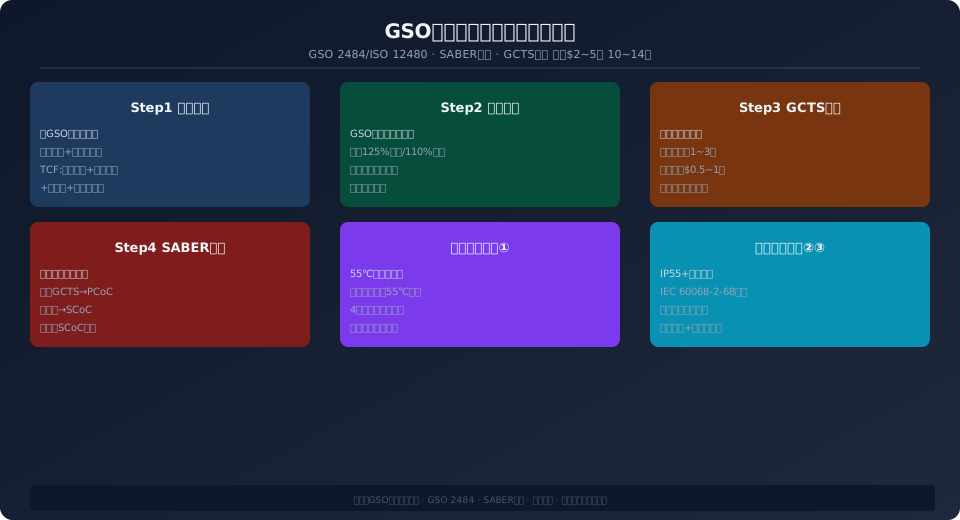
GSO certification process overview

GCTS Certificate Cost
$20,000–50,000
SABER Registration
$500–1,000
Notified Body
GSO-Accredited Lab
Standard
SASO 2484 / ISO 12480
Certificate Validity
1–3 Years
Mandatory Language
Arabic Nameplate

GSO Certification Framework and Standards Chain

The technical foundation of GSO crane certification is GSO 2484 "Cranes — Safety Requirements," which is based on ISO 12480-1 but adds Gulf-specific requirements:

Ambient temperature adaptability — Summer surface temperatures in the Gulf can reach 65–75°C, so overhead crane electrical cabinet cooling must be verified for a 55°C ambient temperature (more stringent than the ISO standard's 40°C);

Sand and dust protection — Electrical cabinets and motors must have a Protection Rating (IP) of at least IP55 (ISO standards typically require IP44–IP54), and air intakes must be fitted with replaceable sand filter screens;

Operation Manual must include an Arabic summary — Safety warnings and emergency operating procedures must be provided in Arabic at minimum. Additionally, Saudi Arabia's standards body SASO, as a GSO member, has a SASO 2484 standard that is fully equivalent to the GSO version.

These three differences may seem like minor technical tweaks, but in practice they are frequent causes of certification delays:

High-temperature adaptability — During midday hours in the Gulf, unprotected steel structures can reach surface temperatures above 85°C, while VFDs and PLCs typically have an upper working ambient temperature limit of 40–50°C. Even with forced air cooling on the electrical cabinet, if the intake air is 55°C, internal temperatures will still approach or exceed component limits. GSO certification therefore requires manufacturers to provide a verification report demonstrating that the electrical system operates normally for four hours at a 55°C ambient temperature — which typically requires setting up a simple heat-test enclosure at the factory.

Sand and dust protection — The Gulf region has an extremely fine "powder sand" (particle size below 0.05 mm) that can penetrate standard IP54 filter screens and enter the electrical cabinet. The GSO sand test requires an eight-hour continuous dust-blowing test using IEC-standard fine sand (0.05–0.15 mm particle size) — after the test, no visible dust accumulation is permitted inside the cabinet. This means not only upgrading the filter screen grade (G3 filtration efficiency recommended) but also adding sealant strips around the cabinet door seams.

Arabic documentation — Translating the safety sections of the Operation Manual is not a job for ordinary commercial translators, as Arabic terminology for lifting appliances varies in usage across different countries (Saudi Arabia, UAE, Oman). We recommend engaging an Arabic translator with hands-on experience in the crane industry within GCC countries to localize safety documentation, at a typical cost of RMB 600–800 per thousand words.

Auditors dispatched by GSO-accredited bodies typically come from recognized institutions in GSO member states—such as Saudi Arabia's SASO, the UAE's ESMA, or international bodies with regional branches in the Gulf—and conduct audits in either English or Arabic. The focus of a factory audit is not on the "paper completeness" of the QA system, but rather on "faithful execution of design requirements throughout the manufacturing process." Auditors will visit the welding workshop to randomly inspect weld seam quality and welder certifications, check calibration label expiry dates on torque wrenches in the assembly workshop, and witness the full-load test procedure of cranes at the test site. This hands-on, execution-focused audit style stands in sharp contrast to the documentation-heavy approach of CE audits. Additionally, GSO auditors place far greater emphasis on on-site safety—such as proper hard hat usage and certified overhead crane operators—than CE auditors do. A safety violation during the audit can result in an automatic failure of the entire assessment. Furthermore, once the GCTS certificate is uploaded to the SABER platform after certification, the importer must apply for a separate batch certificate (SCoC) for each shipment. This certificate is applied for online and issued instantly, but its details must strictly match the packing list and commercial invoice—any discrepancy, such as a typo in the equipment model or a quantity deviation, will result in customs rejection.

Certification Process Stage Requirement Fee Duration
Type Inspection GSOWitness Testing at Accredited Laboratory(Available in China) $1~20,000 2–3 weeks
Technical Documentation Review TCF+GSOGap Assessment $0.5~10,000 3–4 weeks
Factory Audit QASystem Audit(ISO 9001Waivable) $1~15,000 1~2On-site Days
SABERRegistration(Saudi Arabia) Importer to SABERPlatform Registration $500~1,000 1~2Week(Online)
Annual Surveillance Certificate Maintenance+Random Sampling Inspection $0.5~10,000/Year Annually1Times

GSO Certification Process and Notified Body Selection

GSO-recognized notified bodies fall into two categories:

Local bodies within GSO member states (e.g., SASO labs in Saudi Arabia, ESMA in the UAE) — Lower fees but slower communication, as auditors work only in Arabic and English;

International bodies with GCC branches (e.g., SGS Gulf, TÜV Middle East, BV Dubai) — Slightly higher fees but standardized service, more experience reviewing Chinese technical documentation, and the ability to arrange on-site inspections at factories in China.

The process consists of four steps:

Step 1 — Application and Document Review: Submit the application and GSO 2484 gap analysis form to the notified body, which then reviews the technical file (the TCF must include risk assessment, structural calculations, electrical schematic, welding procedure qualification record, and a draft Arabic nameplate);

Step 2 — Factory Type Inspection: The notified body conducts a type inspection at the factory (typically in China; travel expenses for auditors are covered by the manufacturer). Inspection items include: load test (125% rated lifting capacity static load + 110% dynamic load), safety device functional verification (hoisting limit switch, overload limiter, travel limit switch), electrical safety testing (insulation resistance ≥1MΩ / grounding continuity ≤0.1Ω), and noise testing (operator position ≤85dB(A));

Step 3 — Certification and SABER Registration: Upon passing the inspection, the GCTS certificate is issued, and the importer uploads it to the SABER platform to obtain the PCoC;

Step 4 — Batch Customs Clearance: Before each shipment, the importer applies for an SCoC (batch certificate) on SABER, submitting the packing list and commercial invoice for online issuance. Customs releases the goods upon presentation of the SCoC.


Arabic Nameplate and Documentation Requirements

GSO's Arabic language requirements for crane nameplates and documentation are often overlooked by Chinese manufacturers, leading to failed on-site inspections:

Equipment Nameplate — Must be bilingual (Arabic and English) and include: manufacturer name/address, model, serial number, lifting capacity, span, work duty/classification, year of manufacture, and GCTS certificate number;

Safety Warning Labels — All safety warnings (e.g., "No standing under suspended load," "Operation by unauthorized personnel prohibited") must be in Arabic;

User Manual — The full text may be in English, but the table of contents, safety operation section, and emergency shutdown procedures must be bilingual in Arabic. Hiring a professional translator to render the 20–30 pages of safety content into Arabic costs approximately ¥3,000–5,000 — far less than the cost of rework and delays caused by non-compliant nameplates.

Another frequently asked question about GSO certification is whether a full "Halal certification" or "special cultural adaptability" review is required. The answer is that cranes, as industrial equipment, do not require Halal certification. However, there are two non-technical compliance points that are equally important:

Operation Panel Symbol Review — The crane's control station and remote control must not use any symbols or patterns associated with Islamic cultural taboos (such as crosses or hexagrams — this is particularly relevant when designing the Emergency Stop Button icon on the operation panel, as some common emergency stop symbols used by European manufacturers may contain sensitive cross-like graphics);

Packaging and Documentation Compliance — Packaging and shipping documents must not contain any religious or political printed materials (this has occasionally led to customs seizures for goods exported to the Middle East). These two seemingly minor details are, in fact, common non-technical obstacles that Chinese companies encounter during customs clearance in the Middle East.


Frequently Asked Questions

Q: Why does the cost of GSO certification vary so widely ($2–50,000)?

A: The cost depends on three variables: ①Notified body tier — international bodies (SGS/TÜV) charge 30%–50% more; ②Product complexity — a standard single-girder overhead crane costs $20,000–30,000, while an advanced crane with anti-sway, remote control, or multi-crane linkage features costs $40,000–50,000 (due to more extensive review); ③Whether GSO gap testing is required — if the original design did not account for 55°C ambient temperature, IP55 protection rating, and Arabic documentation, remediation costs range from $5,000–15,000. For example, a 32t European Standard double-girder crane designed with GSO 2484 environmental adaptability in mind from the outset can keep total GSO certification costs within $20,000–25,000.

Q: What are the different certification requirements for cranes in the UAE vs. Saudi Arabia?

A: Under the unified GSO framework, the GCTS certificate is valid across all seven GCC states. However, Saudi Arabia adds a SABER platform registration step (an online process), while the UAE requires an additional "national traceability code" registration with ESMA (Emirates Authority for Standardization and Metrology) — essentially filing the GCTS certificate in the ESMA database. The UAE also requires a post-installation on-site safety acceptance inspection by a Municipality engineer. Qatar and Oman currently have the simplest process: the GCTS certificate covers both customs clearance and commissioning, with no additional local registration requirements. Recommended approach: obtain the GCTS certificate first, then address each country's additional requirements individually, rather than trying to satisfy all at once.

Q: What are the key technical differences between GSO 2484 and ISO 12480 that matter?

A: Key differences: ①Ambient temperature — GSO requires a design reference temperature of 55°C for electrical systems (ISO uses 40°C), so the frequency inverter (VFD) and PLC must be derated accordingly; ②Sand and dust testing — the electrical cabinet must pass the IEC 60068-2-68 sand and dust test (not required by ISO), and the intake filter screen must achieve G2 filtration efficiency; ③Hoisting mechanism brake — GSO requires a dual brake (two independent braking systems), while ISO only requires "one brake acting directly on the drum"; ④Emergency stop — GSO requires at least two Emergency Stop Buttons on the crane (one at the control station and one at a visible ground-level position), whereas ISO requires only one. Addressing these four differences during the design phase eliminates the need for costly retrofits later.

Q: Can I use my existing CE certificate for GCC exports?

A: No. GCC does not accept CE marking as equivalent. However, cranes already certified to CE do have a head start: ① Approximately 70% of the content in the Technical Construction File (TCF) can be reused directly—risk assessment structure, electrical schematics, hydraulic diagrams, and welding documentation; ② A factory QA system that has passed CE certification typically meets ISO 9001 requirements, which can reduce GSO factory audit workload by roughly 50%; ③ Core technical indicators—lifting capacity, speed, work duty classification, and protection rating (IP)—align with CE requirements, so only the GSO-specific gaps need to be addressed. In practice, a "CE-to-GSO" conversion saves about 40% in cost and 50% in lead time compared to starting GSO certification from scratch.


Looking at the global landscape for crane export certification, Chinese manufacturers are sitting in a rare strategic window. On one hand, infrastructure demand across Belt and Road Initiative countries continues to grow, and recognition of Chinese cranes for their cost-effectiveness has risen steadily year over year. On the other hand, established European and American crane manufacturers are losing their responsiveness advantage in emerging markets, weighed down by rising certification costs and extended delivery lead times. The companies that move first to build a multi-market certification portfolio—a true "certification matrix" spanning major economies—will secure the compliance-moat advantage in global crane competition for the next decade. What it takes to get there goes beyond technical capability and capital investment; more critically, it demands clear strategic vision from the executive level and an unwavering commitment to push certification initiatives through.

Kelude specializes in the design and manufacture of European-standard heavy-duty cranes, with a product range covering 50t to 300t European Standard Double-Girder cranes. We strictly adhere to the ISO 4301 Crane Design Standard — Core Provisions as well as the FEM/DIN/EN international standard system, and have assisted numerous clients in preparing complete machine compliance documentation and technical files for CE, EAC, and GSO export certifications.

For export certification technical solutions or consultation, contact the Kelude engineering team at 13903802779.

Related News

contact

contact us

phone:
+86 13903802779

mail:3915269@qq.com

Working hours: Monday to Friday

Wechat
Wechat
SHARE
TOP