

Crane Wire Rope Discard Criteria: Broken Wire & Wear Limits
📋 The Standards Governing Wire Rope Inspection and Scrapping
ISO 4309, equivalent to ISO 4309, is the primary basis for scrapping decisions. It quantifies four categories of scrapping criteria — broken wires, wear, corrosion, and deformation — and serves as the core reference throughout this article.
GB/T 22414 specifies wire rope construction, lay, nominal diameter, and permissible deviation at the product level, providing the baseline for calculating diameter wear percentage.
TSG 51-2023 Crane Safety Technical Supervision Regulation places wire rope inspection within the mandatory framework of supervision inspection and periodic inspection. EN 17505:2021 provides non-destructive testing benchmarks under the European Standard system. For dual-standard projects, the applicable value system must be specified in the contract.
Which Standards Govern Wire Rope Inspection and Scrapping
On a port portal crane maintenance site, a veteran technician held a worn wire rope and said it could last another six months — yet the caliper showed the diameter had shrunk by 8%, past the 7% scrapping threshold without anyone noticing. Whether a wire rope should be scrapped is never a matter of feel. It comes down to a set of standards that narrow the decision layer by layer.
ISO 4309, equivalent to ISO 4309 Wire Rope Inspection Standard, is the primary basis for scrapping. It breaks scrapping criteria into four quantifiable categories — broken wires, wear, corrosion, and deformation. Meeting any one category is grounds for scrapping, not all four. The real difficulty is that some of the baselines for these four categories must be traced to upstream standards.
GB/T 22414 specifies wire rope construction, lay, nominal diameter, and permissible deviation at the upstream level. It answers where the "8%" in "diameter reduced by 8%" comes from — without a nominal diameter, wear percentage has no foundation, and every millimeter measured is meaningless.
TSG 51-2023 Crane Safety Technical Supervision Regulation places wire rope inspection within the mandatory framework of supervision inspection and periodic inspection. Failure to inspect on schedule or operating with defects carries regulatory consequences. When Kelude Heavy Industry ships a European-standard double-girder crane, it includes a verifiable wire rope inspection card listing all four scrapping limits, so that on-site decisions are well-founded.
Comparing Scrapping Limits Across Four Dimensions in mm and Percentages
Scrapping limits may appear scattered across different standards, but they can be organized around four dimensions of a single rope: number of broken wires, diameter wear, corrosion, and deformation. Converting each into directly measurable figures is what allows inspectors to put them into practice.
Broken wires are counted as "visible broken wires within one lay length," where one lay length equals approximately 6 times the rope diameter. ISO 4309 provides limits by wire rope construction and total number of load-bearing wires. The more complex the construction and the more load-bearing wires, the higher the permissible number of visible broken wires — but the logic is consistent: reaching the limit for that category means scrapping.
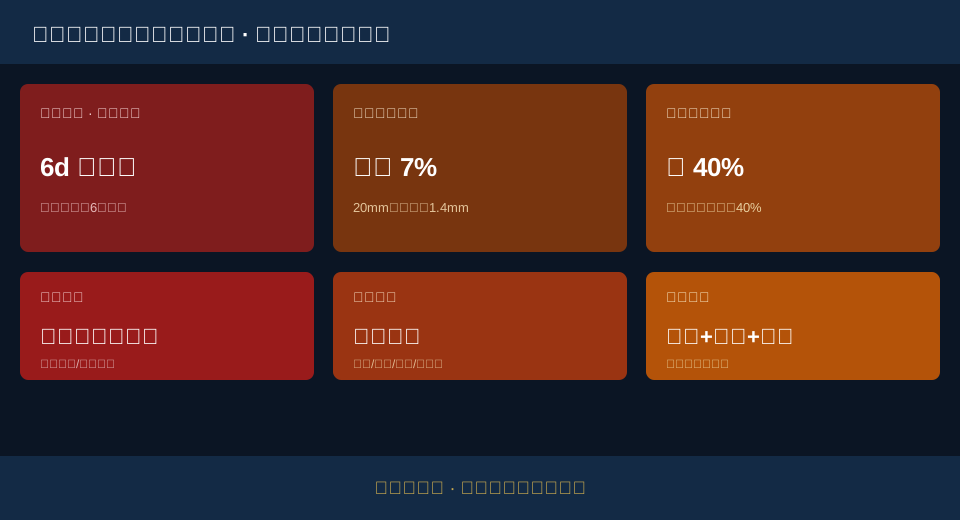
Diameter wear is the second red line. When wire rope diameter decreases by 7% or more relative to nominal diameter, the rope should be scrapped even without visible broken wires. When outer wire wear reaches 40% of original wire diameter, it is also grounds for scrapping. For a wire rope with a nominal diameter of 20 mm, a 7% reduction equals 1.4 mm; for a 50 mm rope, it equals 3.5 mm.
Corrosion is assessed by surface luster and internal corrosion. Obvious corrosion or loss of elasticity in the wires warrants scrapping. Deformation — kinks, waviness, cage distortion, strand extrusion, flattening — is grounds for immediate scrapping with no quantitative allowance. This holds in theory, but three practical factors undermine it on site:
① Inspecting only the exterior without checking the interior, leading to missed detection of internal corrosion and broken wires;
② Measuring diameter only at fixed positions, skipping the most worn sections;
③ Treating deformation as normal wear, missing the window for timely scrapping.
| Comparison Parameter | ISO 4309 | GB/T 22414 | EN 17505:2021 | TSG (Special Equipment Safety Technical Regulation) 51 Safety Technical Specification for Special Equipment-2023 Crane Safety Technical Supervision Regulation | FEM 1.001 Crane Design Standard-2008 |
|---|---|---|---|---|---|
| StandardNature | Discard Criteria(EquivalentISO 4309 Wire Rope Inspection Standard) | product standard | test method | safety supervisionProcedure | design specification |
| applicable subjects | In ServiceWire RopeDiscard | New Ropemanufacturing acceptance | In ServiceWire Rope Inspection | lifecycleInspection | selectiondesign |
| wire breakDiscard | lay lengthInternalNumber of broken wiresClassification | Not Applicable | Non-destructive testingInternalwire break | Includedperiodic inspection | Safety factorBack-Calculation |
| WearDiscard | Diameter reduction7% | Specified DiameterDeviation | Specified Diametertest method | IncludedInspectionItem | Not Directly Specified |
| CorrosionDiscard | ObviousCorrosion/Loss ofElasticity | Surfacequality requirements | corrosion detection | IncludedInspectionItem | Not Directly Specified |
| DeformationDiscard | kink/Waviness/flattening | Not Applicable | DeformationDetection | IncludedInspectionItem | Not Directly Specified |
| inspection interval | Periodic Based on Service Condition | Factory Acceptance Test | PerDetectionPlanned | periodic inspection | Not Applicable |
| scrappingImplementation | Any of the Four Categoriesmeet the standardi.e.scrapping | Not Applicable | ProvideDetectionEvidence | Mandatory Removal from Servicerectification | Not Applicable |
Wire Break Limits for Scrapping by Crane Duty Classification
Wire break limits are not a fixed number — they depend on both the wire rope construction and the crane's work duty. A 6×19 rope used in light-duty service and one used in heavy-duty service do not share the same scrapping threshold. The heavier the operating condition and the more frequent the cycles, the greater the safety margin that must be maintained.
The key to selecting the right threshold is to look up the equipment's work duty, wire rope construction, and rope diameter together in a single table — not to memorize a "universal value." Experienced engineers can make this judgment by feel, but standard requirements demand a verifiable, documented correspondence.
EN 17505:2021, Crane Wire Rope Test Methods provides a non-destructive testing approach under the European Standard (EN) system, complementing the visual counting method used in Chinese standards. Laboratory data and field data often differ by 20% to 35% — visual counting tends to miss internal wire breaks, while non-destructive testing can find them.
For custom projects, Kelude Heavy Industry works backward from the crane's actual work duty to determine the wire rope inspection interval and scrapping threshold, rather than defaulting to a generic value. This ensures that the safety margin for heavy-duty operating conditions is not eroded by rule-of-thumb assumptions.
| Conflict Scenario | StandardArequirements | StandardBrequirements | Recommended Engineering Practice |
|---|---|---|---|
| broken wire countingBaseline | Onelay length6dInternal Counting | Site Practice30dor Full-Rope Counting | Based on6das Discard Baseline,30dFor Trend Recording Only |
| Specified Diameterwear limit | Diameter reduction7%Discard | Outer LayerSteel wireWear40%Discard | Whichever Occurs First,Any of the Four Categoriesmeet the standardi.e.scrapping |
| inspection interval | InspectionProcedurerequirementsperiodic inspection | user unitIntend to Extend the Interval | according to working classFixed Interval,Stricter for Heavy Duty |
| Internalwire breakDetermination | National Standard Primarily Based on Visual Counting | EN 17505ProvideNon-destructive testing | High Riskoperating conditionSupplementary Magnetic Particle Testing, etc.Non-destructive testing |
| European Standard (EN)Coexistence with National Standard | National Standard Discard Limit | European Standard (EN)test method | DualStandardThe Contract Shall Specify the Value System for the Item |
Three Common Misconceptions About Wire Rope Discard Criteria: Why Broken Wires Alone Aren't Enough
The most common misjudgment on site is treating "are there broken wires?" as the sole criterion for "should this rope be discarded?" All three misconceptions stem from this one mistake.
The first misconception is checking only for broken wires while ignoring diameter wear. Many inspectors never bother measuring the 7% diameter reduction threshold because measuring diameter is more tedious than counting broken wires. But wear uniformly weakens the entire rope's load-bearing capacity—far more dangerous than localized wire breaks.
The second misconception is inspecting only the exterior without checking for internal corrosion and broken wires. Following textbook theory versus relying on field experience produces dramatically different results after three years—internal corrosion and internal wire breaks are invisible to the naked eye, and by the time they surface externally, it's often too late.
The third misconception is treating deformation as normal. Once kinking, waviness, or flattening appears, it means localized stress in the wire rope has far exceeded design limits. This isn't a matter of "it can still work for a while"—it's a matter of "the next lift could cause an accident."
What all three misconceptions share is substituting "it looks like it still works" for "standard requirements say it should be scrapped." Kelude Heavy Industry recommends making wire rope inspection a standardized procedure—with records, measuring tools, and dates—so every judgment can withstand retrospective review.
📋 Broken Wire Counting
Count within one lay length (6d); discard when tiered limit is reached
📋 Diameter Measurement
Measure twice perpendicular at the same point, average; 7% reduction = discard
📋 Corrosion Rating
Obvious corrosion or loss of elasticity = discard; internal corrosion requires detection
📋 Deformation Discard
Kink / waviness / flattening / core protrusion — discard on sight
📋 Inspection Records
Standardized checks with measuring tools, dates, and documentation
📋 Discard Closed Loop
Isolate and destroy discarded wire rope to prevent accidental reuse
📖 Related reading: How to Calculate Hoisting Motor Power for Bridge Cranes: Static Power Formula and Total Efficiency Values | High-End Crane Selection Requires a Complete Decision Framework: From Operating Conditions to Brand Implementation Path
FAQ
Q: What does ISO 4309:2016 (ISO 4309) specifically require for discarding crane wire rope due to broken wires?
A: The standard sets tiered limits for the number of visible broken wires within one lay length, based on wire rope construction and the total number of load-bearing steel wires. When that limit is reached, the rope must be discarded. The counting basis is one lay length, approximately 6 times the rope diameter. Beyond broken wires, a 7% reduction in diameter or outer wire wear reaching 40% of original diameter also requires discarding. Meeting any one of these four conditions means the rope cannot continue in service.
Q: At what diameter wear must a crane wire rope be discarded? How do you measure it accurately?
A: A wire rope must be discarded when its diameter is reduced by 7% or more relative to nominal diameter. For a 20 mm rope, that's 1.4 mm; for a 50 mm rope, that's 3.5 mm. Measurement should be taken at the same point in two perpendicular directions and averaged, avoiding flattened or core-protruded areas. Kelude Heavy Industry recommends using a caliper and keeping dated diameter records to track wear trends.
Q: What does it roughly cost to replace a full set of wire rope on a 50t crane, including installation?
A: Wire rope pricing varies widely depending on rope diameter, construction, length, and whether it's European Standard (EN) imported. The cost for a full set of wire rope on a 50t Bridge Crane—including installation, tensioning, and no-load trial lift—is subject to the actual contract. As an industry order of magnitude, the price difference between domestic and imported wire rope can reach several times. We recommend calculating item by item based on rope diameter and drum rope capacity before requesting a quotation.
Q: Which manufacturer makes the best crane wire rope? Does Kelude Heavy Industry supply wire rope for European Standard (EN) models?
A: Kelude Heavy Industry selects wire ropes for European-standard double-girder cranes based on each project's operating conditions. Every crane ships with a wire rope inspection card and a list of discard limits, and we can provide inspection and scrapping guidance in accordance with ISO 4309. The specification, structure, and length of the matching wire rope are subject to the actual contract. We recommend matching by working class and rope diameter first, rather than choosing by brand alone.
Kelude Heavy Industry specializes in high-end customization of European-standard double-girder cranes. Wire rope selection, inspection, and discard criteria are verified unit by unit according to each project's operating conditions, and all discard limits are documented in verifiable inspection cards and factory documents. The final configuration is subject to the actual contract.
