

Complete Series of Electric Hoist Engineering Selection Manuals: CD1/MD1/HC Types—Lifting Speed, Duty Class, and Pulley Ratio Matching
📌 Key Points Three key engineering parameters for selecting models across the full range of electric hoists: Lifting speed is determined by the motor speed and the gear reducer ratio (v = πD₀n/i·m); the duty class determines the continuous-duty rating (JC) value (select 25% for M3–M4, and 40% for M5, M6: 60%), and the pulley ratio affects the balance between wire rope tension and hoisting speed (when m=2, speed is high and tension is low; when m=4, speed is low and tension is high). The CD1 model is suitable for M3–M4, the MD1 for M4–M5, and the HC model for M5–M6. This article covers the full range of selection parameters and calculation procedures for capacities from 1 to 20 metric tons.
Electric hoists are the most critical lifting components of a crane. The CD1, MD1, and HC series electric hoists manufactured by Krude Heavy Industry cover the full range from 1 to 20 metric tons, and all products undergo load testing and insulation testing before leaving the factory. The CD1 (single-speed), MD1 (dual-speed), and HC (square-box hoist) models cover different duty classes ranging from M3 to M6. Proper engineering selection requires balancing three key factors—hoisting speed, duty class, and pulley ratio—all of which are essential. This article outlines the methods for matching selection parameters across the full range of electric hoists from an engineering design perspective, accompanied by a complete calculation process.
For price references and FAQs on basic selection criteria for electric hoists of various load capacities, please refer toTechnical Specifications and Selection Guide for 5-Ton Electric Hoists和FAQs on Electric Hoist Prices. For detailed engineering calculations of the hoisting mechanism (wire rope/drum/motor), please refer toEngineering Calculations for the Hoisting Mechanism of an Electric Hoist。
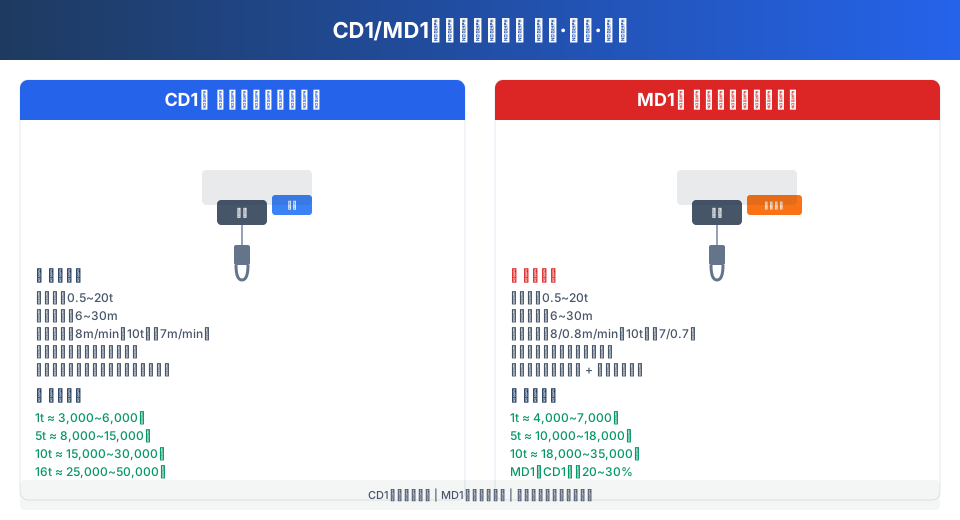
Schematic Diagram of the CD1/MD1 Electric Hoist
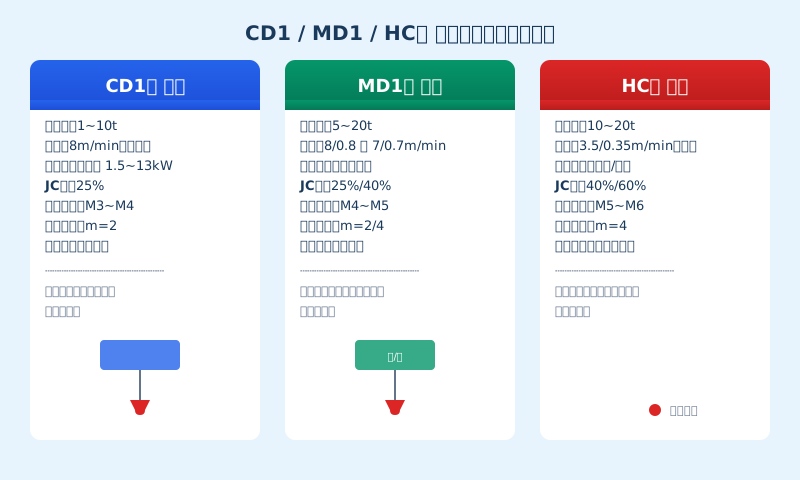
CD1 / MD1 / HC Series Electric Hoist Selection Parameter Comparison Table
I. Calculation of Hoisting Speed Matching
The lifting speed v of an electric hoist is determined by the motor speed n, the gear reducer ratio i, the drum diameter D₀, and the pulley ratio m: v = π × D₀ × n / (i × m × 60). Here, D₀ is the nominal diameter of the drum (m), n is the rated speed of the motor (rpm), i is the gear reduction ratio (approximately 100–120 for a CD1-type three-stage gear reducer), and m is the pulley block ratio. By pairing the same motor with different gear reducer ratios and pulley ratios, a speed range from 3.5 m/min (heavy-duty, low-speed) to 8 m/min (light-duty, high-speed) can be achieved.
Standard speeds for each model: CD1 single-speed 8 m/min (1–5 t); MD1 dual-speed 8/0.8 m/min (5 t) or 7/0.7 m/min (10 t); HC dual-speed 3.5/0.35 m/min (16–20 t). The HC model can also be equipped with a variable-frequency drive to achieve stepless speed control from 0.5 to 8 m/min. Selection Guidelines: For high-frequency lifting operations, prioritize the high-speed 8 m/min model; for heavy-load precision assembly where safety is paramount, prioritize the low-speed 3.5 m/min model; to balance both requirements, select the MD1 dual-speed model.
II. Matching Job Levels with JC Values
The duty class determines the motor’s duty cycle (JC) value (the proportion of time the motor is energized during a single operating cycle). For M3 (light load, low frequency), JC = 25%; the average shutdown time after each operation must be ≥3 times the operating time; M4 (medium load, medium frequency): JC = 25%; M5 (medium-heavy load): JC = 40%; M6 (heavy load, high frequency): JC = 60%. The CD1 model comes standard with JC=25% (suitable for M3–M4); the MD1 model has JC=25%/40% (suitable for M4–M5); and the HC model has JC=40%/60% (compatible with M5–M6).
For a motor of the same power rating, the rated output power at JC=40% is approximately 15% to 20% lower than at JC=25%, because a higher JC value requires greater thermal capacity for heat dissipation. When selecting a motor, never use a motor rated for JC=25% in operating conditions rated M5 or higher—continuous operation will cause the motor to overheat and burn out. If a higher duty class is required, select a motor with a higher power rating or replace it with an HC-type square-box hoist.
III. Pulley Ratio and Wire Rope Tension
The pulley ratio m directly affects the balance between the wire rope tension and the hoisting speed. When m = 2 (double rope), the wire rope tension F ≈ (Q + q)/(2 × η), and the hoisting speed v = 2v₀ (where v₀ is the line speed of the drum); when m = 4 (four-rope configuration), F ≈ (Q + q)/(4 × η), and v = v₀/2. For small-capacity applications (1–10 t), m = 2 is commonly used, offering a simple structure, low cost, and high speed; For large-capacity hoists (10–20 t), m = 4 is commonly used; halving the wire rope tension allows the rope diameter to be reduced by approximately 1–2 sizes. Although the pulley block and drum dimensions increase, the bending fatigue life of the wire rope is extended by 30%–50%.
Impact of pulley ratio on price: A ratio of m=4 requires 2 to 4 more pulleys than m=2, increasing the manufacturing cost of the pulley block by 10% to 15%; however, the reduced wire rope diameter can lower future replacement costs. The wire rope diameter is selected based on a breaking strength of ≥F × n (M5 grade, n = 5). For the specific calculation process, seeEngineering Calculations for the Hoisting Mechanism of an Electric Hoist。
IV. Comparison of Selection Parameters for the Complete CD1/MD1/HC Series
| Model | Lifting Capacity (t) | Speed (m/min) | Motor (kW) | JC value | Job Level |
|---|---|---|---|---|---|
| CD1 1t | 1 | 8 | 1.5 | 25% | M3–M4 |
| CD1 2t | 2 | 8 | 3.0 | 25% | M3–M4 |
| CD1 3t | 3 | 8 | 4.5 | 25% | M3–M4 |
| CD1/MD1 5t | 5 | 8/0.8 | 7.5 | 25%/40% | M4–M5 |
| MD1 10t | 10 | 7/0.7 | 13 | 40% | M4–M5 |
| MD1/HC 16t | 16 | 3.5/0.35 | 13 | 40% | M5–M6 |
| MD1/HC 20t | 20 | 3.5/0.35 | 18.5 | 40% | M5–M6 |
Notes on Selection: The speed values in the table above are for standard configurations; non-standard speeds can be achieved by adjusting the gear ratio of the reducer according to customer requirements. Krude Heavy Industry offers custom speed configuration services; for all non-standard configurations, the wire rope safety factor and motor thermal capacity are recalculated (e.g., reducing the speed of a 5-metric-ton hoist from 8 m/min to 5 m/min to increase lifting capacity). The HC-type square-box hoist can also be equipped with variable-frequency speed control (requires the addition of a variable-frequency drive and an encoder, with an additional cost of approximately 20% to 40%). Any non-standard speed selection requires a recalculation of the wire rope safety factor and motor thermal capacity.
📌 Recommended Standards
• JB/T 10220-2014 "Electric Hoists—Brakes"
• JB/T 10218-2014 "Electric Hoists—Conical-Rotor Motors"
• JB/T 10219-2014 "Electric Hoists with Gear Reducers"
Frequently Asked Questions
Q: How do I choose between the CD1 and MD1 models?
A: For routine lifting operations, choose the CD1 (single-speed, low cost); for precise positioning, choose the MD1 (dual-speed, with a slow speed of 0.8 m/min for accurate alignment). The HC-type square-box hoist is suitable for heavy-duty, high-frequency applications (M5–M6); it is the most expensive but has the longest service life.
Q: Is it better for the hoisting speed to be fast or slow?
A: It depends on the specific operating conditions. For high-frequency hoisting (more than 100 times per day), select the high speed of 8 m/min to improve efficiency; for heavy-load precision assembly, select the low speed of 3.5 m/min to ensure safety. The MD1 dual-speed model balances both needs with speeds of 8 m/min and 0.8 m/min—use the high-speed setting for rapid lifting and lowering, and the low-speed setting for fine-tuning and positioning.
Q: What is the JC value, and what happens if I choose the wrong one?
Answer: Power-on duty cycle = Power-on time / (Power-on time + Power-off time) × 100%. The standard specification for CD1 (JC = 25%) means that the energization time in one cycle is ≤ 25%; it cannot be used for operating conditions rated M5 or higher. If a CD1 is mistakenly used in an M5 operating condition (which requires JC = 40%), the motor will overheat and burn out within 30 to 60 minutes due to insufficient heat dissipation.
Q: How does the pulley ratio affect price and service life?
Answer: A system with m=4 has 2 to 4 more pulleys than one with m=2, and the manufacturing cost of the pulley block is 10% to 15% higher. However, since the wire rope tensile force is halved, the rope diameter can be reduced by 1–2 sizes, and the wire rope’s bending fatigue life is extended by 30%–50%; consequently, the overall operating cost is actually lower. For high-tonnage applications (≥10 t), m = 4 is recommended.
