

Multi-Crane Coordination: AI Unmanned Overhead Crane Architecture
In modern steel and logistics warehousing workshops, simultaneous operations by multiple overhead cranes are standard practice. Statistics show that under traditional manual dispatching, the collision risk probability for three coordinated cranes is as high as 12%. However, with an AI-driven multi-vehicle collaborative dispatching system, this risk drops to below 0.1%, while overall logistics throughput efficiency increases by approximately 35%. This article provides a deep dive into the complete technical architecture of AI unmanned overhead crane multi-vehicle collaborative scheduling, revealing the technology behind efficient smart lifting equipment—from underlying communication protocols to upper-layer conflict detection algorithms.
System design and safety assessments for AI unmanned overhead cranes must strictly adhere to national standards. For instance, the mechanical and electrical design of the system architecture must comply with FEM 1.001 Crane Design Specification, while safety distances and anti-collision logic during multi-vehicle operation must meet the relevant supervision requirements of TSG 51-2023 Safety Technical Supervision Regulation.
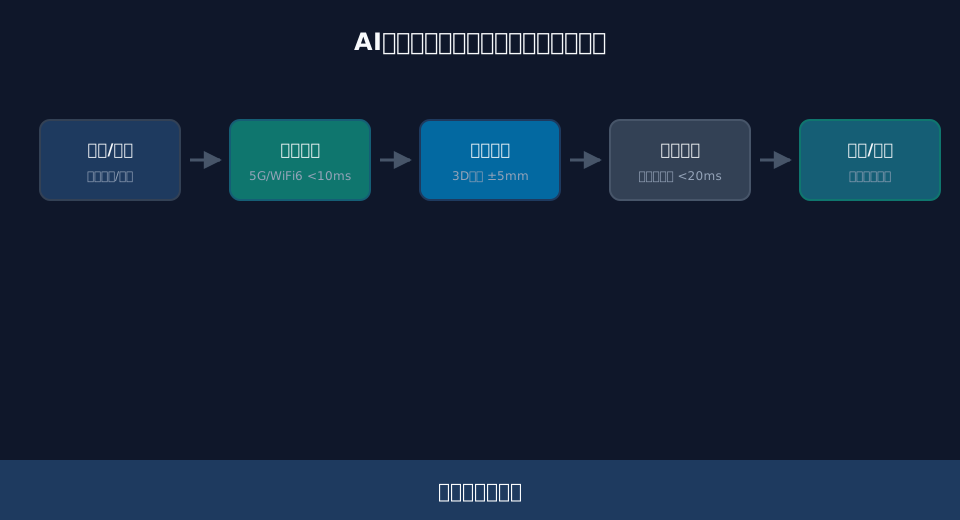
The following sections detail the multi-vehicle collaborative scheduling of AI unmanned overhead cranes, analyzing communication network construction, path planning algorithms, conflict detection mechanisms, engineering case studies, and system maintenance strategies to provide a comprehensive understanding of smart lifting dispatch technologies.
Industrial Ethernet-Based Communication Protocol Architecture for AI Multi-Vehicle Collaboration
Stable, low-latency communication networks form the foundation of multi-vehicle collaborative scheduling. In large workshops, overhead cranes must exchange position, speed, and load status in real-time, imposing strict reliability requirements on wireless communication. Currently, industrial-grade 5G and WiFi 6 are the mainstream choices for building crane communication networks, offering air interface latency under 10ms, uplink bandwidth of 100Mbps, and packet loss rates below 0.1%, fully meeting the needs for high-frequency data interaction among multiple vehicles.
"According to measured data from industrial IoT deployments, in workshops equipped with private 5G networks, the median state synchronization delay when three cranes operate simultaneously at 60m/min is 8.5ms, satisfying the stringent real-time performance requirements for multi-vehicle collaborative control."
Protocol stack design typically employs a layered architecture to ensure data security and efficiency. First, the physical and data link layers handle modulation and anti-interference processing of underlying wireless signals, ensuring link stability in strong electromagnetic environments. Second, the network layer uses UDP combined with custom application-layer verification mechanisms to reduce transmission overhead while guaranteeing reliable delivery of critical control commands. Third, the application layer encapsulates crane status heartbeat packets, task assignment instructions, and emergency shutdown signals, enabling the dispatching system to monitor the operational status of each device in real-time.
⚠️ Note
Dual-link redundancy mechanisms must be configured in communication network design. If the primary 5G network experiences fluctuations, the system must automatically switch to the standby WiFi 6 network within 50ms to prevent single point of failure from causing multi-vehicle collaborative logic failure.
Furthermore, the communication architecture requires deep integration with the crane's underlying control system. For example, during high-precision lifting and transport tasks, the communication system synchronizes real-time position data to the AI Anti-sway Algorithm module. This allows the algorithm to calculate and output optimal VFD control frequencies based on current vehicle speed and load status, maintaining Lifting spreader stability during high-speed operation.
Dynamic Path Planning via 3D Point Cloud and Digital Twin Integration
With communication resolved, path planning becomes the core process for multi-vehicle collaboration. Traditional cranes often rely on fixed two-dimensional coordinate systems for simple avoidance, whereas modern AI unmanned overhead cranes introduce 3D point cloud and Digital Twin technologies. By installing 3D LiDAR on cranes, the system scans the workshop environment at a frequency of 2 million points per second, constructing high-precision 3D spatial models with Positioning Accuracy of ±5mm and reducing path planning cycles to under 50ms.
"By mapping the real-time status of the physical workshop, the digital twin system enables path planning algorithms to perform tens of millions of collision simulations in a virtual environment. This filters out global optimum trajectories before actual operation, increasing overall logistics throughput by approximately 20%."
Path planning based on 3D point clouds primarily relies on improved A* algorithms and dynamic window methods. The system first voxelizes the 3D space to create a grid map of traversable areas and obstacles. Then, considering kinematic constraints such as maximum acceleration and turning radius, it searches for an initial collision-free path on the grid map. During operation, the dynamic window method locally adjusts the travel trajectory based on real-time perception of moving obstacles (such as other cranes or ground AGVs), ensuring smooth operation.
💡 Tip
The installation position and angle of 3D LiDAR significantly impact point cloud quality. During the commissioning stage, radar calibration using standard calibration plates is required to ensure consistency across multi-vehicle coordinate systems, avoiding path planning errors caused by coordinate system deviation.
In practical implementation, Kelude Heavy Industry's technical team optimizes the update frequency of the digital twin model based on specific customer workshop layouts. For high-frequency operation areas, the model refresh rate is set to 10Hz; for low-frequency areas, it drops to 2Hz. This balances computational resources with real-time performance, ensuring stable operation of the entire cluster dispatching system.
Spatial Conflict Detection and Obstacle Avoidance Cost Analysis in Cross-Operation Scenarios
When multiple cranes run towards each other on cross tracks or the same track, spatial conflict detection is key to safety. The AI collaborative dispatching system calculates the predicted trajectory envelope of each crane and performs real-time spatial intersection operations. Once envelope overlap is detected, the system triggers obstacle avoidance logic within 20ms, adjusting speed curves or reassigning task priorities to reduce collision probability to below 0.05%.
To intuitively demonstrate the advantages of AI collaborative scheduling, we can compare the core indicators of traditional versus AI dispatching in the table below.
📊 Comparison of Core Indicators: Traditional Manual Dispatching vs. AI Multi-Vehicle Collaborative Scheduling
| Comparison Parameter | Traditional manual operationdispatching | AIMulti-cranecollaborative scheduling |
|---|---|---|
| task allocationMethod | Manual experience-based allocation,Prone to idle time | Global coordination,DynamicloadBalanced |
| ConflictResponse time | Driver-dependentvisual inspection,>1000ms | Real-time algorithmic calculation,<20ms |
| Equipment utilization rate | Approximately65% | Increased to85%Above |
| collisionRisk probability | Approximately12% | Reduced to0.05%Below |
Selecting the right industrial wireless communication protocol is a critical decision that directly impacts both the retrofit cost and operational performance of your system. When upgrading to an unmanned overhead crane, engineers must weigh significant trade-offs in latency, bandwidth, and total cost of ownership.
📊 Wireless Communication Selection Comparison for Unmanned Overhead Cranes
| Communication solution | Air interfacelatency | Uplinkbandwidth | Single unitretrofit costEstimated |
|---|---|---|---|
| IndustrialWiFi 6 | 10~20ms | 100Mbps | Approximately810,000 RMB(subject to the actual contract) |
| 5GPrivate network | <10ms | 200Mbps+ | Approximately1510,000 RMB(subject to the actual contract) |
| Leaky waveguideCable | <5ms | 50Mbps | Approximately2010,000 RMB(subject to the actual contract) |
Industry data shows that workshops using 5G private networks for multi-vehicle collaboration achieve a 28% higher comprehensive logistics efficiency compared to those relying on traditional conductor rail power supply and manual dispatching. The investment payback period is typically between 1.5 and 2 years.
⚠️ Note
When calculating the cost budget, do not overlook software licensing and post-installation maintenance costs. Kelude Heavy Industry typically advises clients to include first-year software licensing fees and second-year maintenance expenses in their total cost accounting to avoid budget overrun. Additionally, sensor quantity should be configured reasonably in accordance with the specific requirements for anti-collision safety distance.
Routine Maintenance and Common Fault Troubleshooting for Unmanned Overhead Crane Dispatching Systems
The AI unmanned overhead crane collaborative dispatching system integrates numerous precision sensors and computing units. Its stable operation relies on scientific routine maintenance. According to equipment operating specifications, the regular inspection cycle for the main control cabinet should be set to 30 days, focusing on checking for loose terminal blocks and ensuring the cooling fan operates normally. Furthermore, the drive motor's temperature rise must be strictly controlled within an 80K limit, and vibration amplitude during operation should remain below 2mm/s to prevent positioning deviation caused by mechanical looseness.
Preventive maintenance data indicates that workshops strictly implementing a 30-day inspection cycle experience a 45% lower failure rate in overhead crane control system hardware compared to those without regular inspections, effectively avoiding production interruptions caused by unexpected downtime.
Regarding fault handling, the system features a comprehensive self-diagnostic function. When anomalies occur in multi-vehicle collaboration, follow this logic for troubleshooting. First, check the network status of the dispatching server to confirm normal reception of heartbeat packets from each overhead crane, ruling out communication link interruption. Second, review LiDAR point cloud data to identify any missing data due to lens contamination or moisture; clean if necessary. Third, verify encoder feedback data by comparing actual position with system-recorded position. If the deviation exceeds ±10mm, recalibrate the encoder.
💡 Tip
Beyond electrical and control systems, the health of the metal structure is equally critical. We recommend conducting weld crack detection every six months, especially under heavy load conditions with frequent starting and stopping, to ensure structural integrity and provide a reliable physical foundation for multi-vehicle collaboration.
By establishing standardized maintenance records that document inspection data and fault handling processes for each event, enterprises can gradually monitor equipment degradation trends. This not only helps extend the service life of the lifting equipment but also provides real data support for future system upgrades and algorithm optimization.
Engineering Case Study and Performance Verification of AI Collaborative Dispatching Under Heavy Load Conditions
The reliability of theoretical architectures is ultimately verified through engineering case studies. Under heavy load conditions, the braking performance of the crane is closely related to the anti-collision safety distance settings in multi-vehicle collaboration. Consider an engineering example where an unmanned overhead crane with a Rated Lifting Capacity of 50 tons has a Long Travel Speed of 60 m/min (1 m/s). When the system detects an obstacle ahead and triggers emergency braking, the deceleration is set at 0.5 m/s².
Using kinematic formulas, we can calculate the braking distance in detail. Given initial velocity v=1 m/s, deceleration a=0.5 m/s², and final velocity 0, the braking distance s = v²/(2a) = 1²/(2×0.5) = 1 m. This means that physically, the crane requires a sliding distance of 1 meter from the issuance of the braking command until it comes to a complete stop.
In practical verification projects by Kelude Heavy Industry, considering response delay (approx. 10 ms) and control system latency (approx. 50 ms), the system adds a dynamic safety margin of 1.5 meters to the physical braking distance of 1 meter when calculating safety distances. Consequently, the anti-collision trigger distance for multi-vehicle collaboration is set to 2.5 meters.
⚠️ Note
When performing engineering calculations and setting safety distances, fully account for the differences between full load and no-load conditions. Braking distance is longer under heavy load, requiring a correspondingly larger safety distance. Additionally, changes in the friction coefficient of the crane rail surface affect braking performance; designs must retain a safety margin of at least 20%.
Through rigorous engineering calculations and performance verification, the AI collaborative dispatching system not only accurately calculates the trajectory of each overhead crane but also ensures absolute safety between vehicles under complex heavy-load conditions. This architecture, based on dual validation of physical models and real-time data, forms the cornerstone of efficient and safe operation for modern intelligent lifting equipment.
FAQ
Q: What are the specific requirements for workshop network environments for AI unmanned overhead crane multi-vehicle collaborative dispatching?
A: The system requires a highly reliable, low-latency industrial wireless network. It is generally recommended to deploy Industrial WiFi 6 or 5G private networks, ensuring air interface latency is below 20 ms. Uplink bandwidth must support high-frequency uploads of point cloud and status data from multiple cranes, and dual-link redundancy should be configured to handle sudden network fluctuations.
Q: What are the standards for positioning accuracy and response latency in multi-vehicle collaborative dispatching?
A: When integrating 3D point cloud technology with a Digital Twin architecture, the real-time Positioning Accuracy for an overhead crane typically requires a tolerance of ±5mm or less. The system’s conflict detection and path replanning response delay must be kept under 20ms to ensure timely obstacle avoidance during high-speed operation.
Q: What is the approximate budget for retrofitting traditional overhead cranes into AI-driven unmanned overhead cranes with multi-vehicle collaboration?
A: The retrofit cost is significantly influenced by the communication solution and Sensor configuration. For a 5G private network solution, the hardware and communication retrofit cost per overhead crane is approximately $22,320 (around 150,000 CNY). With Industrial WiFi 6, the cost drops to around $11,900 (approximately 80,000 CNY). Final pricing depends on the specific operating conditions and customization requirements of your Workshop and is subject to the actual contract.
Q: In dense areas where multiple overhead cranes perform cross operations, how does the system prevent deadlock?
A: The system prevents deadlock through global task priority allocation and dynamic path reservation mechanisms. The scheduling algorithm continuously evaluates the weight of each vehicle's tasks, clearing paths in advance for high-priority overhead cranes in intersection zones. Low-priority vehicles are forced to wait in safe zones, ensuring orderly passage and unidirectional traffic flow.
In summary, multi-vehicle collaborative dispatching for AI unmanned overhead cranes is a complex engineering project involving communication, algorithms, hardware, and operational validation. Kelude Heavy Industry possesses extensive practical experience in heavy load customization. We provide complete solutions ranging from underlying hardware Retrofit to upper-layer algorithm deployment, tailored to the actual operating conditions of your Workshop, helping enterprises achieve true intelligent logistics Upgrade.
