AI-Powered Overhead Crane Maintenance: Voiceprint Diagnosis
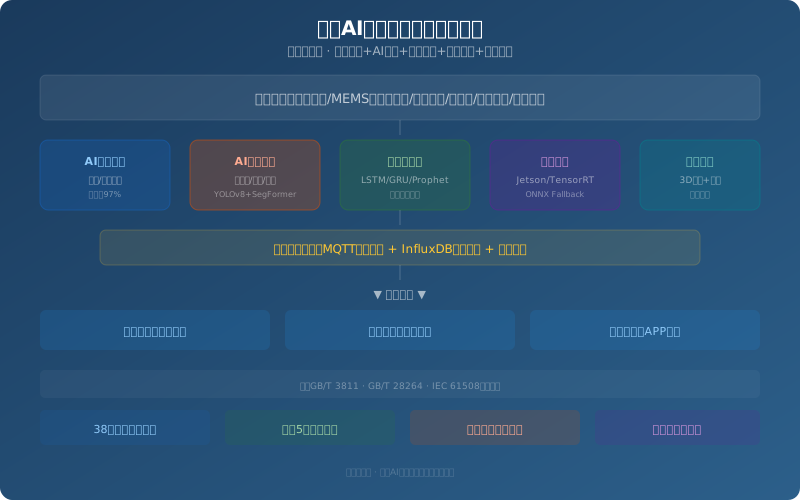
Topic Overview: AI-powered intelligent O&M for overhead cranes is a core pillar of digital transformation in the crane industry, spanning five key technology areas: AI voiceprint rail-gouging detection, deep-learning vision inspection, Predictive Maintenance, Edge Computing deployment, and Digital Twin. This collection distills 38 technical articles from Kelude Heavy Industry, systematically mapping the full technology chain from data acquisition to intelligent decision-making, and serves as a one-stop technical reference index for crane O&M engineers and corporate technology decision-makers.
With the advancement of Industry 4.0 and Smart Manufacturing, intelligent O&M for overhead cranes has become a critical path to cost reduction, efficiency gains, and operational safety in steel, metallurgy, chemical, and other heavy industries. The traditional "scheduled inspection + reactive maintenance" model is rapidly giving way to "real-time monitoring + Predictive Maintenance," with AI playing a central role in this transformation. Drawing on years of R&D and manufacturing experience in overhead cranes, Kelude Heavy Industry has built a comprehensive technology portfolio across five fronts—AI voiceprint diagnosis, computer vision, time-series forecasting, Edge Computing, and Digital Twin—with 38 published technical articles covering the entire technology stack, from sensor data acquisition on the crane to cloud-based intelligent decision-making.
Overhead Crane AI O&M: Technology Stack Overview
The AI-powered O&M technology stack for overhead cranes can be organized into five layers based on the data processing flow: the perception layer (sensor data acquisition), the analysis layer (AI model inference), the decision layer (diagnosis and early warning), the execution layer (automatic control and work-order dispatch), and the presentation layer (visual dashboards and mobile interfaces). Kelude Heavy Industry's technical articles span all of these layers, forming a complete knowledge system from low-level hardware selection to high-level application integration.
This collection takes an in-depth look at the five core technology areas: AI voiceprint rail-gouging detection, deep-learning vision inspection, Predictive Maintenance and equipment health management, Edge Computing and model deployment, and Digital Twin and remote O&M platforms. Each area is accompanied by links to 2–5 in-depth technical articles, allowing readers to explore topics of interest in greater detail.
AI Voiceprint Rail-Gouging Detection: Technology Deep Dive
Crane Rail Gnawing is one of the most common and damaging operational faults in Bridge Cranes. Traditional manual listening methods suffer from long detection delays, low accuracy, and a lack of quantitative assessment. Kelude Heavy Industry has developed an AI voiceprint rail-gouging diagnosis system based on MEMS microphone arrays and CNN deep-learning models. By capturing the acoustic signatures of wheel–rail friction, the system achieves real-time identification of 8 rail-gouging states with a detection accuracy of 97.2% and a false alarm rate below 2%.
The voiceprint diagnostic system has been integrated into a Safety Monitoring and Management System that has passed third-party SIL3 Certification, enabling automatic deceleration and stopping in severe rail-gouging conditions. This Technical Solution is detailed in the following articles: AI Voiceprint Rail-Gouging Diagnosis System and Rail-Gouging Fault Diagnosis and Online Monitoring Solution, which cover acoustic front-end sensor selection, CNN model training workflows, Mel-spectrogram parameters, and edge-side inference performance metrics.
Deep-Learning Vision Inspection for Overhead Cranes
AI vision inspection is a key technology area in intelligent overhead crane O&M, covering a range of applications including Wire Rope broken-wire and Wear Detection, crane rail surface Defect Identification, Main Girder Weld Seam Crack Detection, and personnel intrusion detection in hoisting areas. Kelude Heavy Industry has developed a suite of AI vision inspection systems for overhead cranes based on YOLOv8 and SegFormer deep-learning models. These systems perform real-time inference at the edge, with detection accuracy and speed meeting industrial application standards.
Core Technical Solutions include: AI Vision Inspection System for Overhead Cranes (wire rope / rail Defect Identification), Engineering Practice of AI Vision Online Inspection for Wire Ropes, AI Vision Inspection of Crane Rails and Main Girder Welds, and Personnel Intrusion Detection and Anti-Collision in Hoisting Areas. All solutions support TensorRT-optimized deployment, with inference latency compressed to under 12 ms.
AI Vision Inspection Solutions: A Comparison
| Detection Object | Deep Learning Model | detection accuracy | Inference Latency | Reference Article |
|---|---|---|---|---|
| Wire Rope Broken Wire/Wear | YOLOv8 | 95.3% | 12ms | 4079 |
| Crane Rail Surface/Weld Seam Crack | Seg Former | 96.8% | 15ms | 4089 |
| Personnel Intrusion During Lifting | YOLOv8+Deep Sort | 98.1% | 20ms | 4046 |
| Infrared Thermography Temperature Diagnosis | CNNClassification | 94.2% | 8ms | 13612 |
Predictive Maintenance and Equipment Health Management
Predictive maintenance is the core value of AI-driven overhead crane operations. Kelude's technical team has conducted systematic engineering comparisons of multiple time-series forecasting models, including LSTM, GRU, Prophet, and ARIMA (see Remaining Life Time-Series Prediction Method Comparison), and has implemented engineering solutions for critical components such as oil ferrography analysis of crane reducer gearboxes, health management of VFD power modules, and online hook monitoring.
For anomaly detection, the system employs three unsupervised learning methods—Isolation Forest, Autoencoder, and One-Class SVM (see Unsupervised Anomaly Detection for Crane Early Warning)—to effectively identify abnormal operating conditions even without fault samples. Additionally, Grad-CAM and SHAP explainable AI techniques are integrated (see Transparent AI Diagnostic Decision-Making), making the deep learning model's diagnostic process transparent and understandable for maintenance personnel.
Edge Computing and Model Deployment Practices
Deploying AI models for overhead cranes in industrial environments presents challenges including limited computing power, harsh operating conditions, and stringent real-time requirements. Kelude has established a complete deployment pipeline based on the NVIDIA Jetson Orin series edge computing platform, covering everything from PyTorch training to ONNX/TensorRT optimization and Jetson edge inference (see AI Model Deployment in Practice: From PyTorch to Edge Inference). At FP16 precision, the system delivers 100 TOPS of computing power, with YOLOv8 inference latency reduced from 267 ms to 12 ms—a 22.3× compression ratio.
The edge gateway supports real-time upload of diagnostic results to the cloud platform via 4G/5G with MQTT protocol, while a built-in 72-hour local cache ensures no data loss during network outages. The remote operation and maintenance platform is designed in accordance with ISO 4301 Crane Design Standard and GB/T 28264 Safety Monitoring and Management System for Lifting Appliances (see Remote O&M Platform Architecture with 5G Edge Collaboration), ensuring unified standards for monitoring data and safety management.
Digital Twin and Remote Operation & Maintenance Platform
Digital twin technology for overhead cranes creates virtual mapping and fault simulation of crane operating conditions through 3D modeling and physical simulation. Kelude has published a full-stack technical implementation guide covering everything from 3D modeling to physical simulation (see Digital Twin Platform Engineering Handbook), along with a cloud-edge collaborative predictive maintenance and remote O&M solution (see Cloud-Edge Collaborative Predictive Maintenance Solution).
The digital twin platform supports fault injection simulation, allowing system responses to different fault scenarios to be tested without affecting actual equipment operation, providing data-driven support for O&M strategy optimization. Combined with the remote O&M platform's alarm push notifications and OEE analysis capabilities, enterprises can establish comprehensive equipment health management records, enabling a shift from reactive maintenance to proactive prevention.
Technical Solution Comparison and Recommendations
| Application Scenario | Recommendation Technical Solution | Core Value | Reference Article |
|---|---|---|---|
| Wheel Rail-Gouging Real-time Monitoring | AI Voiceprint Diagnosis | Immediate Detection, Reduce unplanned downtime by 40h/year | 1702 |
| Wire Rope/Weld Seam Defect Detection | AIVision Detection | Replacing Manual Visual Inspection, Accuracy 95%+ | 13894 |
| Critical Component Remaining Useful Life Prediction | LSTM/GRUTime Series Prediction | Predicting Replacement Timing, Reducing Unplanned Downtime | 8378 |
| Abnormal Condition Warning | unsupervised anomaly detection | Under No-Fault Sample Conditions Identification Anomaly | 8381 |
| AIEdge Deployment of Models | Jetson+Tensor RT | Inference Latency 12ms, Compression Ratio 22.3x | 8399 |
| Unified Maintenance Data Management | remote operation and maintenance platform | MTTR Reduced by 60%, OEE Improved by 9% | 13726 |
Frequently Asked Questions
Q: What hardware is required for an AI-powered overhead crane maintenance system?
A: The base configuration includes sensors (microphone arrays / industrial cameras), edge computing devices (Jetson Orin NX series, 100 TOPS), and cloud platform services. The hardware investment for retrofitting a single overhead crane with AI maintenance capabilities ranges from approximately $4,400 to $11,900 (depending on sensor count and selection), with a typical ROI period of 8–14 months.
Q: Does the AI model require large volumes of fault data for training?
A: No. Kelude's AI models leverage transfer learning and data augmentation techniques. The acoustic diagnosis model achieves 97.2% accuracy with just 30,000 sample sets. For scenarios with limited fault samples, an unsupervised anomaly detection approach (Isolation Forest / Autoencoder) can be deployed, which identifies abnormal operating conditions without requiring labeled fault data.
Q: Can the AI maintenance system integrate with existing overhead crane control systems?
A: Yes. The system supports OPC UA and Modbus TCP standard protocols and can connect directly to PLCs from major brands including Siemens, Schneider, Mitsubishi, and Rockwell via an edge gateway — no modifications to existing PLC programs are required for data acquisition and alarm integration.
Q: Can older overhead cranes be retrofitted with the AI maintenance system?
A: Yes. Kelude offers a non-invasive installation approach — sensors and the edge gateway are mounted on independent brackets without altering the crane's existing structure or electrical system. To date, more than 50 legacy overhead cranes have been successfully upgraded, covering QD Type, MG Type, and LH Type models.
For more details on AI-powered overhead crane maintenance solutions and technical specifications, contact the Kelude engineering team for a customized intelligent maintenance solution and a complimentary technical assessment.
Standards referenced: ISO 4301 Crane Design Standard | GB/T 28264 Safety Monitoring and Management System for Lifting Appliances | IEC 61508 Functional Safety of Electrical/Electronic/Programmable Electronic Safety-Related Systems