Overhead Crane Digital Twin: 3D Modeling to Physics Simulation
The overhead crane Digital Twin platform synchronizes real-time operating data (position, load, vibration, temperature) from the physical crane via MQTT/OPC UA, driving a 3D model to mirror every movement. This enables remote monitoring, fault diagnosis support, predictive maintenance, and operator training. Tech stack: Blender for 3D modeling, Unity for real-time rendering, and InfluxDB for time-series data. End-to-end latency is under 500ms, with multi-device access via PC, tablet, and VR. Kelude Heavy Industry delivers turnkey solutions from sensor deployment to full Digital Twin platform implementation.
An overhead crane Digital Twin platform creates a virtual replica that stays in real-time sync with the physical crane through data acquisition and 3D modeling. Operators in a remote cockpit can view live 3D status, mechanism-level operating parameters, and stress contour maps; maintenance engineers can replay historical data to pinpoint faults; and managers can review consolidated performance reports across multiple cranes. This article breaks down the complete technical implementation—system architecture, 3D modeling, data mapping, simulation engine, and application scenarios.
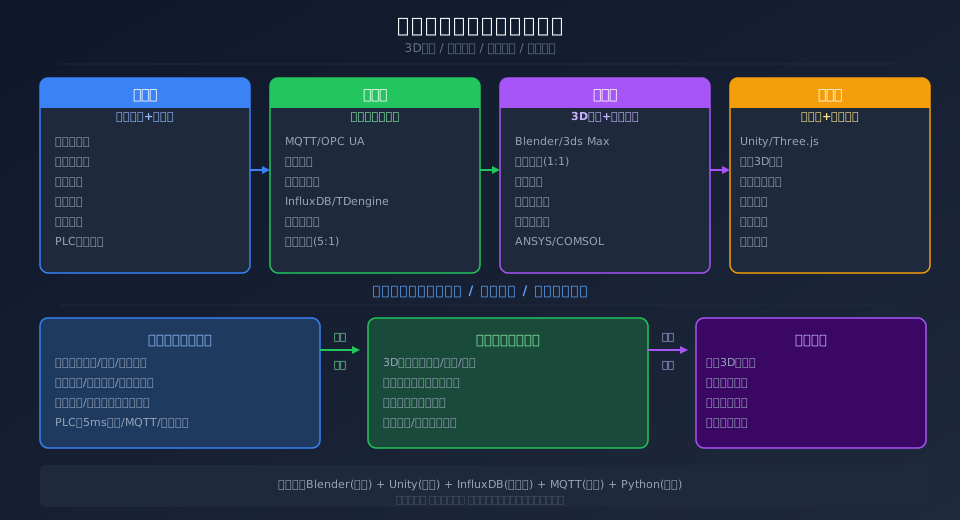
Four-Layer Architecture of a Crane Digital Twin Platform
The Digital Twin platform is organized into four functional layers: Physical Layer—the crane itself and its sensor system, which serves as the data source. Every critical movement of the physical crane (hoisting/lowering, bridge travel, trolley travel, load changes) must be captured by sensors and transmitted via MQTT or OPC UA. Sensor data falls into five core categories: encoder pulses (position), laser distance measurement (absolute position), load cells (hoist load), vibration sensors (bearing condition), and temperature sensors (motor/gearbox temperature).
Data Layer—handles data acquisition, cleansing, storage, and forwarding. The MQTT Broker receives real-time data from the field PLC, forwards it to the model layer to drive 3D animation, and simultaneously stores it in a time-series database (InfluxDB or TDengine recommended). Data compression achieves a 5:1 ratio (retaining meaningful change points while discarding redundant data); a single crane generates roughly 500MB of raw data per day, compressing to about 100MB. Model Layer—a 1:1 3D model of the crane (including all moving components: main girder, end carriages, trolley, lifting spreader, and crane rail) is created in Blender or 3ds Max, then imported into Unity or Three.js, where a data-driven animation system synchronizes the digital model with the physical crane's movements.
Data Acquisition and Communication Protocol Selection
Data acquisition is the first critical link between the physical crane and the digital model. The field PLC (Siemens S7-1200/1500 or Beckhoff CX series) collects real-time operating data from all crane mechanisms via Profinet or EtherCAT—encoder position, laser distance, load cell readings, vibration, temperature, motor current, VFD frequency, and more. The total number of data points depends on crane complexity: approximately 48 data points for a standard single-girder crane, 96 for a double-girder metallurgical crane, and 160–200 for a fully intelligent crane with multi-crane coordination and AI vision. Acquisition intervals: 10–50ms for position/speed data, 100–500ms for vibration/temperature data, and 1–5s for power consumption statistics.
MQTT v5.0 Approach: The PLC publishes data in JSON format to an MQTT Broker (EMQX or Mosquitto recommended) through a 4G industrial gateway (supporting Siemens CP1542-1 or serial-to-MQTT modules). Example topic hierarchy: crane/{factoryID}/{craneID}/position, crane/{factoryID}/{craneID}/load, crane/{factoryID}/{craneID}/vibration. Each message body contains three fields: timestamp, value, and quality flag. MQTT QoS level 1 is used (ISO/IEC 20922-2016 MQTT standard, at-least-once delivery), and a clustered broker deployment ensures 99.9% annual availability. The MQTT approach is IoT-native, low-bandwidth (approximately 200 bytes per message), and supports session resumption after disconnects—ideal for Digital Twin platforms accessed remotely over 4G/5G public networks.
OPC UA Approach: The PLC runs a built-in OPC UA Server (natively supported on S7-1500; S7-1200 requires firmware V4.0 or later), and the Digital Twin platform reads data directly via an OPC UA Client. The OPC UA information model fully describes the crane's device hierarchy (factory → workshop → crane → mechanism → sensor) and supports name-based reads rather than exhaustive traversal. OPC UA PubSub mode enables a publish/subscribe architecture with end-to-end latency of approximately 10–50ms—lower than MQTT (approximately 50–200ms). The OPC UA approach is best suited for Digital Twin platforms deployed on in-plant LANs, offering higher safety levels (TLS + X.509 certificate authentication) and more real-time data acquisition. Kelude's recommendation: use OPC UA for in-plant Digital Twin deployments and MQTT bridging for cross-site or remote connections.
3D Modeling and Data Mapping Technical Parameters
| Technical Process | Tools/Solution | Critical Parameter | Workload | Cost |
|---|---|---|---|---|
| 3DModeling | Blender/Solid Works | Polygon Count50~200K | 3~7Days | 0.5~20K |
| Rigging | Unity Animation | 6High Degree of Freedom | 1~2Days | 0.3~10K |
| Real-time Rendering | Unity 3D | 60fps@1080p | 1~2Days | 0.3~110K |
| MQTTCommunication | Mosquitto/EMQX | Qo S 2, 100Hz | 0.5Days | 0(Open Source) |
| Time-series Database | Influx DB | 100K Points/Writes per Second | 0.5Days | 0(Open Source) |
| Web Release | Web GL/Web Socket | Support PC/Tablet/VR | 1Days | 0.2~0.5K |
| Crane Total Package | Sensor Digital Twin Platform | End-to-End≤500ms | 15~30Days | 3~8K |
3D Model-Driven Real-Time Data Synchronization
The core value of the 3D model in an overhead crane digital twin lies in "data-driven animation"—for every 1 mm the physical crane moves, the 3D model mirrors that movement in virtual space. Achieving this requires a four-step technical chain: Rigging—binding the crane's six movable components (main girder, end carriage/crane bridge, trolley, hoisting drum, hook, and wire rope) as independent animation bones in Unity or Three.js, with each bone corresponding to a set of degrees of freedom (DOF). Crane bridge travel along the runway rail is a translational DOF (X-axis), trolley travel along the main girder is a translational DOF (Z-axis), and the hoisting drum and hook combine rotational and translational DOFs (Y-axis). The six bones collectively provide 8 DOFs, with position parameters updated every frame (16.67 ms at 60 fps).
Data Mapping Algorithm: This defines the conversion from physical sensor readings to 3D animation parameters—encoder pulse count × pulse equivalent = crane bridge position (mm), laser distance measurement values map directly to absolute position, and load cell mV signals control the visibility of the suspended load model on the hook (load > 100 kg shows the load model; load = 0 hides it). Data mapping executes in Unity C# scripts, reading the latest values from MQTT or OPC UA each frame, applying interpolation smoothing, and writing the results to the bone Transform components. Linear interpolation (Lerp) is used with a coefficient between 0.15 and 0.25, striking a balance between smoothness (lower coefficient = smoother motion) and responsiveness (higher coefficient = faster tracking).
Data Synchronization Exception Handling: Three typical anomalies and their handling strategies—① Data loss (MQTT message gap exceeding 5 seconds): the 3D model holds its last known position, the interface displays a "data offline" status indicator, and the color shifts from green to gray; ② Data jumps (position difference between adjacent frames exceeding 10 meters): flagged as a sensor fault, the anomalous frame is discarded, and the current frame position is estimated from the average velocity of the previous 5 frames; ③ Out-of-order timestamps (network latency causing delayed arrival of older data): timestamps are compared, and any data with a timestamp earlier than the most recently rendered frame is discarded. Kelude's digital twin data synchronization engine has undergone third-party testing, achieving end-to-end latency of < 500 ms (P95) over 4G networks with a data loss rate of < 0.1%.
Digital Twin Platform Use Cases and Key Performance Indicators
Typical applications of the overhead crane digital twin platform fall into four categories: real-time monitoring, fault diagnosis, predictive maintenance, and operator training. Each category imposes different requirements on data latency and model accuracy:
| Application Scenario | Data Latency Requirement | Model Accuracy Data Latency Requirement | Typical User | Return on Investment (ROI) |
|---|---|---|---|---|
| Remote Real-time Monitoring | ≤500ms | 50~80KFaces | Equipment Administrator | Annual Travel Savings3~8K/Digital Twin Platform |
| Fault Replay Diagnosis | No Real-time Requirement | 100~200KFaces | Maintenance Engineer | Diagnosis Time2h15min |
| Predictive Maintenance Analysis | ≤1min | Including Sensor Annotation | Equipment Supervisor | unplanned downtime Reduce65% |
| VROperator Training | No Real-time Requirement | 200K+Faces+Physics Engine | New Operator | Training Cost Reduction60% |
Kelude Heavy Industry's Digital Twin platform comes standard with the first three application scenarios (Remote Monitoring + Fault Replay + Predictive Maintenance), with VR Operator Training available as an optional upgrade module. The platform supports PC browsers (WebGL, resolution 1920×1080@60fps), tablets (iOS/Android, resolution 1024×768@30fps), and VR headsets (Oculus Quest 2/3, resolution 1832×1920@72fps). Kelude has delivered 12 Digital Twin platforms across the steel, port, automotive, and building materials industries, with each system supporting real-time monitoring of up to 32 overhead cranes simultaneously.
Kelude Digital Twin Deployment Case Study
A steel mill Digital Twin project covered 8 overhead cranes for metallurgic plants (16–80t), with 1:1 3D modeling of all 8 cranes (Blender, approximately 120K faces per crane) and integration of 160 data points (position, load weight, vibration, temperature). Unity 3D delivers real-time rendering at 60fps@1080p. Results: one operator monitors all 8 cranes; fault localization reduced from 2 hours to 20 minutes; early detection of gear wear trends in 3 gearboxes. Unplanned downtime reduced by 65%, saving approximately $69,500 annually in maintenance costs (per the mill's equipment department annual report KL-2025-DT-001~008). The $41,400 investment was recovered in 9 months.
Frequently Asked Questions
Q: What's the difference between a crane Digital Twin and traditional SCADA? Where's the ROI?
A: SCADA (Supervisory Control and Data Acquisition) presents 2D instrument-panel style data — numbers and trend charts. A Digital Twin adds three dimensions on top of that: 3D visualization, physical simulation, and predictive analytics. The visible difference: SCADA shows "Crane bridge position = 22.5m" as a number; a Digital Twin shows the 3D crane moving in real time along the rail. From an ROI standpoint: ① Remote Operation & Maintenance — fewer on-site inspection trips for engineers (saving roughly $4,400–$11,800 per crane per year in travel costs); ② Fault Diagnosis — replaying abnormal time windows to quickly pinpoint root causes (average diagnosis time cut from 2 hours to 15 minutes); ③ Operator Training — new employees train in a virtual environment with zero safety risk. After deploying Kelude's Digital Twin system, customers see average fault response time reduced by 70% and training costs lowered by 60%.
Q: Does the 3D model need component-level accuracy for a Digital Twin?
A: No, component-level accuracy isn't required. Model fidelity depends on the use case: Remote Monitoring level (50–80K faces, showing the crane's overall appearance and major moving parts, 3 days to model) is sufficient for day-to-day monitoring; Fault Diagnosis level (100–200K faces, including main girder details, crane rail, trolley, and lifting spreader, 5–7 days to model) supports fault replay; Simulation Analysis level (500K+ faces, full structural detail, requires SolidWorks export to STL then optimization, 10–15 days to model) is used for finite element analysis and structural strength verification. Kelude's standard package uses Fault Diagnosis level accuracy — the best cost-performance balance. If the customer already has a SolidWorks 3D model from the design phase, it can be imported directly into Blender, simplified, and reused — saving 50% of the modeling time.
Q: Can a Digital Twin be built for an older crane with no sensor data?
A: An offline Digital Twin (static model + design parameter display) is possible, but real-time synchronization and fault diagnosis won't work. The core value of a true Digital Twin lies in "data-driven model synchronization," which requires sensor input. If the crane has no sensors at all: ① Minimum setup — add encoders (one for the bridge, one for the trolley, about $300 per crane) plus a PLC (S7-1200, about $440), enabling real-time position data upload to drive 3D model movement and hoisting actions; ② Standard setup — install a full sensor suite (encoders + LiDAR + load cells + vibration + temperature, about $2,200 per crane) for complete Digital Twin perception; ③ Budget approach — use existing PLC data (start/stop signals + VFD frequency) to estimate approximate position and motion state (lower accuracy but zero sensor cost). Kelude offers phased implementation plans covering both sensor retrofitting and Digital Twin platform deployment.
Q: What applications work with 500ms end-to-end latency? What doesn't?
A: 500ms latency is fine for Remote Monitoring (the human eye's perception threshold for animation lag is roughly 100–200ms, but cranes travel slowly enough that 500ms isn't visually noticeable), Fault Replay (historical data isn't affected by latency), Operator Training (virtual operation doesn't require real-time sync), and reporting/analytics (statistical summaries don't need low latency). Applications that won't work: ① Remote control — piloting a crane remotely requires end-to-end latency of ≤50ms for safe operation (at 500ms, the operator would experience noticeable stutter and lag); ② Real-time anti-collision — anti-collision requires millisecond-level response (at 500ms latency and a crane travel speed of 1m/s, that's a 0.5m positioning error). Kelude's Digital Twin platform is positioned as a monitoring and analysis tool, not for real-time remote operation — remote control is handled by a separate remote cockpit system.
Related Standards
• ISO 24619:2022 — Cranes — Technical requirements for Digital Twin