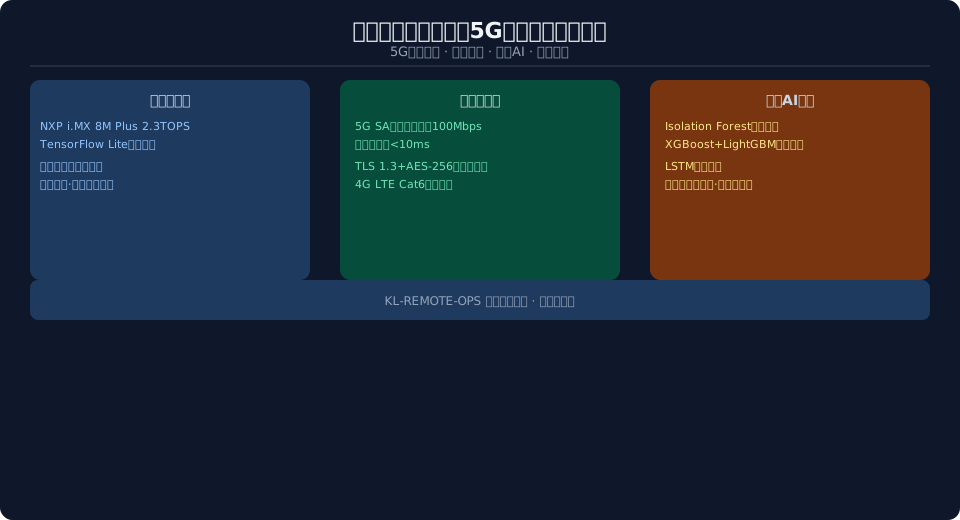

Overhead Crane Remote O&M Platform & 5G Edge Diagnostics
The remote operation and maintenance platform for overhead cranes connects crane PLCs, sensors, and AI diagnostic models to the cloud through a 5G industrial gateway. Edge-side real-time inference works in tandem with cloud-based big data analytics, with support for mobile app viewing and historical trend review.
Traditional overhead crane maintenance relies on on-site inspections and scheduled servicing, which leads to slow fault response and diagnosis that depends heavily on individual expert experience. The KL-REMOTE-OPS remote operation and maintenance platform uses a 5G industrial gateway as its edge computing node. The platform architecture follows the technical requirements for remote monitoring and data acquisition set out in ISO 4301 Crane Design Standard and GB/T 28264 Safety Monitoring and Management System for lifting appliances. It connects crane PLCs (real-time data), various sensors (vibration, temperature, current, etc.), and AI diagnostic models. The edge side runs lightweight inference models (TensorFlow Lite quantized models, <10MB), delivering millisecond-level real-time fault detection and local alarms. Edge results and raw feature data are uploaded to the cloud platform via 5G, where high-accuracy large models perform deep analysis and cross-comparison across multiple machines.
The system uses a four-layer architecture:
Sensor Layer — Sensors and PLCs connect to the edge gateway via Modbus TCP/OPC UA.
Edge Layer — Industrial-grade edge computing gateway (NXP i.MX 8M Plus, 4-core Cortex-A53@1.6GHz + 2-core Cortex-M7@800MHz, 2.3 TOPS NPU) running containerized inference models.
Network Layer — 5G SA standalone network (uplink peak 100Mbps, end-to-end latency <10ms).
Cloud Platform Layer — Kubernetes-based microservice cluster hosting full AI models and visualization dashboards.
End-to-end data encryption (TLS 1.3 + AES-256), certified to Level 2 security protection standard.
System Architecture and Deployment Options
The Sensor Layer of the KL-REMOTE-OPS platform supports major overhead crane PLC brands (Siemens S7-1200/1500, Mitsubishi FX5U/Q series, AB CompactLogix) and a wide range of sensors (vibration, temperature, current, load encoders, etc.), all connected through Modbus TCP or OPC UA for unified access. For legacy PLCs without digital communication interfaces (such as relay-logic-controlled cranes), the platform offers a standalone IO data acquisition module (16 AI + 8 DI channels, 4~20mA/0~10V compatible) to enable data integration with minimum retrofit effort. Data acquisition frequency at the Sensor Layer is configurable: vibration signals default to 6.4kHz (dual channel for acceleration and speed), slow-varying signals such as temperature and current default to 1Hz, and PLC status words and fault codes default to 10Hz.
The Edge Layer gateway uses an NXP i.MX 8M Plus processor (2.3 TOPS INT8) and comes preloaded with three containerized applications:
Data Acquisition Agent — Handles protocol conversion and data caching.
Edge Inference Engine — Runs anomaly detection and real-time alarms.
Communication Agent — Manages 5G/WiFi/Ethernet multi-link connectivity and offline data buffering and retransmission.
In the event of network disconnection, the edge gateway can locally buffer up to 30 days of data and automatically retransmit once connectivity is restored. The gateway supports dual-SIM redundancy (China Mobile + China Unicom/Telecom) with automatic carrier switching in under 500ms if the primary carrier signal is lost. The platform also supports OTA firmware upgrades and hot model updates for edge gateways, eliminating the need for on-site intervention.
Four-Layer Architecture Technical Specifications
Kelude Heavy Industry: Overhead Cranes & Industrial Hoists
Kelude Heavy Industry specializes in the design and manufacture of overhead cranes, gantry cranes, and electric hoists for demanding industrial applications. With a focus on structural integrity, operational safety, and long-term reliability, our material handling equipment is engineered to meet the rigorous standards of modern manufacturing and heavy industry.
Frequently Asked Questions
Q: What is the typical lead time for a standard overhead crane?
A: Standard single-girder cranes typically ship within 30-45 days after order confirmation. Double-girder and custom configurations may require 60-90 days depending on specifications.
Q: Do you provide installation services?
A: Yes, our technical teams offer professional installation services worldwide. We also provide operator training and maintenance documentation with every delivery.
Q: Can your cranes be adapted for explosion-proof environments?
A: Absolutely. We offer explosion-proof versions of our hoists and cranes, compliant with ATEX and IECEx standards, suitable for hazardous areas classified as Zone 1 and Zone 2.
Q: What is the warranty period for Kelude equipment?
A: All our cranes and hoists come with a standard 12-month warranty covering parts and workmanship. Extended warranty options are available upon request.
| Deployment Level | Hardware Component | Core Functionality | Performance Indicator |
|---|---|---|---|
| Perception Layer | PLC+Sensor+IOModule | data acquisitionand Signal Conversion | Vibration6.4kHz/Slow-varying1Hz |
| Edge Layer | i.MX 8M Plus Gateway | Inference+Caching+protocol conversion | 2.3 TOPS/Caching30Day |
| Network Layer | 5G CPE+Dual SIMredundancy | Data Uplink+Link Redundancy | Data Uplink100Mbps/Switching<500ms |
| Cloud Platform Perception Layer | K8smicroservice Cluster | Large Model Analytics+Visualization | Support200+Unit(s)overhead crane Integration |
Cloud-Based AI Models & Big Data Analytics
A: Kelude's Cloud Platform runs three AI models, each serving a distinct diagnostic level:
Level 1: Anomaly Detection Model (Isolation Forest, 32 feature dimensions) — Performs unsupervised anomaly detection on multi-sensor data from each overhead crane, flagging data points that deviate from normal operating conditions as suspicious events.
Level 2: Fault Classification Model (XGBoost + LightGBM ensemble, 128 feature dimensions) — Applies supervised classification to flagged events, outputting a probability distribution of fault types.
Level 3: Remaining Useful Life Prediction Model (LSTM temporal network, 60-day time window, 30-day prediction horizon) — Forecasts the health trend of critical components over the next 30 days.
Model training data is sourced from all overhead cranes deployed on the Cloud Platform (approximately 200 cranes as of Q2 2026, with a cumulative 3.2PB of data).
Cross-comparative analysis is the Cloud Platform's core differentiator. Maintenance personnel can select multiple cranes of the same model and operating conditions on the dashboard to compare vibration severity, load spectrum distribution, and health index trends. When a crane's indicators deviate from the peer average by more than 2σ, it is automatically flagged as anomalous with inspection recommendations pushed. For example, at an aluminum plant, among six 32t cranes from the same batch, Crane #3's reducer vibration severity consistently ran at 2.3 times the peer average. An on-site inspection traced the issue to loose anchor bolts. This cross-comparison capability slashed the detection time for such systemic faults from a monthly cycle with manual inspection to a daily cycle.
Maintenance Model Comparison
| Comparison Parameter | Traditional On-premise Maintenance | remote operation and maintenance platform |
|---|---|---|
| data acquisition | Manual Recording+Scheduled Export | Automatic Data Acquisition+Edge Preprocessing+5GUpload |
| AIDiagnosis | None | Three-tier Architecture(Anomaly Detection+Classification+Prediction) |
| Cross-comparison | Unable(Isolated Standalone) | Plant-wide/Group-wide Multi-equipment Comparative Analysis |
| Fault Response | On-site Troubleshooting(Hour-level) | Remote Diagnostics+Positioning(Minute-level) |
| Expert Resources | Dependency1~2In-house Experts | Cloud Expert Knowledge Base+Remote Consultation |
| Monthly Report | Manual Compilation(2~3Day) | Automatic Generation PDF+Trend Charts |
Edge Gateway Installation and Network Configuration
The edge gateway mounts on a free DIN rail inside the overhead crane electrical cabinet. Ensure a DC24V power source is available nearby (recommended: tap from the reserved terminals on the cabinet's switching power supply, or install a dedicated DC24V/2A DIN-rail power module). Keep a minimum clearance of 100mm between the gateway and strong interference sources such as VFDs. The antenna attaches via magnetic base to the top or side of the electrical cabinet; a 7dBi omnidirectional antenna is recommended. Initial deployment requires the following configuration: PLC communication parameters (IP address, port, register address mapping table), sensor channel calibration (AI channel zero-point and full-scale calibration), 5G APN settings (operator-provided dedicated APN supporting private IP assignment), and cloud platform access certification (mutual TLS authentication). Configuration is done through the gateway's web management interface (HTTPS access, default IP 192.168.1.100) or via one-tap activation by scanning a QR code with the mobile app.
For network reliability, the platform supports three communication modes:
5G SA mode (recommended) — uplink peak 100Mbps, typical latency <10ms.
WiFi 6 mode — suitable for plants with existing WiFi coverage, uplink peak 200Mbps, latency <5ms.
4G LTE Cat4 mode — for areas without 5G coverage, uplink peak 50Mbps, latency <30ms.
All three modes can be enabled simultaneously with automatic priority-based switching (5G>WiFi>4G); failover to the standby link occurs within 500ms of primary link interruption. During network outages, data is buffered on the gateway's local SD card (256GB, storing approximately 30 days of full vibration and slow-variable data) and automatically uploaded once connectivity is restored. Kelude provides a network diagnostic tool that displays real-time uplink/downlink rates, packet loss (target <0.1%), and link-switch counts for each overhead crane, helping maintenance teams identify network bottlenecks.
Application Case Study and Measured Results
After deploying the KL-REMOTE-OPS platform across 28 overhead cranes at an aluminum company, unplanned downtime incidents dropped from 17 to 3 per year (an 82.4% reduction). Mean time to repair (MTTR) fell from 4.5 hours to 1.2 hours (a 73.3% improvement), and overall equipment effectiveness (OEE) rose from 76% to 91%. Twelve months after platform commissioning, remote diagnostics accounted for 67% of all fault resolutions, and on-site engineer dispatch frequency was reduced by 55%.
The company's equipment maintenance manager noted, "I used to get at least three crane fault calls a day; now it's fewer than two a week." The system's return on investment period is approximately 14 months, with first-year maintenance cost savings of about ¥380,000 (approx. $56,200). The same platform model has been rolled out to 72 cranes across four additional plant sites, with 68 edge gateways deployed and 1,240 sensors connected, forming a group-wide equipment health management network. Using the cross-comparison feature, the group's equipment department identified a synchronous abnormal vibration trend (2.1σ deviation from the mean) in the reducers of six same-batch cranes at one plant in the fifth month of operation. The root cause was traced to a batch-wide grease quality issue; after a unified grease replacement, all units returned to normal — a systemic fault pattern that would be nearly impossible to detect from isolated single-unit data.
FAQ
Q: What are the installation environment and power supply requirements for the edge gateway inside the overhead crane electrical cabinet?
A: The gateway measures 180×120×45mm, mounts on a DIN rail, and operates on DC24V power (15W typical power consumption, 25W peak). It operates in ambient temperatures from −20 to +60°C. It can be powered directly from the DC24V output of the switching power supply in the overhead crane electrical cabinet.
Q: How is the monthly service fee for the remote operation and maintenance platform calculated based on the number of connected cranes?
A: Billing is per connected crane: ¥200/crane/month (approx. $30) for the basic monitoring tier (real-time data + alarm push + monthly reports), and ¥500/crane/month (approx. $74) for the advanced diagnostics tier (includes AI diagnostics + trend prediction + remote expert consultation). The first system includes a 3-month free service period.
Q: Does the Kelude remote operation and maintenance platform support integration with a customer's existing MES or ERP systems?
A: Yes. The cloud platform provides standard REST API and OPC UA interfaces, with data output in JSON, CSV, or XML formats. It has been integrated with three major ERP systems: SAP, Yonyou U8+, and Kingdee K/3 WISE. MQTT bridging to a customer's private cloud is also supported.
Q: How is data security ensured on the remote operation and maintenance platform?
A: End-to-end transmission encryption uses TLS 1.3 + AES-256-GCM, and cloud storage is AES-256 encrypted. The platform has passed China's Class 2 Cybersecurity Level Protection certification and supports private deployment.