

AI Fault Diagnosis on Crane Edge Devices: Accuracy vs. Cost
📋 Key Summary
Crane edge devices have limited compute, memory, and power budgets, so large cloud-trained models cannot be deployed directly. Model lightweighting—via quantization, pruning, distillation, or lightweight architectures—is essential. Lightweighting inevitably trades some accuracy, and the goal is to strike the right balance between accuracy and compute cost. This article breaks down the methods and trade-offs of lightweighting, with a side-by-side deployment comparison and common pitfalls to avoid.
🧮 Core Formulas in This Article
Model size ∝ parameter count × bit width per parameter; inference time ∝ compute workload ÷ edge compute capacity. Quantization reduces parameters from 32-bit floating point to 8-bit integers, cutting model size and compute workload to roughly 40% of the original, at the cost of a small accuracy loss.
These formulas apply to deploying real-time detection models on edge devices. They are not applicable to cloud training or offline analysis tasks where compute is abundant and lightweighting is unnecessary.
Cloud-trained AI inspection models deliver excellent accuracy, but they hit a wall when deployed on crane edge devices: limited chip compute, constrained memory, and tight power budgets. A model that runs to tens or hundreds of megabytes simply won't fit, and inference crawls.
That's the unavoidable trade-off in edge deployment: either make the model smaller or accept that it won't run. Below, we break down the methods and costs of lightweighting.
Edge Deployment Constraints: Compute, Memory, and Power
Unlike the cloud, edge devices don't have elastic compute. They face three hard constraints.
First, compute. Edge chips deliver far less compute than cloud GPUs, so a large model may take hundreds of milliseconds or longer to process a single frame—far too slow for real-time detection.
Second, memory. Edge devices have limited memory, and when the model plus intermediate inference results exceed that limit, you get memory overflow. Model size directly determines whether it can fit at all.
Third, power. Edge devices run continuously, and higher power draw means more heat and cooling pressure, especially for vehicle-mounted or on-site edge devices. These three constraints make model lightweighting a must for edge deployment. Before deploying on edge devices, Kelude first maps the compute, memory, and power ceilings of the target hardware, then decides how far to compress the model. ISO 24445, Technical Specification for Smart Sensors on Cranes, provides a useful reference for edge device selection.
Balancing Accuracy and Compute: Quantization, Pruning, and Distillation
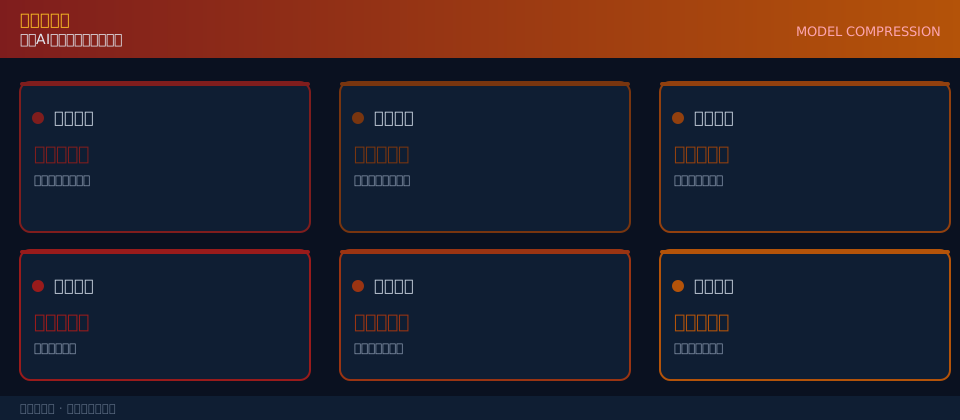
There are four main lightweighting methods, each with its own trade-offs.
Quantization is the most common approach. By reducing model parameters from 32-bit floating point to 8-bit integers, model size and compute workload drop to roughly 40% of the original, with a noticeable boost in inference speed and typically minimal accuracy loss. It's the go-to choice for edge deployment.
Pruning removes less important parameters from the model to shrink it further, but aggressive pruning hurts accuracy. The key is finding the right balance between compression ratio and accuracy.
Distillation uses a large "teacher" model to train a smaller "student" model, allowing the compact model to inherit the larger model's capabilities. It achieves significant size reduction while preserving accuracy, but training costs are higher.
Lightweight architectures involve choosing models designed specifically for edge devices, such as lightweight detection networks, trading a bit of accuracy for built-in edge-friendliness. These four methods can be combined—quantization as the baseline, with pruning or distillation added as needed.
Deployment Example: Original Model vs. Lightweighted Model
Take a wire rope broken wire detection model as an example: the cloud-trained original model delivers excellent accuracy but is too large to run on edge devices. ISO 24621, AI Fault Diagnosis for Cranes, provides the framework for diagnostic models. After quantization, model size and compute workload drop to roughly one-quarter of the original, bringing inference time into the real-time range with minimal accuracy loss.
If further size reduction is needed, pruning can be applied on top, further lowering the model footprint—but accuracy degradation becomes visible. Where you land on this trade-off depends on how much accuracy loss the detection scenario can tolerate: safety monitoring demands high accuracy and calls for conservative compression, while assistive alerting scenarios can afford more compression in exchange for speed.
The judgment criteria are whether the accuracy loss is acceptable and whether inference speed meets real-time requirements. When deploying on edge devices, Kelude compresses the model just enough to meet the accuracy and real-time demands of each scenario, rather than chasing the smallest possible size.
Common Lightweighting Mistakes
Mistake one: over-compressing in pursuit of the smallest model. Stacking quantization and pruning too aggressively shrinks the model, but accuracy collapses and detection results become unreliable—a losing trade. The goal of lightweighting is "good enough," not "smallest."
Mistake two: forcing a large model onto edge hardware without checking compute capacity. Skipping the device compute assessment and pushing a cloud-scale model onto an edge device leads to poor performance that gets mistaken for an algorithm problem. The first step in edge deployment is understanding the device's compute limits.
Mistake three: skipping re-validation after lightweighting. A lightweighted model must be re-validated on real data to confirm accuracy—never assume the loss is "just a little." Kelude always re-validates lightweighted models against real operating-condition data and only deploys when they meet the required standards.
Key Parameters for Lightweighting Methods at a Glance
| Method | Principle | Compression Effect | AccuracyLoss |
|---|---|---|---|
| Quantization | ReductionParameterAccuracy | Approximately One Quarter | Minimal |
| Pruning | RemovalredundancyParameter | Medium-High | Medium |
| Distillation | Teacher-Student Distillation | High | Relatively Small |
| Lightweight Architecture | Edge-Specificdesign | High | Medium |
Edge Deployment vs. Cloud Training: A Division of Responsibilities
| Stage | Placement | Rationale | Key Action |
|---|---|---|---|
| model training | Cloud | Sufficient ComputeAccuracyPriority | Large Model Training |
| model lightweighting | Cloud | Compression Requires Compute | Quantization, Pruning, and Distillation |
| Real-Time Inference | Edge | latencySensitivebandwidthConstrained | Deploylightweight designModel |
FAQ: Edge-Side Model Lightweighting
Q: What standards apply to edge-side model deployment?
A: For AI fault diagnosis, refer to ISO 24621; for smart sensors, ISO 24445; and for IoT interfaces, ISO 24619. These standards define the technical framework for edge devices, sensors, and diagnostic models. Model lightweighting itself has no single mandatory standard—in practice, it is governed by engineering constraints on edge-side compute, memory, and power consumption.
Q: How do I know if my model needs lightweighting?
A: The key question is whether the model can actually run on the edge device. If the model size exceeds available memory, inference time misses real-time requirements, or power draw is unsustainable, lightweighting is needed. Conversely, if the model is already compact and the edge device has sufficient compute headroom, don't compress it—you'll only sacrifice accuracy for no benefit. The real test is whether the device's compute, memory, and power ceilings can accommodate the model as-is.
Q: Why is there always a trade-off between accuracy and compute on edge devices?
A: Because edge devices impose hard limits on compute, memory, and power. Large models trained in the cloud simply won't fit or run fast enough, so lightweighting is unavoidable. The process inherently trades a degree of accuracy for smaller size and faster inference—quantization, pruning, and distillation all introduce some accuracy loss. Where you draw the line depends on the application's tolerance for error: safety monitoring calls for conservative compression, while assistive alerts can tolerate more aggressive reduction. Finding that sweet spot—just enough accuracy for the job—is the essence of edge deployment.
For engineering practice on edge deployment, see the lightweighting approach described in Core Vision AI Technology: YOLOv8-Based Load Identification and Jetson Edge Deployment.
Running AI models on the edge ultimately comes down to balancing accuracy against compute. Kelude tailors model compression to each application's accuracy and real-time requirements, using quantization as the baseline and applying pruning and distillation where needed—so detection stays both fast and reliable.
