

How to Prevent Crane AI Model Drift: Keep AI Inspection Accurate
📋 Key Summary
Here's a counterintuitive fact: AI inspection systems perform well at launch but degrade over months of use. The model isn't broken—it's that changing operating conditions and sensor aging shift the data distribution, and the model fails to keep up. This is called model drift. This article breaks down the four signs of drift, how to confirm it, and where the root causes lie, then lays out a three-part prevention framework: monitoring, retraining, and rollback.
When an AI inspection system passes acceptance testing with a wire-break recognition accuracy of 97.3%, everyone is pleased. But after six months in service, experienced operators notice it starting to miss alarms and generate false alarms—on the same wire rope that it used to detect flawlessly.
Most people's first reaction is "the model is broken" or "the supplier let us down." In reality, the more common culprit is model drift—the model hasn't degraded; the on-site operating conditions have changed, and the model hasn't kept pace.
Model drift is an unavoidable challenge once an AI system goes live. Here's a closer look at how it manifests and how to prevent it.
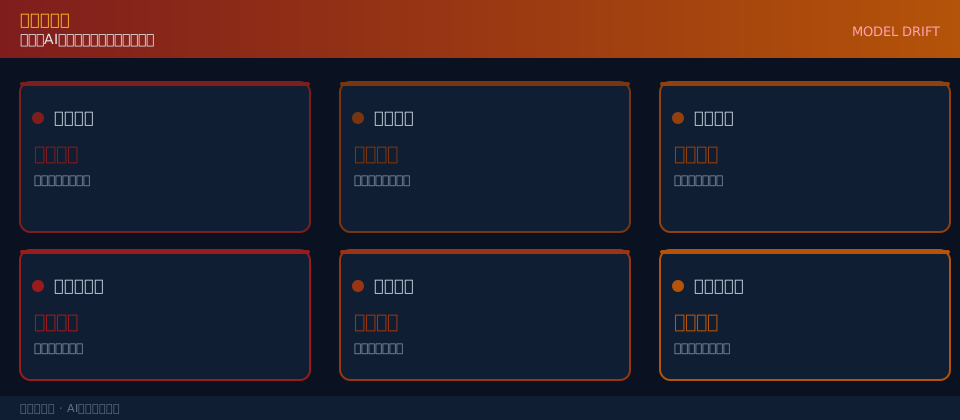
Four Signs of Model Drift: Accuracy Drop, Rising False Alarms, Rising Missed Alarms, and Failure on New Operating Conditions
The first sign is declining accuracy. Comparing test results from the same batch of test data between initial deployment and several months of operation shows a clear downward trend in recognition rates.
The second sign is an increase in false alarms. Normal samples are increasingly flagged as anomalies, deluging maintenance crews with spurious alerts and gradually eroding their trust in the system.
The third sign is a rise in missed alarms. Real defects go undetected—wire breaks and cracks that should trigger early warnings slip through. This is the most dangerous form because the safety consequences are the most severe.
The fourth sign is failure under new operating conditions. When the load material changes, lighting conditions differ, or the work takt time shifts, the model fails outright. These four signs are all classic indicators of model drift.
Diagnostic Procedure: How to Confirm Model Drift vs. Data Issues
When detection performance degrades, don't jump to conclusions. You need to determine whether the cause is model drift or a problem with sensors, data, or the environment.
Step one: review the input data. First confirm that cameras and sensors are not damaged, dirty, or misaligned, and that the incoming data is clean. If the input data is compromised, even the best model will fail.
Step two: compare against the historical baseline. Use the test indicators from initial deployment as the baseline and compare them with current metrics to see whether accuracy, false alarm rate, and false negative rate are in sustained decline. A persistent downward trend is a hallmark of drift.
Step three: sample the misclassified cases. Pull recent misjudged samples for manual review to determine whether errors are concentrated in a specific type of operating condition or occur randomly. If errors cluster around a new class of operating conditions, drift is almost certainly the cause. Kelude follows this three-step approach—data, baseline, and error samples—to rule out data issues before confirming drift. ISO 24621, "Fault Diagnosis for AI in Cranes," also requires ongoing validation of diagnostic models.
Root Cause Analysis: Shifting Data Distribution from Operating Changes and Sensor Aging
The root cause of model drift is a mismatch between the data distribution used for training and the data distribution encountered in real operation. Three specific sources drive this.
The first is changing operating conditions. When load materials change, lighting conditions vary, or work takt times shift, the distribution of on-site images and sensor data deviates from what the model saw during training. The model hasn't encountered these new distributions, so it naturally misjudges.
The second is sensor aging. Dust on camera lenses, wire rope wear, and sensor drift gradually push collected data away from its calibrated state. This slow, subtle shift is the most insidious and the most likely to accumulate into full-blown drift.
The third is concept drift itself. For example, the standard for "wire breaks requiring scrapping" evolves with changes in steel wire rope models and service life. The model learned the old standard and no longer aligns with the new one. At their core, all three sources are data distribution shifts—they differ only in speed and direction. Kelude incorporates periodic sensor calibration into its maintenance schedule to slow drift at the source.
Drift Prevention Framework: Monitoring, Retraining, and Rollback
Model drift can't be eliminated, but it can be managed—through the three-part system of monitoring, retraining, and rollback.
Monitoring is the prerequisite. After deployment, continuously track online indicators such as accuracy, false alarm rate, and false negative rate. Set thresholds so that any degradation triggers an alert, catching drift early.
Retraining is the remedy. Once drift is detected, retrain or incrementally update the model using data accumulated under the new operating conditions, keeping the model aligned with on-site changes. GB/T 28264-2017, "Safety Monitoring and Management System for Lifting Appliances," requires operational data to be retained, which supports retraining. With continuous data feedback and model updates, drift is continually corrected.
Rollback is the safety net. If a newly deployed model performs worse than the previous version, you need to be able to revert to the prior version with one click, ensuring that drift correction doesn't become a new problem. Kelude makes monitoring, retraining, and rollback standard features of its AI systems, keeping models reliable throughout continuous operation.
Model Drift Diagnosis and Response Comparison
| Drift Manifestation | diagnostic method | Root Cause | Remedial Action | Preventive Measure |
|---|---|---|---|---|
| AccuracyLowering | comparisonDeployment Baseline | Data Distribution Shift | Model Retraining | ProductionIndicatorMonitoring |
| false alarmIncrease | Statisticsfalse alarm rate | thresholdNo Longer Fit | CriticalCalibrationthreshold | Alert Feedback Loop |
| missed alarmIncrease | Sampled Error Cases | Noveloperating conditionsUnseen Samples | Augment with New Dataoperating conditionsData | Continuous Data Refeeding |
| Noveloperating conditionsFailure | Byoperating conditionsDecomposition | operating conditionsBoundary Extrapolation | Rollback to Previous Version | Version Rollback Capability |
Quick Reference of Standard Clauses for Model Drift
| Standard | Key Clause Points | Relationship with Drift Management |
|---|---|---|
| ISO 24621 | craneAI fault diagnosisFramework | diagnostic modelSustained Validity |
| GB/T 28264 Safety Monitoring and Management System | safety monitoringTraceabilityrequirements | operational dataSupport Retraining |
| ISO 24445 | smart sensortechnical specification | SensorAgingMonitoring |
FAQ: Model Drift in Crane AI Vision Systems
Q: How can you tell model drift apart from a fundamentally flawed model?
A: Look at the timing of the performance decline. A fundamentally flawed model typically underperforms from day one. Model drift, on the other hand, shows strong performance initially that gradually degrades over time. Compare current indicators against the baseline metrics recorded at deployment. If the model performed well initially and has since deteriorated—especially if the decline is concentrated in specific new operating conditions—it's most likely drift. Always rule out sensor and data issues before concluding drift.
Q: What should you do first when model drift is detected?
A: Start by reviewing the input data—verify that sensors and cameras are clean, properly positioned, and functioning correctly to rule out data quality issues. Then compare against baseline indicators to confirm the decline is sustained. Once drift is confirmed, assess the scope of its impact. If the situation is urgent, roll back to the previous version to stop the bleeding, then retrain the model using data from the new operating conditions. The sequence is: rule out data issues, confirm drift, roll back to mitigate, and retrain to recover.
Q: How can model drift be prevented proactively?
A: Three things: continuously monitor online indicators such as accuracy, false alarms, and missed alarms after deployment, with thresholds set for early warning; keep feeding live field data back into the system and retrain periodically so the model stays aligned with changing operating conditions; and maintain rollback capability so you can revert to a previous version at any time. Drift can't be fully prevented, but early detection through monitoring, timely correction through retraining, and a safety net through rollback keep its impact to a minimum.
For ongoing model drift management, refer to the data accumulation and retraining approach outlined in "Crane AI Vision Algorithm Training and Testing Platform Launched, with Over 500,000 Annotated Images of Industrial Defects".
An AI model is not a one-time deployment. Operating conditions change, data evolves, and the model must evolve with them. Kelude relies on a three-pronged approach—monitoring, retraining, and rollback—to keep detection models reliable throughout continuous operation.
