

AI Crane Anomaly Detection Without Labels
📋 Key Summary
Conventional AI inspection demands large volumes of defect annotations — yet defects are precisely the rarest and hardest data to label. Unsupervised anomaly detection flips this approach: it learns only from normal data and flags anything that deviates from the learned pattern, enabling early warnings without a single defect annotation. This article explains how autoencoders, Isolation Forest, One-Class SVM, and clustering work in practice, along with the capability boundary of unsupervised detection.
AI-based crane inspection hits a fundamental bottleneck: training a model requires defect annotations, but defects are the scarcest and most difficult data to label. Collecting a usable set of annotated wire rope broken wires or weld cracks can take months.
Is there a way to skip annotation altogether and go straight to early warning? Yes — unsupervised anomaly detection. Instead of learning what a defect looks like, it learns what normal looks like. Anything that doesn't fit the normal pattern is flagged as anomalous.
This approach upends the conventional "annotate first, train later" workflow. Here's how it works.
Unsupervised Anomaly Detection: Learn Normal, Flag the Rest
The difference between supervised and unsupervised learning comes down to what the model learns. Supervised learning requires large sets of labeled defect samples — the model learns what defects look like. Unsupervised learning needs only samples of normal operation — the model learns what normal looks like.
The logic is straightforward: normal data follows consistent patterns and clusters together, while anomalies deviate from those patterns. The model captures the structure of normal data; when new data falls outside that structure during operation, it's flagged as anomalous.
The upside is obvious: normal samples are everywhere, defect samples are rare. Learning only from normal data sidesteps the annotation bottleneck. The downside is equally clear: it tells you something is wrong, but not whether it's a broken wire or a weld crack. Kelude positions unsupervised detection as the first-pass filter — "flag first, verify manually" — and ISO 24621, AI Fault Diagnosis for Cranes, provides the framework for anomaly early warning.
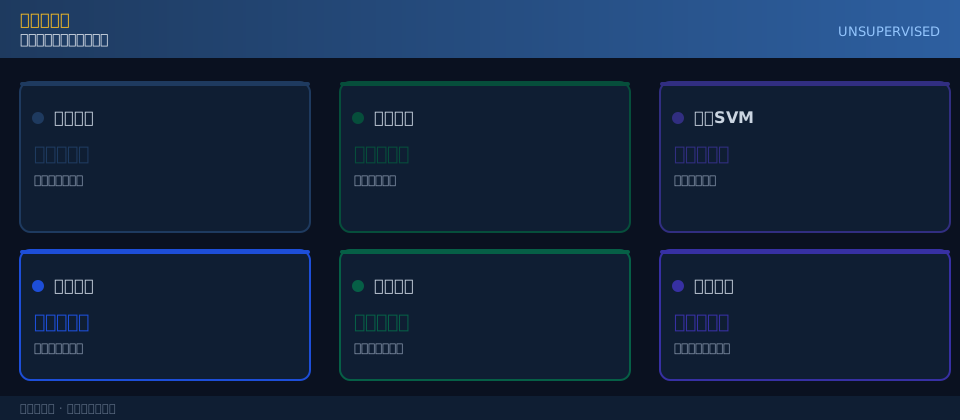
Four Unsupervised Methods: Autoencoder, Isolation Forest, One-Class SVM, Clustering
First, the autoencoder. A neural network compresses normal data and reconstructs it; normal data reconstructs accurately, while anomalies produce large reconstruction errors. The magnitude of reconstruction error determines whether a sample is anomalous. This method excels with image data and high-dimensional sensor feeds.
Second, Isolation Forest. It exploits the fact that anomalies are easier to isolate: random partitions cut anomalies out in a few steps, while normal points require many more splits. It's computationally fast, making it well suited for rapid screening of large sensor datasets.
Third, One-Class SVM. It learns the boundary of normal data; anything falling outside that boundary is anomalous. This works best with moderate-sized datasets that have clear distributions.
Fourth, clustering. Data is grouped into clusters, and isolated samples far from all cluster centers are flagged as anomalies. It's intuitive and easy to interpret, making it a good starting point for exploratory analysis. Each method has its own application scenarios — choose based on your data structure.
Capability Boundary: Detect, Don't Classify
Unsupervised anomaly detection is not a silver bullet. Its capability boundary needs to be clearly understood.
First, it detects anomalies but cannot classify the specific defect type. It reports that data deviates from normal — whether the cause is a broken wire, wear, or sensor drift requires manual review or a supervised model layered on top.
Second, it's sensitive to the quality of normal training data. If anomalies slip into the "normal" training set, the model learns them as normal and missed alarms follow. Training data must be verified as genuinely clean and normal.
Third, thresholds require calibration. How much deviation counts as anomalous? A loose threshold leads to missed alarms; a tight one produces false alarms. Thresholds must be tuned against actual operating conditions. Kelude uses unsupervised detection as a pre-filter, pulling suspicious samples for manual review — saving annotation effort while maintaining reliability.
Deployment: Pre-Filter, Review, Then Layer Supervised Models
The best use of unsupervised detection isn't to replace supervised learning — it's to work alongside it.
Step one: use unsupervised detection as a pre-filter. Learn only normal data, automatically pull out suspicious samples that deviate from the norm. This layer runs without any defect annotations, and ISO 24619, IoT Interface Specification for Cranes, provides the access system for collecting normal data.
Step two: manually review the flagged samples. Engineers confirm whether each sample is a genuine defect — defects go into the annotation library, noise is discarded.
Step three: layer on supervised models. Once the annotation library reaches a critical mass, train classification models with supervised learning for precise defect classification. Kelude follows this three-stage approach — pre-filter, review, layer — letting unsupervised detection answer "is something wrong?" while supervised models answer "what exactly is it?"
Unsupervised Methods vs. Application Scenarios
| Method | Principle | Data Suitability | Initial Cost | Application Scenarios |
|---|---|---|---|---|
| autoencoder | Reconstruction Error | High-Dimensional Image Data | Medium | visionAnomaly Pre-screening |
| Isolation Forest | Isolation Partitioning | MassiveSensorData Suitability | Low | SensorData Screening |
| One-ClassSVM | Normal Boundary Learning | Medium-Scale Data | Medium | Well-Defined Distribution Scenarios |
| Cluster Analysis | Outlier Detection | Explainability Requirement | Low | Initial Data Exploration |
Quick Reference of Standard Clauses for Unsupervised Detection
| Standard | Key Provisions | Relationship with UnsupervisedDetectionRelationship |
|---|---|---|
| ISO 24621 | craneAI fault diagnosisFramework | Anomalyearly warningFramework for |
| ISO 24619 | craneIoT interfaceSpecification | Normaldata acquisitionaccess system |
| GB/T 28264 Safety Monitoring and Management System | safety monitoringTraceabilityrequirements | Normal Patterndata source |
FAQ: Unsupervised Anomaly Detection
Q: What is the fundamental difference between unsupervised detection and supervised learning?
A: It comes down to what the model learns. Supervised learning requires defect annotation — the model learns what defects look like and can classify specific defect types, but annotation costs are high. Unsupervised learning only needs normal data — the model learns what normal looks like and flags deviations as anomalies. No annotation is required, but it can only detect anomalies, not classify them. One trains on labeled data first; the other learns normal patterns and spots deviations.
Q: When is unsupervised detection the right choice?
A: It works best when defect annotations are scarce but normal data is abundant. If you're just starting out and don't have a labeled dataset yet, unsupervised detection lets you run initial anomaly screening and pull out suspicious samples — the fastest way to get going. Once manual review has built up enough annotations, you can upgrade to supervised learning for precise classification. The value of unsupervised detection is in getting a system up and running with early warning capability, not in replacing supervised approaches.
Q: What should I do about frequent false alarms in unsupervised detection?
A: First, check whether your training data is clean — if abnormal samples slipped into the "normal" dataset, the model will learn the wrong baseline. Next, recalibrate the threshold: a loose threshold causes more false alarms, while a tight one leads to missed alarms. Finally, manually review the false-alarm samples — discard those that are just noise and add annotations for genuine anomalies. Some false alarms are inherent to unsupervised detection; continuous threshold calibration and manual review will keep them in check.
Unsupervised detection and predictive maintenance complement each other. For a closer look at anomaly identification in practice, see Equipment Health Management (PHM): Big Data and ML-Driven Predictive Maintenance for Overhead Cranes.
The real value of unsupervised anomaly detection is that it removes annotation as a bottleneck for AI early warning. Kelude uses unsupervised screening, manual review, and supervised layering to cut annotation costs while maintaining reliability — getting detection up and running first, then refining accuracy over time.
