

How GNN Reads Crane Component Relationships
📋 Key Summary
Crane components are not isolated—the motor connects to the gearbox, the gearbox to the drum, and these relationships carry diagnostic value. A graph neural network treats components as nodes and transmission paths as edges, letting AI reason directly on the equipment's structure. This article explains how GNNs map equipment into graphs, how they model relationships, and where they stand in industrial practice today.
Picture an overhead crane taken apart: motor, gearbox, brake, drum, wire rope—each component is a node, and the transmission and connection between them is an edge. The graph formed by these nodes and edges already holds diagnostic clues.
Traditional AI treats each sensor signal in isolation, like staring at a single part without seeing how parts interact. A graph neural network, by contrast, teaches AI to read this relationship graph.
Below, we break down how it maps equipment into a graph and how it reasons on that graph.
GNN Fundamentals: Components as Nodes, Relationships as Edges
The starting point of a graph neural network is abstracting equipment into a graph.
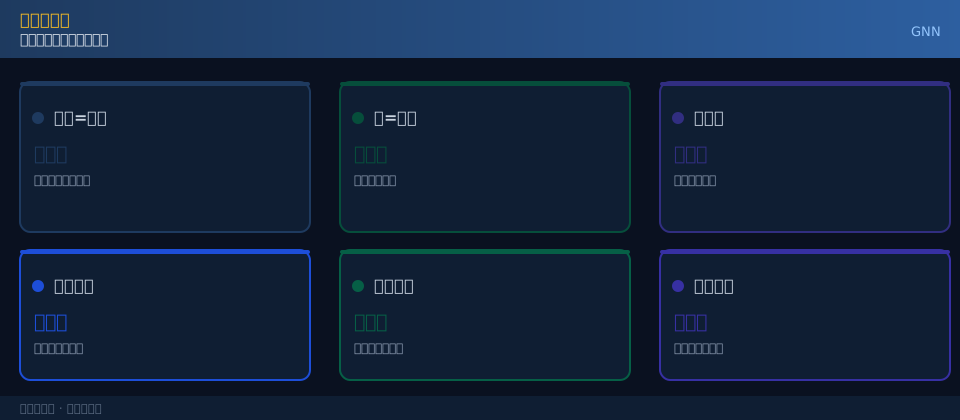
Nodes are components. The motor, gearbox, brake, and drum each become a node, and each node carries that component's sensor data—temperature, vibration, current.
Edges are relationships. The motor connects to the gearbox, the gearbox to the drum—these transmission and connection paths are edges, carrying the structural information of "what connects to what, what influences what."
With this graph, AI no longer looks at each component's signal in isolation; it can follow edges to see interactions: an anomaly in the motor propagates through the drive train to the gearbox. Kelude Heavy Industry believes this structured relationship modeling is the core value that sets GNNs apart from traditional methods, and ISO 24621 "AI Fault Diagnosis for Cranes" provides the diagnostic model framework.
How GNNs Reason on Graphs: Message Passing and Graph Convolution
GNNs reason on graphs through two core mechanisms.
Message passing lets information flow between nodes along edges. Each node receives messages from its neighbors, updates its own state, and after multiple rounds, every node "knows" what's happening around it.
Graph convolution generalizes message passing into an aggregation operation: each node aggregates features from its neighbors to produce a new feature that incorporates local structure. Stacking multiple convolution layers lets a node sense increasingly distant relationships.
Together, these mechanisms let AI leverage structural relationships for diagnosis: for instance, vibration anomalies in one component, combined with current fluctuations in the upstream motor, can pinpoint the fault source more accurately—something isolated single-point signals cannot achieve.
The Value of GNNs: From Isolated Signals to Relational Reasoning
The value of a graph neural network comes down to one word: relationships.
Traditional methods model each sensor signal in isolation, severing the connections between components and missing how faults propagate along the drive train. GNNs preserve structural relationships, enabling earlier and more accurate fault localization through patterns like "motor anomaly driving elevated gearbox vibration."
GNNs are especially suited to equipment with clear structures and tightly coupled components, such as a crane's drive train. But it's important to stay grounded: GNNs are still early-stage in industrial applications. Building an accurate equipment relationship graph requires domain knowledge, and implementation costs are not trivial. Kelude Heavy Industry positions GNNs as "piloting on equipment with well-defined relationships" rather than rolling out broadly, and GB/T 28264-2017 Safety Monitoring and Management System for Lifting Appliances requires traceability of relationship data.
Most Common GNN Implementation Mistakes
The first mistake: getting the relationship graph wrong. GNN performance depends on graph quality—if component relationships and connection methods are misdrawn, reasoning goes off track. The graph must be built by engineers who understand the equipment, not guessed at.
The second mistake: ignoring sensor data quality. No matter how good the graph structure, if the sensor data on nodes is inaccurate or noisy, reasoning will be unreliable. Data quality is the foundation.
The third mistake: treating GNNs as a universal solution. They deliver real value only on equipment with clear structural relationships and tightly coupled components. For simple relationships or independent components, traditional methods suffice—no need for GNNs. Kelude Heavy Industry decides whether to apply GNNs based on equipment structural complexity.
Traditional Methods vs. Graph Neural Networks
| Dimension | Conventional Methods | Graph Neural Networks (GNN) | Differentiation Points | Application Scenarios |
|---|---|---|---|---|
| Modeling Approach | Signal Isolation Analysis | Relational Graph Modeling | structureLeveraging Heterogeneity | structureComplexity SelectionGNN |
| Relationship Exploitation | None | Propagation Linkageinference | Varying Relationship Value | Drivetrain Scenario |
| Data Requirements | Single-Point Signals | Signals with Relational Graphs | Additional Relationship Requirements | Relationship Availability SelectionGNN |
| Maturity Level | Mature | Early Stage | Deployment Phase Variance | Pilot SelectionGNN |
Quick Reference of Standard Clauses for Graph Neural Networks
| Standard | Clause Essentials | Relationship with GNN |
|---|---|---|
| ISO 24621 | craneAI fault diagnosisFramework | diagnostic modelFramework |
| GB/T 28264 Safety Monitoring and Management System | safety monitoringTraceabilityrequirements | CloseCoefficientData Traceability |
| GB/T 28757 | overhead and gantry cranesTerminology | ComponentRelationship Terminology Benchmark |
FAQ: Graph Neural Networks in Equipment Health Management
Q: My GNN model isn't performing well — where should I start troubleshooting?
A: Start by verifying the relationship graph. If component connections or the connection method are mapped incorrectly, the inference will be off. Next, check the quality of sensor data feeding the nodes — noisy or inaccurate data undermines even a well-structured graph. Finally, assess whether the application actually calls for a GNN. For equipment with simple relationships and independent components, traditional methods are often sufficient. Work through these three steps in order: relationship graph, data, then scenario fit.
Q: How do I know if my equipment actually needs a graph neural network?
A: Look at the complexity of the equipment structure and the degree of component coupling. GNNs add real value when the structure is well-defined, components are tightly coupled, and faults propagate along the drive chain — such as the transmission path in a crane. In those cases, relational modeling captures what isolated signal analysis misses. If components are largely independent, analyzing each signal on its own is sufficient. Also consider whether you can accurately map the relationships in the first place — if the graph can't be drawn reliably, a GNN won't help. The key criteria are structural complexity and relationship availability.
Q: Why can a graph neural network leverage equipment relationships?
A: Traditional methods treat each sensor signal in isolation, effectively severing the connections between components. A GNN, by contrast, models components as nodes and transmission paths as edges, allowing information to propagate along these edges. An anomaly detected at the motor, for instance, can be traced through the drive chain and picked up at the reducer. The network exploits the structural information of "what connects to what" — insight that isolated single-point signal analysis can never provide.
Graph neural networks represent an advanced approach to relationship modeling. For related diagnostic strategies, refer to the Equipment Health Management (PHM): Big Data and ML-Driven Predictive Maintenance for Overhead Cranes — Engineering Practice.
By mapping component relationships into a graph, AI can truly interpret equipment structure. Kelude is piloting GNNs on equipment with complex, tightly coupled structures, using domain knowledge to build accurate relationship graphs — moving diagnostics from isolated signals to relational inference.
