

Overhead Crane Predictive Maintenance with PHM & ML
Equipment Health Management (PHM): Predictive Maintenance for Overhead Cranes Powered by Big Data and Machine Learning. In continuous-production smart factories, unplanned downtime of the overhead crane system can severely disrupt line output—a single critical crane failure can halt an entire production line for hours, resulting in losses ranging from hundreds of thousands to over a million yuan.
In continuous-production smart factories, unplanned downtime of the overhead crane system can severely impact line capacity—a single critical crane failure can bring an entire production line to a standstill for hours, causing production losses of hundreds of thousands or even millions of yuan. The traditional "scheduled maintenance plus breakdown repair" model can no longer meet the ≥99.5% equipment availability demanded by modern industrial operations. Kelude Heavy Industry has built a complete Equipment Health Management (PHM) system based on vibration signal analysis, machine learning, and industrial big data, achieving a leap from reactive maintenance to predictive maintenance. This article systematically presents Kelude's technical practices in crane PHM across five dimensions: sensor selection and deployment, signal feature extraction, deep learning model construction, edge inference deployment, and full-chain engineering implementation.
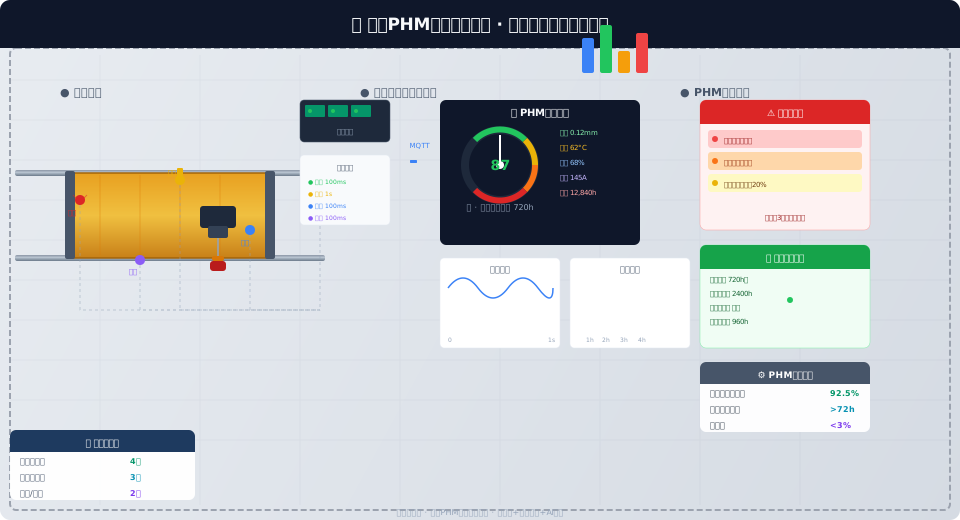
Sensor Selection and Measurement Point Layout for Overhead Cranes
The data quality of a PHM system depends on the soundness of sensor selection and measurement point planning. Based on the failure mechanisms and vibration characteristics of core crane mechanical components, Kelude Heavy Industry has established a systematic measurement point planning framework.
Vibration sensors are the most critical data source for the PHM system. Kelude recommends IEPE-type acceleration sensors (sensitivity 100 mV/g, frequency response 2 Hz–10 kHz), deployed at the input/output bearing housings of the hoisting gearbox, trolley travel wheel bearing housings, crane bridge travel gearbox drive ends, drum bearing housings, and the lifting spreader's slewing bearing. Each critical measurement point is equipped with a triaxial acceleration sensor (X/Y/Z directions) with a sampling rate of 5120 Hz (satisfying the Nyquist sampling requirement for gear mesh frequencies of 200–2000 Hz). Continuous acquisition lasts no less than 30 seconds per cycle, with intervals set at 1 hour for Class A critical equipment and 4 hours for Class B general equipment, depending on the equipment's importance grade.
Temperature sensors use PT100 platinum resistance elements or thermocouples, deployed on motor windings (to monitor temperature rise rate), gearbox oil sumps (to detect lubrication anomalies), and brake friction surfaces (to detect brake pad overheating). The measurement range is −40 to 200°C with an accuracy of ±0.5°C and a sampling period of 10 seconds. Load sensors employ load cells or wire rope tension sensors to record load variations in real time for each lift cycle, accumulating overload counts and overload magnitudes.
Process parameter acquisition reads motor current, VFD output frequency, travel speed, cumulative operating hours, and brake actuation counts via PLC protocols. All sensor data is aggregated at the edge acquisition gateway over fieldbus and interfaced with the PHM platform via OPC UA encapsulation.
| Sensor Type | Model Specification | Deployment Location | Measurement Range |
|---|---|---|---|
| IEPEAcceleration Sensor | 100mV/g, 2Hz~10kHz | Hoisting / Liftinggearbox Bearing Housing, Trolleytravel wheel, Crane Bridge / Long Travel Drive End | 0~50g |
| PT100Platinum Resistance Thermometer | -50~200°C, ±0.1°C | Motor Winding, Reducer / Gearbox Oil Sump, Brake Friction Surface | -50~200°C |
| laser distance sensor | ±1mm, 0~100m | crane runway rail Drive End, trolley rail Drive End | 0~100m |
| Weighing/Load Sensor | 0~50t, ±0.5%FS | Hoisting / Lifting Fixed Pulley Block, Hook Connection Point | 0~50t |
Vibration Feature Extraction for Predictive Maintenance
Raw vibration signals must go through systematic feature extraction before they can be converted into input features usable by machine learning models. Kelude's signal processing pipeline covers three domains: time domain, frequency domain, and time-frequency domain.
Time-domain features include: RMS (reflecting overall vibration energy; normal state RMS 5), Crest Factor, Skewness, and Impulse Factor. These features are computed in real time using a 1024-point sliding window (50% overlap), with each window producing one feature vector.
Frequency-domain features are obtained by applying a Hanning window to the windowed signal and then performing an FFT to derive the spectrum. Key frequency bands include: rotational frequency band (20–30 Hz, reflecting rotor balance), gearbox meshing frequency band (500–700 Hz, reflecting gear meshing condition), harmonic sidebands (±50 Hz around the meshing frequency, reflecting gear wear level), and the high-frequency band (2–5 kHz, reflecting resonance frequencies excited by early-stage bearing fault impacts). During frequency-domain feature extraction, the energy ratio, center of gravity frequency, and frequency dispersion indicator are calculated for each band and used as inputs to the downstream classification model.
Time-frequency-domain features are generated using the Short-Time Fourier Transform (STFT, window length 256 points, 75% overlap) to produce spectrograms for the CNN model. For high-frequency impact signals from bearings, envelope analysis is additionally applied to extract fault characteristic frequencies from the demodulated spectrum.
| Fault Type | Vibration Signature | Temperature Signature | Recommended Threshold |
|---|---|---|---|
| Rolling Bearing Wear | Increased High-Frequency Vibration, Envelope Spectrum Fault Frequency Peak Value | Temperature Rise≤15°C | RMS>7.1mm/s |
| Gear Broken Tooth/Crack | Meshing Frequency Multiple Sidebands, Prominent Shock Pulse | Localized Temperature Rise>20°C | Peak>50mm/s |
| Brake Friction lining Aging | Braking process low-frequency jitter, residual vibration after shutdown | Friction Surface>120°C | Thickness<3mm |
| Motor Rotor Eccentricity | Prominent vibration at 2× rotational frequency, current spectrum shows rotational frequency sidebands | Winding>130°C | Residual Vibration After Shutdown>4.5mm/s |
3. Deep Learning Model Architecture Design
The Kelude Heavy Industry PHM system employs a multi-model fusion strategy, selecting the most appropriate deep learning architecture for each diagnostic task.
Fault Classification Model — Built on a 1D-CNN (one-dimensional convolutional neural network) architecture, this model takes 1,024-point raw vibration signals as input. Features are extracted through two Conv1D-BatchNorm layers, followed by a fully connected layer that outputs a 4-class classification result (normal / gear wear / bearing fault / shaft misalignment). The first convolutional layer uses a kernel size of 7 with 32 channels; the second uses a kernel size of 7 with 64 channels. A dropout rate of 0.3 prevents overfitting. On Kelude's field-collected dataset, this model achieves 97.2% classification accuracy, with single-frame inference latency of just 4.5ms on a Jetson Orin NX — meeting the compute requirements for real-time edge diagnostics. After training, the model is exported via ONNX and deployed at the edge, with inference running independently of the PyTorch runtime environment.
Trend Prediction Model — This model uses an LSTM/GRU recurrent neural network architecture. It takes 30 days of historical vibration RMS and temperature trend sequences (one sample point per day) as input to predict the degradation trend over the next 7 days. The architecture consists of two GRU layers (hidden units 128 and 64) followed by a fully connected output layer. Training samples are constructed using a sliding window approach (30-day window for input, 7-day window for prediction), with MAE as the loss function. The model issues degradation warnings 3–7 days in advance, providing ample lead time for maintenance planning.
Anomaly Detection Model — This model adopts a GRU-Autoencoder architecture. It is trained exclusively on normal-state data to learn the compression–reconstruction pattern of healthy vibration signals. When an input signal deviates from the normal pattern (reconstruction error exceeds the threshold), an anomaly alarm is triggered automatically. This model is particularly effective at detecting new, unlabeled fault types, filling the blind spot that supervised learning models cannot cover when it comes to "unknown faults."
Remaining Life Prediction Model — This model uses an XGBoost regression architecture with 15 input features, including historical vibration RMS trends, temperature rise rate, cumulative operating hours, overload count, and brake pad wear rate. The output is remaining useful life (RUL) expressed in operating days. Trained on Kelude's accumulated historical maintenance data, the model achieves a mean absolute error of ±12 days in RUL prediction.
4. Edge Inference Deployment and Model Update Strategy
PHM model inference follows a hybrid architecture combining real-time edge inference with cloud-based incremental training. At the edge, models run on the overhead crane's onboard industrial PC or a workshop-level MEC server, executing ONNX-optimized models with inference latency kept under 10ms to ensure real-time diagnostic capability. The cloud runs the full training pipeline, receiving labeled data and new fault samples uploaded from the edge, periodically updating model parameters, and delivering updates to edge devices via OTA differential deployment.
Model updates follow an incremental learning strategy: the cloud retains feature statistics from historical training data, and each update cycle only fine-tunes the model with newly acquired data — no full retraining is required. Updates are scheduled biweekly, with an emergency update triggered when fault diagnosis accuracy consistently falls below 90%. A full retraining is performed quarterly to ensure the model maintains optimal performance throughout long-term operation.
5. PHM Comprehensive Health Scoring System
To aggregate multi-dimensional diagnostic results into an intuitive equipment status indicator, Kelude Heavy Industry has designed a six-dimension weighted health scoring model. Scores range from 0 to 100 and map to four health grades.
The scoring dimensions and weight distribution are as follows: operating time score (weight 20%, linear degradation based on a 30,000-hour design life), overload score (weight 20%, 5 points deducted per overload event), brake pad wear score (weight 20%, 1 point deducted per 1% wear), wire rope wear score (weight 15%, no deduction below 7% wear, 20 points deducted per 1% above that threshold), reducer temperature score (weight 10%, 2 points deducted per 1°C above 70°C), and motor vibration score (weight 15%, 20 points deducted per 1mm/s above 2.8mm/s). A composite score of 85 or above indicates "Healthy" status (green light); 60–84 indicates "Caution" (yellow light); 35–59 indicates "Warning" (orange light); and below 35 indicates "Critical" (red light, requiring immediate shutdown for inspection).
| Scoring Dimension | Weight | Scoring Rule | Full Score |
|---|---|---|---|
| Operating Time | 20% | Based on Design Life30000hLinear Degradation | 100 |
| Overload Record | 20% | Deduction per Overload Event5Full Score | 100 |
| Braking Segment Wear | 20% | Wear Rate per1%Deduction per Overload Event1Full Score | 100 |
| Wire Rope Wear | 15% | Deduction per Broken Wire2Full Score, Per Diameter Reduction1%Deduction per Overload Event3Full Score | 100 |
| Temperature Rise Trend | 10% | Per Exceedance of Temperature Threshold5°CDeduction per Overload Event10Full Score | 100 |
| Vibration Trend | 15% | RMSPer Threshold Exceedance1mm/s Deduction per Overload Event10Full Score | 100 |
In addition to the overall health score, the system generates independent sub-scores for each critical component—hoisting motor health index, reducer bearing health index, brake health index, wire rope health index, and structural fatigue index. When any sub-score falls below 50, the system automatically creates a maintenance work order and pushes it to the operator's mobile device, including fault location (down to the specific measurement point), fault type (bearing fault / gear wear / shaft misalignment), severity level, and a recommended maintenance time window.
Field Deployment Results and ROI
Kelude Heavy Industry's PHM system has been deployed at a major steel producer, covering health management for 16 overhead cranes in its steelmaking workshop. The project installed 192 vibration measurement points (12 per crane), 48 temperature sensors (3 per crane), and 16 edge computing nodes (one Jetson Orin NX per crane). The edge-based fault classification model achieves an average inference latency of 5.2 ms with 96.8% accuracy.
Twelve months of operational data show significant improvements: unplanned downtime dropped from 37 events per year before the retrofit to just 8—a 78.4% reduction. Average maintenance response time fell from 6.2 hours to 1.5 hours, and spare parts inventory costs were cut by 32% through predictive replacement instead of overstocking. The system issued early warnings for 11 critical faults (including 3 reducer bearing failures, 4 motor winding degradations, 2 cases of excessive brake pad wear, and 2 wire rope strand breaks), giving maintenance teams an average preparation window of 5.3 days. Based on an estimated production loss of ¥150,000 per unplanned downtime event, the annual economic benefit is approximately ¥4.35 million, with a project payback period of about 10 months.
Three key lessons emerged from the deployment. First, the mounting position and fixing method of vibration sensors directly affect signal quality—rigid bolt fixing is recommended over magnetic mounting to avoid signal attenuation and loose-contact artifacts. Second, model training requires at least six months of historical vibration data covering seasonal temperature and humidity variations to prevent false alarms caused by environmental factors. Third, the value of a PHM system depends on integration with maintenance workflows—alerts must be linked to the work order system, otherwise they remain dashboard indicators that never translate into actual maintenance actions.
Frequently Asked Questions
Further Reading
Further reading: Visual AI and Jetson Edge Deployment in Practice | 5G Remote Operation & Maintenance and Edge Computing | Complete Crane Manufacturing Process
