

6D Pose Estimation for Overhead Crane Automatic Pickup
📋 Key Summary
An overhead crane's automatic pickup isn't about finding where the load is — it's about knowing its exact 3D coordinates and orientation. 2D object detection only returns a bounding box: position without orientation, pixels without scale. That's why the grab misses. 6D pose estimation fills in those three missing degrees of freedom, outputting XYZ translation plus roll, pitch, and yaw rotation in one pass. This article walks through a real-world case of pickup deviation to explain why 2D detection causes misalignment, how 6D pose estimation completes the picture, and what it takes to put pose estimation into production for automatic pickup.
In September 2024, a port yard retrofitted its portal crane for automatic pickup, aiming to grab loads from stacked loose parts without operator intervention. On day one, the system failed: the spreader aligned with the load, but the hook landed off by 10–20 cm every time, and the locking holes on the spreader never matched the lifting points. The operator had to switch back to manual, fine-tuning the position more than twenty times per shift. Automatic pickup was effectively useless.
The project team's first instinct was that the mechanical arm's repeat positioning accuracy was insufficient — possibly encoder or gearbox backlash. They swapped motors, recalibrated the reducer, and re-ran the mechanical arm calibration. A week later, the hook was still off. Only then did they realize the problem wasn't in the execution end at all — the arm was accurate; the target coordinates it received were wrong from the start.
Tracing back through the vision module, they found the root cause: the upstream 2D object detection only output the load's center pixel and a bounding box in the image. Depth was estimated from a monocular camera, and orientation was ignored entirely. The model couldn't tell whether the load was lying horizontally or vertically, facing the camera or at an angle — the same box could represent any of those. Field measurements showed that monocular depth error at a 3 m working distance reached centimeter-level, while the alignment accuracy required for pickup was millimeter-level. The root cause was clear: the machinery wasn't missing — the system was given position without orientation or scale.
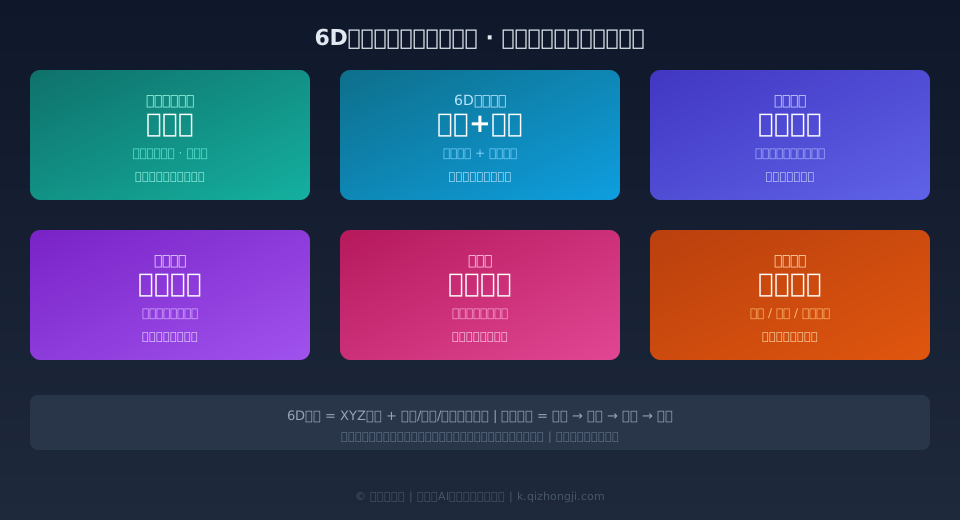
What 6D Pose Estimation Solves: Why 2D Detection Only Gives Half the Answer
For an overhead crane to pick up a load automatically, it needs to know not just where the load is, but which way it faces, how large it is, and its full orientation. A 2D object detection output is a bounding box — essentially four pixel coordinates on the image plane that describe where the load appears in the frame and how big it looks.
But pickup happens in 3D space. A bounding box tells you whether the load is in the upper-left or lower-right of the image, but it can't tell you the real distance from the camera — that's scale. Nor can it tell you how many degrees the load is rotated around each of the three axes — that's orientation. A load lying flat, standing upright, facing forward, or angled sideways can project to the exact same box.
6D pose estimation fills in exactly those three missing pieces. The "6D" refers to six degrees of freedom: translation along the X, Y, and Z axes, plus rotation around those axes — roll, pitch, and yaw. With all six values known, the load's position and orientation in space are fully described, and the pickup action has a reliable coordinate reference. This precision requirement aligns with the positioning and alignment demands for hoisting mechanisms set out in FEM 1.001, the crane design specification.
Troubleshooting the Pickup Deviation: From Mechanical Suspicions to a Vision-Side Root Cause
When a pickup misses, most people blame the machinery first — and this case shows exactly why that's a trap. The project team replaced motors, recalibrated the reducer, and re-ran the mechanical arm calibration. After a week, the deviation remained unchanged, proving the problem wasn't in the execution end.
That misdiagnosis was costly: not just a week of lost time, but new assembly errors introduced by repeated disassembly and reassembly, making the troubleshooting more complicated. The right approach is to break down the deviation by layer from the start — the execution end provides the actual pose of the mechanical arm's tip, the vision end provides the desired pose, and the difference between the two is the alignment deviation.
Kelude follows a clear chain when troubleshooting positioning issues: first confirm whether the execution end's baseline accuracy meets spec, then verify whether the coordinate data from the source is reliable. If the execution end passes and the coordinate data is corrupted, the deviation is locked to the vision chain. If the execution end itself is off, swapping the vision system won't help.
Inspection confirmed it: the vision module was outputting a 2D box plus monocular depth estimation — orientation missing, scale inaccurate. The real source of the deviation was incomplete coordinate information, not mechanical misalignment. The lesson: in automated pickup, the bottleneck is often the eye, not the hand.
How 6D Pose Estimation Works: Three Technical Routes and Their Fit for Crane Pickup
To get a full six-degree-of-freedom output from the vision end, there are three mainstream approaches, each with its own applicability limits. The right choice for crane pickup depends on the operating conditions.
The first is point cloud registration using a depth camera. An RGB-D camera or stereo vision provides true depth directly, which is then registered against the load's 3D model to derive the pose. The advantage is real scale without monocular estimation; the trade-off is that depth cameras degrade in bright light, reflective surfaces, and long-distance scenarios.
The second is monocular keypoint-based pose solving. Keypoints on the load are detected in the image, and the 3D pose is recovered from 2D keypoints by solving the PnP problem. The advantage is simple hardware and low cost; the trade-off is sensitivity to keypoint detection accuracy and occlusion — when the load is partially blocked, the solution becomes unstable.
The third is direct regression using deep learning. A network regresses translation and rotation parameters directly from the image, end-to-end. The advantage is strong adaptability to complex appearances; the trade-off is the need for large volumes of annotated data, and rotation regression converges less reliably than translation. When Kelude selects a solution, it evaluates these three routes within the 3D spatial modeling framework proposed by ISO 24619, the technical requirements for crane Digital Twins, unifying the coordinate system before discussing accuracy.
No single route is inherently superior. For crane pickup — close-range, heavy-load, occlusion-prone — the practical approach is usually a combination of depth and monocular, model-based and learning-based, rather than betting on one method alone.
Putting 6D Pose Estimation into Production: From Calibration to Closed-Loop Verification
Having a 6D pose output is a long way from a reliable pickup. Pose estimation returns values in the camera coordinate system; the crane executes motions in the spreader coordinate system. Between the two lies a coordinate transformation that must be rock-solid.
The first critical point is hand-eye calibration. The transformation between the camera frame and the mechanical arm or spreader frame must be calibrated accurately. Calibration errors translate directly into pickup errors. If the calibration goes stale, even the most accurate pose estimation is useless.
The second is real-time performance and computing power. Pose estimation must complete within the pickup takt time. Accuracy and latency are a trade-off — the goal is to keep single-frame processing time within the alignment tolerance budget.
The third is closed-loop verification. Use measured pickup success rates to validate whether pose estimation meets the requirement, rather than relying on offline accuracy metrics alone. Kelude treats pose estimation as a general capability for automatic pickup, and pairs it with the traceability requirements for positioning data in GB/T 28264, the Safety Monitoring and Management System for lifting appliances, so every pickup's coordinate input is documented and auditable.
Pickup Deviation: Solution Comparison at a Glance
| Issue | Root Cause | repair plan | Effect Verification |
|---|---|---|---|
| lowering the hookOffset by 10+ cm | Large Monocular Depth Error,Absence of True Scale | ReplaceRGB-DIntroduce True Depth via Depth Camera or Stereo Vision | Depth Error Significantly Converged(Based on Actualoperating conditionAs Reference) |
| Lifting spreaderLock Hole MisalignmentLifting point | Center-Pixel-Only Output,Missing Orientation | Introduce6DPose Estimation to Supplement Three-Axis OrientationRotation | Complete Orientation Information,Alignment AchievedPowerImprovement |
| Under OcclusionDetectionBounding Box Drift | 2D Bounding Box Under OcclusionrobustnessPoor Performance | Point Cloud Registration or6DRegression,Leverage Geometric Priors | More Stable Gripping in Occluded Scenes |
| Camera Frame andMachineryArm Frame Misalignment | Hand-EyeCalibrationmissing dataor Outdated | Re-Calibrate Hand-EyeCalibrationUnified Coordinate System | Coordinate Transformation Error Eliminated |
| Automatic PickupRepetitivemanual intervention | Positioning AccuracyInsufficient Correction Leading to Frequent Adjustments | Pose Estimation with Closed-Loop Verification | manual interventionSignificant Reduction in FrequencyLowering |
Quick Reference of Standard Clauses for Positioning
| Standard | Key Clause Points | Camera Frame andPositioningRelationship with Gripping |
|---|---|---|
| FEM 1.001 Crane Design Standard《crane design specification》 | Hoisting mechanismCamera Frame andWork Duty / Classification | Positioning Accuracyand AlignmentrequirementsBasis |
| GB/T 28264 Safety Monitoring and Management System《lifting appliancesSafety Monitoring and Management System》 | safety monitoringData Traceabilitytraceable | Gripping Process Data Retrievable |
| ISO 24619《craneDigital Twintechnical requirements》 | 3D Spatial Model and Coordinates | of Pose CoordinatesDigitalizationbase |
| ISO 24621《craneAI fault diagnosis》 | AIDiagnosisdata qualityFramework | visionPositioningData Quality Benchmark |
📖 Related Reading: Vision-Based Object Detection and Precision Positioning for Overhead Cranes: YOLOv8 Pickup Detection and Vision-Guided Positioning in Engineering Practice | Visual SLAM Environment Mapping and Positioning for Overhead Cranes
FAQ: 6D Pose Estimation for Vision-Guided Pickup
Q: When automatic pickup on an overhead crane shows large positioning deviation, how do I isolate whether the issue is in the vision system or the mechanical execution?
A: Start by checking the execution side—verify the robot's repeat positioning accuracy and confirm that the encoder and gearbox backlash are within spec to rule out mechanical issues. Then move to the vision side: determine whether the upstream data is a 2D bounding box or a full 6D pose, and whether depth comes from monocular estimation or actual measurement. Tracing the coordinate source layer by layer will pinpoint where the deviation originates.
Q: What level of 6D pose estimation accuracy is required before an overhead crane can safely run automatic pickup?
A: It depends on the clearance between the lifting spreader and the lifting point—there is no universal threshold; actual operating conditions dictate the requirement. The translation error of the pose estimate must be smaller than the spreader's alignment tolerance, and the rotation error must be small enough for the spreader to seat cleanly. Kelude recommends running alignment tests with your specific lifting point dimensions and using measured success rates to determine whether the system is ready.
Q: Why does the crane still miss the load even when 2D object detection provides a bounding box?
A: Because a 2D box only describes the load's position and size in the image plane—it lacks depth and orientation. The same bounding box can represent a load lying flat or standing upright, facing forward or at an angle, yet the pickup motion required is completely different. Monocular depth estimation degrades significantly at longer distances, and orientation is simply not available at all. In short, having a box does not mean you can grasp accurately.
6D pose estimation gives the overhead crane the half of the answer that 2D detection misses—orientation and scale. Kelude treats pose estimation as a core capability for automatic pickup, ensuring every lowering of the hook is driven by a complete six-degree-of-freedom coordinate frame rather than a position-only box. The more thoroughly the positioning problem is solved, the more confidently automatic pickup can be deployed.
