

Design of an Intelligent Crane Dispatch System: Algorithms for Multi-Crane Collaborative Path Planning and Task Assignment
📌 The core functions of the intelligent crane dispatch system include task assignment (optimized using genetic algorithms), path planning (obstacle avoidance using the A* algorithm), multi-crane coordination (priority-based yielding + time-slot coordination), and real-time dispatch. The system can simultaneously manage 8 to 20 cranes, increasing daily throughput by 30% to 50% and reducing the no-load rate by 20%.
In large workshops and yards, it is common for multiple cranes to work in coordination within a single bay or across multiple bays; however, collisions between cranes, task conflicts, and inefficiency have long been persistent challenges. The intelligent crane dispatch system developed by Krude Heavy Industry is based on operations research optimization algorithms and enables automatic task assignment, path planning, and coordinated control of multiple cranes.
The intelligent dispatching system is a key technology for achieving unmanned lifting operations. For information on the IoT platform for remote monitoring of overhead cranes, please refer toSetting Up an IoT Platform for Remote Monitoring of Overhead Cranes。
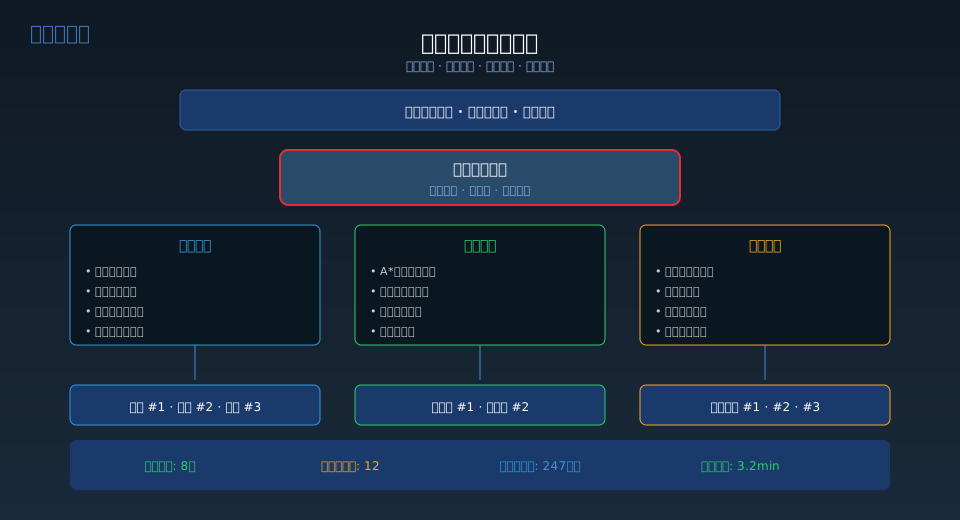
Core Technology Modules
Task Assignment Algorithm.An improved genetic algorithm is used to solve multi-objective optimization problems. The encoding method is priority-based real-number encoding, and the fitness function combines four metrics: shortest path distance, task priority, equipment load balancing, and urgent order insertion. The selection operator uses tournament selection (scale 3), while the crossover operator is dynamically selected between PMX and OX, with the mutation probability adaptively adjusted between 0.05 and 0.15. In a typical scenario involving 20 tasks assigned to 5 overhead cranes, the solution time is less than 5 seconds.
Path Planning Algorithms.The hierarchical A* algorithm is used: the global layer plans a rough path on the workshop grid map (1-meter resolution), while the local layer refines the path in a dynamic environment (0.1-meter resolution). The cost function incorporates three factors: path length, collision risk, and the current equipment’s occupied area. Dynamic obstacle detection occurs every 200 ms, and local path replanning upon encountering an obstacle takes less than 50 ms.
Multi-vehicle coordination strategies.A dual mechanism combining a priority-based yielding protocol and time-window coordination is employed. Each crane is assigned a dynamic priority (based on task urgency), and low-priority cranes proactively yield to high-priority cranes. Time-window coordination prevents deadlocks: Each crane’s operational trajectory locks regional resources for specific time intervals; when requests conflict, they are resolved based on a priority-plus-earliest-completion-time strategy. In this project, Krude Heavy Industries adopted a hybrid architecture combining centralized scheduling with distributed execution: the scheduling server is responsible for task assignment and global path planning, while the local controller of each overhead crane handles local path tracking and obstacle avoidance.
Comparison of System Metrics
| Indicators | Manual Scheduling | Intelligent Scheduling | Increase Rate |
|---|---|---|---|
| Number of Lifts Per Day | 150–200 times | 240–300 times | +50%~60% |
| Equipment Idle Rate | 35%~45% | 15%~25% | -20% |
| Average Wait Time | 8–15 minutes | 3–5 minutes | -60%~70% |
| Risk of Collision | High (relies on workers' experience) | Low (algorithm-guaranteed) | Significantly reduced |
| Task Response Time | 10–20 minutes | 2–5 minutes | -75% |
|
Genetic Algorithms 20 tasks, 5 vehicles—find a solution in less than 5 seconds |
A* Path Planning Dynamic reprogramming takes less than 50 ms |
Multi-Vehicle Coordination Dual Mechanism of Priority and Time Window |
|
Increased Throughput Daily hoisting operations increased by 501 TP3T or more |
The design of the intelligent dispatch system complies with the GB/T 37651 and T/CPARK 4 standards. Dispatch systems manufactured by Krude Heavy Industry undergo 2,000 hours of continuous operation testing before leaving the factory to ensure stable 24/7 operation.
Frequently Asked Questions (FAQ)
Q: How many cranes can a smart dispatching system coordinate?
Answer: Taking Krude Heavy Industry products as an example, the standard system configuration supports up to 20 cranes working in coordination within the same area. If there are more than 20 cranes, a multi-level dispatch architecture must be used. The equipment is first divided into groups (8 to 12 cranes per group), with coordination within each group handled by the group’s dispatch server and arbitration between groups handled by the master dispatch server.
Q: How do the scheduling system and the PLC interact?
Answer: The dispatch server communicates with the PLCs of each overhead crane via OPC UA or Modbus TCP to issue task commands (target position, lifting height, travel speed) and read equipment status (current position, load, operating mode, fault information). The communication cycle is 200 ms. Dispatch commands take precedence over local operations.
Q: How does the dispatch system handle unexpected failures?
Answer: When a crane malfunctions, the dispatch engine automatically reassigns its uncompleted tasks to an adjacent available crane within 3 seconds. The operational area where the malfunctioning crane is located is marked as a no-entry zone, and other cranes automatically reroute to bypass it. The entire system maintains a throughput of 90% or higher even in the event of a single-crane failure.
Q: What safety measures are required for the operation of autonomous overhead cranes?
Answer: Three-tier safety protection: (1) Zone interlock logic (PLC hardwiring, network-independent); (2) Sensor-level obstacle avoidance (dual detection using LiDAR and millimeter-wave radar); (3) Dispatch-level safety (dynamic safety distance and speed limiting). The safety level complies with the ISO 13849 PLd mechanical safety standard.
📌 Recommended Standards
• GB/T 6974.6-2008《起重机 术语 第6部分:铁路起重机》
• GB/T 6974.7-2008《起重机 术语 第7部分:浮式起重机》
• GB/T 24818.4-2009《起重机 通道及安全防护设施 第4部分:臂架起重机》
