

Why AI Fault Diagnosis Fails Across Crane Operating Conditions
📋 Key Summary
An AI inspection model that performs flawlessly in one operating environment often fails when moved to another—different lighting, different load materials, different equipment models. This is one of the most common complaints about industrial AI. Transfer learning lets a model apply what it has already learned to a new environment, achieving cross-domain adaptation with only a small amount of labeled data. This article explains three approaches—pretraining with fine-tuning, domain adaptation, and domain generalization—and how to put transfer learning into practice.
A frustrating reality for many factories: an AI inspection system runs accurately in Workshop A, but fails when deployed in Workshop B—because the lighting differs, the load materials differ, and the equipment models differ. When the data distribution shifts, the model breaks down.
Transfer learning is designed to solve exactly this "fails when the environment changes" problem. It allows a model to carry the capabilities it learned in the source environment over to a target environment that lacks labeled data, achieving cross-domain adaptation with minimal data.
Here's how transfer learning works in practice.
How Transfer Learning Works: Applying Learned Knowledge to New Conditions
The core idea behind transfer learning is that you don't start from scratch. A model that has already learned to identify defects in one environment has acquired transferable, general-purpose capabilities. When moving to a new environment, you only need to fill in the gaps.
The key difference from training from zero is the starting point. Training from scratch means accumulating a large amount of labeled data in the new environment—slow and expensive. Transfer learning starts from a pre-trained model and fine-tunes it with a small amount of new-environment data—fast and cost-effective.
Transfer learning works because defect detection across different environments shares common ground: recognizing fundamental features like wire breaks, cracks, and skew is universal. What differs is the surface-level data distribution, and that can be adapted with just a small amount of labeled data. Kelude Heavy Industry defaults to transfer learning for cross-project deployments rather than training each model from scratch. ISO 24621, AI Fault Diagnosis for Cranes, provides guidance on cross-environment diagnostics.
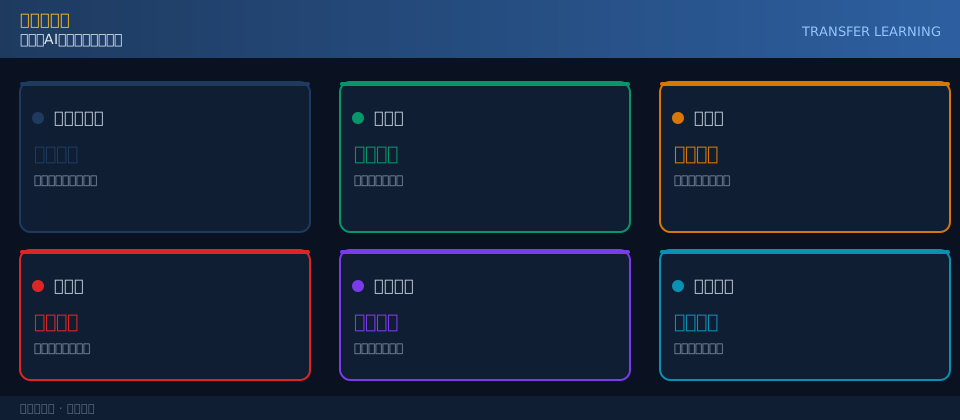
Three Transfer Methods: Fine-Tuning, Domain Adaptation, and Domain Generalization
The first method is pretraining plus fine-tuning. Start with a model pre-trained on large-scale data as the base, then fine-tune it on a small amount of labeled data from the new environment. This is the most commonly used approach—low investment, quick results.
The second method is domain adaptation. This approach specifically aligns the feature distributions between the source and target environments so the model can maintain stable recognition in the target environment. It's more precise, but requires some data from the target environment.
The third method is domain generalization. Here, the model is deliberately trained to handle variations across multiple environments, so it can generalize to unseen environments rather than being optimized for one specific condition. It's the most challenging approach, but offers the best robustness. Choose among the three based on the amount of data available in the target environment and your deployment requirements.
Implementation Path: Start with a Solid Base, Fine-Tune with Minimal Data
Transfer learning follows a clear implementation path.
Step one: select a strong pre-trained base model. Use a general-purpose model trained on large-scale data as your starting point. It has already learned fundamental feature-extraction capabilities—this is the foundation for transfer.
Step two: fine-tune with a small amount of labeled data. Label a small sample set in the new environment and fine-tune the base model to adapt it to the new data distribution. The annotation effort here is far smaller than training from scratch.
Step three: validate and feed back. Validate the fine-tuned model in the new environment, deploy it once it meets the required standards, and continuously feed new-environment data back into the model so it becomes more stable over time. GB/T 28264-2017, Safety Monitoring and Management System for Lifting Appliances, requires traceability of cross-environment data. Kelude Heavy Industry follows this three-step approach—base model, fine-tuning, and validation with feedback—for all transfer learning initiatives.
Common Mistakes in Transfer Learning Deployment
Mistake one: forcing transfer when the environments are too different. If the source and target environments differ too greatly—for example, moving from an indoor setting to intense outdoor lighting—even the underlying features won't align, and transfer will perform worse than training from scratch. Always assess the degree of difference between environments before attempting transfer.
Mistake two: using too little labeled data for fine-tuning. Transfer learning reduces the annotation burden, but if you cut it down to almost nothing, the fine-tuning won't be sufficient and the model will remain unstable in the new environment. The fine-tuning dataset needs to be large enough to cover the variations in the new environment.
Mistake three: skipping re-validation after transfer. The performance of a transferred model in the new environment must be re-validated—you can't assume that "if it transferred, it works." Kelude Heavy Industry insists on validating transferred models under real operating conditions before deployment.
Comparison of Three Transfer Learning Methods
| Method | Principle | Objectiveoperating conditionsData Requirements | Performance | Application Scenarios |
|---|---|---|---|---|
| Pre-trainingfine-tuning | baseFine-tuning with Limited Dataannotation | Fine-tuning with Limited Dataannotation | Superior | Preferred for Cross-Project Deployment |
| Domain Adaptation | Feature Alignment | Partial Data | Improved | Well-Defined Distribution Shift |
| Domain Generalization | Multipleoperating conditionsPre-training | Target-Free / No Target Data Required | robustnessSuperior | Multiple Unknownsoperating conditions |
Quick Reference of Standard Clauses for Transfer Learning
| Standard | Key Clause Points | andtransfer learningRelationship with |
|---|---|---|
| ISO 24621 | craneAI fault diagnosisFramework | Cross-operating conditionsDiagnosisSpecification |
| GB/T 28264 Safety Monitoring and Management System | safety monitoringTraceabilityrequirements | Cross-operating conditionsData Traceability |
| ISO 24445 | cranesmart sensortechnical specification | SensorAdaptation Discrepancy |
FAQ: Transfer Learning in Equipment Health Management
Q: What's the fundamental difference between transfer learning and training from scratch?
A: It comes down to the starting point. Training from scratch means accumulating large volumes of annotated data for each new set of operating conditions and learning everything from zero—slow and expensive. Transfer learning starts from a pre-trained model that has already learned general identification capabilities. You only need a small amount of new-condition annotation for fine-tuning to close the gap. The essence is reusing existing knowledge rather than reinventing the wheel for every operating condition.
Q: How do I get started with transfer learning on a limited budget?
A: Start with pre-training plus fine-tuning—it's the lowest-cost, fastest-ROI approach to transfer learning. Pick a solid base model, fine-tune it with a small set of new-condition annotations, and you're ready to deploy quickly. Once you've accumulated enough data and the differences between operating conditions become clear, you can move on to domain adaptation and domain generalization. The sequence is: base model first, minimal fine-tuning, then validate and feed results back. Get cross-condition deployment working before anything else.
Q: How do I know if my operating conditions require transfer learning?
A: Look for the "works in one condition, fails in another" pattern. If your model performs well on the source condition but degrades on a new one—or if you need to deploy across multiple operating conditions without retraining from scratch each time—transfer learning is the answer. Conversely, if you have a single stable operating condition with sufficient data, training from scratch works fine. The key question is whether you have cross-condition deployment needs. If you do, transfer learning is the way to go.
Transfer learning and model drift are two sides of the same coin. For cross-condition adaptation strategies, refer to the model maintenance approach outlined in "Equipment Health Management (PHM): Big Data and ML-Driven Predictive Maintenance for Overhead Cranes—An Engineering Practice".
When AI fails under new operating conditions, the model isn't the problem—transfer learning is the missing piece. Kelude uses a base-model-first approach with minimal fine-tuning and iterative validation, enabling models to adapt quickly across operating conditions without starting from zero on every project.
