

3 Limits of Unmanned Overhead Cranes Before Selection
Unmanned overhead cranes are seeing adoption rates in warehousing and manufacturing grow by over 30% annually. However, more than 40% of implementation projects face delays or budget overruns due to insufficient initial assessments. This article provides an in-depth analysis of three critical limitations: AI vision blind spots, factory infrastructure retrofitting requirements, and the hidden maintenance costs associated with AI algorithms. Our goal is to help you mitigate technical risks before selection, ensuring a smooth intelligent upgrade that delivers expected returns.
Before discussing these constraints, it is essential to clarify that regardless of whether you are using traditional or unmanned overhead cranes, foundational design and safety supervision must strictly adhere to the structural calculation and mechanism selection principles outlined in FEM 1.001 Crane Design Specification. Furthermore, the installation and commissioning of all safety protection devices must meet the mandatory requirements of the TSG 51-2023 Safety Technical Supervision Regulation for Lifting Appliances.
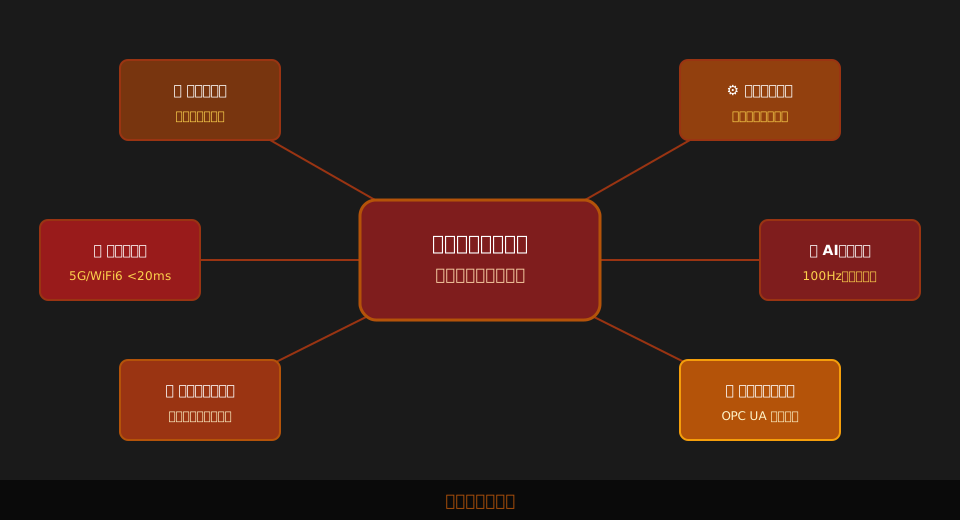
The following sections detail the technical barriers you must overcome when selecting an unmanned overhead crane system, covering five key areas: AI visual safety identification, factory network and rail infrastructure, life cycle cost, anti-sway algorithm bottlenecks, and system interface compatibility.
AI Vision Blind Spots and Safety Risks in Complex Operating Conditions
The core of an unmanned overhead crane lies in its ability to achieve automatic operation through AI vision and sensor fusion. However, a significant gap exists between ideal laboratory environments and harsh industrial sites. In steel smelting or cement manufacturing workshops, airborne dust, water vapor, and intense light from welding operations can severely interfere with camera imaging quality.
When workshop dust concentration exceeds 50mg/m³, the target recognition rate of standard industrial cameras drops sharply to approximately 85%. To ensure safety, the AI system frequently triggers emergency stops or deceleration, significantly reducing overall operational efficiency. Additionally, visual processing algorithms inherently possess physical latency, typically around 50ms. During high-speed operation, this 50ms delay means the crane travels an extra distance before reacting. For specific calculations regarding safe braking distance, refer to the guidelines on anti-collision safety distance.
Consider a Long Travel Speed of 60m/min (1m/s). If the system's set deceleration is 0.5m/s², the theoretical braking distance is calculated as s=v²/(2a)=1²/(2×0.5)=1m. Adding the 50ms response delay from AI vision processing results in an additionalSliding distance of 0.05m. Therefore, the actual total safe braking distance must be set to at least 1.05m, with sufficient margin reserved in the system parameters.
"Industry measured data indicates that in workshop environments with drastic lighting changes and metal reflections, pure vision solutions suffer a false alarm rate as high as 12%, drastically increasing the frequency of operator intervention."
⚠️ Note
In workshops with high dust concentrations or strong electromagnetic interference, do not rely solely on vision solutions. It is recommended to add LiDAR or millimeter-wave radar as redundant sensors to build a multi-modal perception system.
Infrastructure Retrofitting Constraints: Space and Network Requirements
Many enterprises focus exclusively on equipment performance when introducing unmanned overhead cranes, neglecting the compatibility of factory infrastructure. Unmanned cranes have far stricter accuracy requirements for runway rails than traditional models; even minor rail deviations are amplified by the positioning system, causing the lifting spreader to misalign.
Regarding infrastructure standards, unmanned overhead cranes require track elevation differences to be strictly controlled within ≤3mm/2m, with rail span deviations not exceeding ±5mm. If the rail foundation of an older factory building undergoes settlement, the crane generates additional mechanical stress during operation. This accelerates wheel wear and amplifies positioning accuracy deviations to over ±15mm. Simultaneously, unmanned cranes rely heavily on industrial wireless networks for data interaction, requiring end-to-end latency for 5G or WiFi6 networks to be less than 20ms, with network jitter not exceeding 5ms.
"According to a retrofit report from an automotive manufacturing plant, in sections where track settlement exceeded 2mm, the failure rate of automatic material handling spiked from 0.1% to 4.5%, severely obstructing production takt time."
💡 Tip
Before introducing an unmanned overhead crane into an old factory building,Essential hire professional agencies to re-survey main girder deflection, rail foundation settlement, and workshop network coverage blind spots. Reinforcement of civil structures may be necessary.
To intuitively demonstrate the differences in infrastructure requirements between traditional and unmanned overhead cranes, we have compiled the following comparison data for your factory retrofit planning reference.
📊 Comparison of Infrastructure Requirements for Overhead Cranes vs. Unmanned Overhead Cranes
| Evaluation Criteria | ConventionalManualoverhead crane | unmanned overhead crane(AIcontrol system) |
|---|---|---|
| Crane RailLeveling Tolerance | ≤10mm/2m | ≤3mm/2m |
| Networklatencyrequirements | No Strict Requirementrequirements(Wiredcontrol system) | <20ms,Vibration/Jitter<5ms |
| WorkshopLightingrequirements | Sufficient for Manual OperationvisionSuffices(>50 Lux) | Uniform and Glare-Free(>200 Lux) |
AI Algorithm Iteration and Hidden Maintenance Costs in the Unmanned Overhead Crane Lifecycle
When evaluating an unmanned overhead crane project, initial hardware procurement costs are often just the tip of the iceberg. The core of an AI system lies in the continuous iteration and optimization of its algorithms, which introduces significant hidden maintenance costs. As production material types increase or workshop layouts change, existing AI identification models may become obsolete, requiring new data collection and model training.
Financially, the total investment for an unmanned overhead crane typically increases by approximately $67,000 (about 45%) compared to traditional overhead cranes. This premium primarily covers high-accuracy Sensors, edge computing gateways, and AI software licenses. More critically, the cycle for retraining AI models is usually six months, during which algorithm engineers must be on-site for commissioning. Kelude Heavy Industry incorporates these post-deployment algorithm maintenance costs into our customized solution Quotation, preventing clients from facing a situation where they can afford to buy but not operate. This ensures that the life cycle cost remains controllable throughout the project's lifespan.
"Industry association statistics indicate that software maintenance and algorithm upgrade expenses for unmanned overhead crane projects in years 3 through 5 often account for 15% to 20% of the initial hardware total investment. This is a blind spot frequently overlooked in corporate budget planning."
⚠️ Note
Do not focus solely on hardware pricing during selection. Require suppliers to provide a life cycle cost list that includes algorithm upgrade fees for three to five years, and clarify access permissions for source code or underlying interfaces.
Unmanned overhead crane solutions with different control logic structures exhibit significant differences in cost structure and performance. The following table provides a comprehensive evaluation of mainstream AI control schemes.
📊 Cost and Performance Comparison of Different AI Control Schemes for Unmanned Overhead Cranes
| control systemSolution Type | Initial Softwarecost | Subsequent PhasemaintenanceDifficulty | Scenario Adaptability |
|---|---|---|---|
| Rule Engine+Conventionalvision | Low | Low(ModificationParameterSuffices) | Limited ToStandard-ization/-ation、FixingScenario/Application |
| deep learning+Multi-Sensor Fusion | High | High(Requires Model Retraining) | Adaptable to Complex、Variable/Dynamicoperating condition |
| Digital Twin+Predictivecontrol system | Very High | Medium(Model-DependentAccuracy) | Suitable for Ultra-Large Scale、Hightakt timeproduction line |
AI Anti-Sway Bottlenecks and Failure Limits in Extreme Operating Conditions
Anti-sway control is a key technology for precise positioning in unmanned overhead cranes. However, under extreme operating conditions, AI anti-sway algorithms often expose response bottlenecks. When the lifting spreader is at full load and requires high-speed startup or emergency braking, the flexible characteristics of the wire rope cause complex nonlinear swinging. This places extremely high demands on computing power and real-time performance.
Under heavy load conditions, the system must strictly control the sway angle within ±0.5°, requiring the AI algorithm’s calculation frequency to exceed 100Hz. Traditional PID anti-sway algorithms struggle with parameter tuning when facing large inertia loads, often leading to overshoot. For a deeper analysis of advanced control strategies, see AI Anti-Sway Algorithm. Kelude Heavy Industry’s technical team has observed in multiple projects that when the eccentric load exceeds 5% of the Rated Lifting Capacity, traditional algorithms experience significantly extended convergence times, potentially triggering system oscillation.
"Field tests show that under conditions where the Lifting Capacity reaches 80% of the rated load and the Cross Travel Speed exceeds 60m/min, adaptive anti-sway models based on deep reinforcement learning reduce swing suppression time by approximately 40% compared to traditional PID algorithms."
⚠️ Note
For operating conditions requiring frequent high-speed luffing and heavy-load translation, it is recommended to explicitly require suppliers to provide adaptive anti-sway models based on load identification in the Technical Agreement, and set strict acceptance criteria for sway angles.
Compatibility Limits in Data Interface Standardization and Cross-Brand Coordination
In modern smart factories, unmanned overhead cranes do not operate in isolation; they must interact with MES systems, Warehouse Management System (WMS), and other logistics equipment. However, inconsistent data interface standards across different manufacturers create severe "data silos," becoming one of the biggest limitations restricting the global efficiency of unmanned overhead crane systems.
Protocol conversion can introduce an additional communication delay of approximately 10ms and may lead to the loss of critical control commands. Ideally, cross-system data loss rates must be controlled below 0.1%. Additionally, structural health monitoring data from the unmanned overhead crane itself (such as weld crack detection data for the Main Girder and motor current spectra) needs to be uploaded to the cloud in real-time for big data analysis. If interfaces are not open, these valuable status data cannot be effectively utilized.
"In large integrated steel enterprises, due to unified underlying protocols, the average failure rate of cross-system data calls once reached 8%, preventing the dispatching system from obtaining crane positions in real-time and severely impacting overall logistics efficiency."
💡 Tip
In bidding Technical Agreements, it is mandatory to specify the use of open standard protocols such as OPC UA. Suppliers must be required to open their underlying data dictionary and reserve at least 20% redundancy in communication interfaces to accommodate future production line expansion.
FAQ
Q: How does the AI vision system of an unmanned overhead crane ensure recognition accuracy in low-light or nighttime environments?
A: Pure vision solutions indeed have limitations in low-light environments. The common approach is to add infrared thermal imaging cameras or LiDAR for multi-sensor fusion. Infrared devices do not rely on visible light and can identify obstacles through temperature differences. Combined with point cloud data from LiDAR, night-time recognition accuracy can be maintained above 95%, ensuring safe operation around the clock.
Q: What specific requirements does introducing an unmanned overhead crane system place on the factory building's grid regarding harmonics and power factor?
A: Unmanned overhead cranes extensively use Frequency Inverters / VFDs and Servo Drives, which generate harmonics. The total harmonic distortion (THD) of the grid must be controlled within 5%, and the power factor must reach above 0.95. It is recommended to install source filters or reactive power compensation devices at the front end of the Power Distribution Cabinet to ensure stable power supply to the control system motherboard and AI computing modules, avoiding crashes caused by voltage fluctuations.
Q: How are software licensing fees and subsequent algorithm upgrade costs typically calculated for unmanned overhead cranes?
A: Software licensing is usually purchased outright once per crane unit or number of control nodes, although some manufacturers adopt an annual subscription model. Subsequent algorithm upgrade fees depend on complexity; basic patches are typically free, but if new scenario AI model retraining is involved, charges apply based on labor hours or model customization fees. Specific amounts are subject to the actual contract; it is recommended to lock in costs for the first three years upfront.
Q: How should the positioning system of an unmanned overhead crane respond if strong electromagnetic interference exists in the workshop?
A: Strong electromagnetic fields can cause conventional encoders or magnetic navigation to fail. The countermeasure is to use Multi-turn absolute encoders combined with Laser Distance Sensors for position closed loop control. Laser distance measurement is immune to electromagnetic interference and provides millimeter-level absolute position feedback. Meanwhile, Shield Grounding must be properly implemented in the Control Cabinet, and communication cables should use twisted-pair shielded cables to physically isolate interference sources.
Selecting an unmanned overhead crane is far more than a simple equipment purchase; it is a complex engineering challenge involving vision-based safety, infrastructure Retrofit, cost accounting, algorithmic constraints, and system compatibility. By fully addressing these core limitations, you can navigate the path to intelligent Upgrade with greater efficiency. Kelude Heavy Industry provides comprehensive lifecycle service, from initial Site Survey and tailored solutions to ongoing algorithm maintenance. Our robust Heavy load customization capability ensures the smooth implementation of every unmanned operation project.
