

Crane Coupling Installation & Shaft Alignment: 4 Parameters vs 5 Standards
Selecting the right crane coupling requires evaluating four key dimensions: rated torque, speed range, misalignment compensation, and installation space. This article compares four coupling types—gear, elastic pin, diaphragm, and crowned gear—across parameters including torque range (0.05–1,250 kN·m), maximum rotational speed (2,000–10,000 r/min), and angular compensation (0.5°–45°). It also details five acceptance criteria for shaft alignment, including radial deviation ≤ 0.05 mm/100 mm and face runout ≤ 0.03 mm.
4 Common Crane Coupling Types: Features and Suitable Applications
Couplings in crane drive systems serve the critical function of connecting the motor output shaft to the gearbox input shaft. The selection directly impacts the smoothness and safety of the entire crane operation. Per the design requirements for transmission mechanisms outlined in ISO 4301 Crane Design Standard, couplings must satisfy three key technical indicators: rated torque, impact load coefficient, and misalignment compensation capability.
Crane couplings commonly used in the industry today fall into the following four categories based on their structural principles:
Type 1: Gear Coupling (GCL) — Transmits torque through meshing of internal and external gear sleeves. Offers the highest load-carrying capacity with a rated torque range of 1.6–400 kN·m. Ideal for heavy-duty impact applications such as metallurgical and ladle cranes, and is the standard configuration for Kelude's large-capacity bridge cranes.
Type 2: Elastic Pin Coupling (HL) — Transmits torque through nylon pins engaging with flange bores on the half-coupling. Rated torque ranges from 0.25–160 kN·m. Provides cushioning and vibration damping, making it suitable for hoisting mechanisms on 5–50 t general purpose bridge cranes.
Type 3: Diaphragm Coupling (JZM) — Uses stainless steel diaphragm packs as the elastic element. Rated torque spans 0.05–1,000 kN·m with a maximum speed of 10,000 r/min. Features zero backlash and lubrication-free operation, ideal for high-speed precision crane drives.
Type 4: Crowned Gear Coupling (WGT) — Features crowned tooth profile modification for a spherical contact surface. Offers angular compensation up to 3°, radial compensation of 2–15 mm, and rated torque from 2–1,250 kN·m. The preferred choice for long-travel mechanisms on large-span gantry cranes.
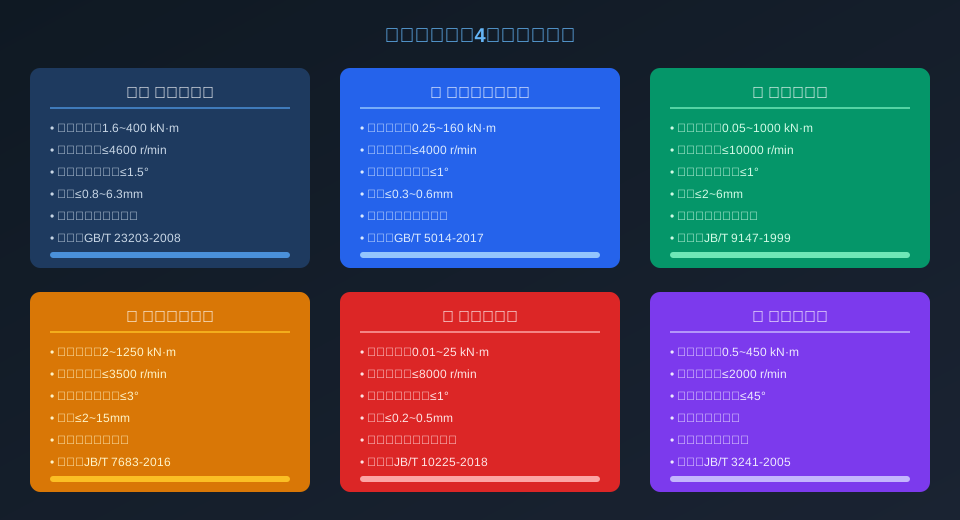
Gear vs. Diaphragm Couplings: Key Performance Differences
Gear and diaphragm couplings are the two most widely used types in the crane industry, and they differ significantly in core performance characteristics. According to the technical specifications in FEM 1.001 Couplings for General Purpose Bridge Cranes, the following parameters should be compared carefully before making a selection.
| Comparison Parameter | Gear Coupling (GCL Type) | Diaphragm Coupling (JZM Type) |
|---|---|---|
| Nominal Torque Range | 1.6~400 k N·m | 0.05~1000 k N·m |
| Maximum Rotational speed | 4600 r/min | 10000 r/min |
| Angular Misalignment Compensation Capacity | 1.5Degrees | 1.0Degrees |
| Radial/Axial Compensation | Radial0.8~6.3mm | Axial Compensation2~6mm |
| Lubrication Requirement | Requires Periodic Greasing(Lithium grease2No.) | Maintenance-Free Lubrication |
| Applicable Operating Conditions | Heavy-Duty Impact, Low Speed, High Torque | High Speed, High Precision, Frequent Start-Stop |
How to Select a Coupling Model and Safety Factor Based on Torque and Rotational Speed
The core engineering approach to coupling selection follows a three-step process: calculate torque, consult the selection table, and verify the safety factor. Kelude's engineering team has refined this into the following workflow:
Step 1: Calculate the design torque (Tc).
The formula is Tc = K × Tn, where Tn is the motor's rated torque (in N·m) and K is the service factor. For hoisting mechanisms, K ranges from 2.0 to 3.0; for crane bridge travel mechanisms, K ranges from 1.5 to 2.0; and for trolley travel mechanisms, K ranges from 1.3 to 1.8.
Step 2: Match Tc against the coupling selection table, ensuring that Tc does not exceed the coupling's rated torque [T].
For example: A Kelude 50t overhead crane with a hoisting motor rated at 45 kW and 740 r/min produces Tn = 9550 × 45/740 ≈ 581 N·m. With K = 2.5, Tc = 1453 N·m. A GCL-type gear coupling with a rated torque of at least 1600 N·m should be selected.
Step 3: Verify the maximum rotational speed.
The actual operating speed of the coupling must not exceed 80% of its permissible speed (np). Diaphragm couplings offer a permissible speed of up to 10,000 r/min—well above the 4,600 r/min limit of gear couplings—making them the preferred choice for high-speed applications.
Additionally, TSG 51-2023 Crane Safety Technical Supervision Regulation requires a minimum safety factor of 1.5 for transmission systems in lifting appliances. When selecting a coupling, it is recommended to build in an extra 30%–50% torque margin beyond the calculated value.
Crane Coupling Shaft Alignment: 3-Step Inspection Method and 5 Acceptance Criteria
Coupling alignment accuracy is a decisive factor in service life. According to Kelude's after-sales data, approximately 62% of premature coupling failures are linked to poor shaft alignment. The following is the standardized on-site alignment procedure.
Step 1: Initial coaxiality adjustment.
Using a straightedge and feeler gauge, take measurements at four points (top, bottom, left, right) on the coupling's outer circumference. Adjust the shims under the motor base to bring radial deviation within 0.10 mm. Kelude cranes come standard with adjustable motor bases that allow fine-tuning within ±10 mm.
Step 2: Precision adjustment of flange face parallelism.
Mount a dial indicator on one half-coupling with the plunger contacting the mating flange face. Rotate the shaft slowly through 360 degrees and record the difference between the maximum and minimum readings. Face runout (the gap value) should be held within 0.03 mm per 100 mm of flange diameter.
Step 3: Hot-state recheck.
After the crane has run continuously for 2 hours, shut it down and re-measure the alignment while the equipment is still at operating temperature. If the deviation exceeds 1.5 times the cold-state reading, uneven thermal expansion is indicated, requiring realignment and the installation of heat-insulating pads.
| Inspection Item | Standard Limit Value | Detection Tool |
|---|---|---|
| Radial Displacement(Concentricity) | 0.05mm/100mm Shaft Diameter | dial indicator+Magnetic Base Indicator |
| Angular Deviation(Gap Opening Value) | 0.03mm/100mm Flange Diameter | dial indicator+Feeler Gauge |
| Axial Clearance | 2~6mm(According to Model Refer to Manual) | Feeler Gauge/optical flat |
| Bolttightening torque | According to GB/T 23203Table Value ±10% | Torque Wrench |
| Vibration Start Button RMS (Root Mean Square) | 4.5mm/s(No-Load) | Vibration Meter |
| Temperature Rise(Continuous Operation2h) | 40K(Gear Type)/30K(Elasticity Type) | Infrared Thermometer |
1.6~1250
Coupling rated torque range
Unit: kN·m
10000
Max speed for diaphragm couplings
Unit: r/min
62%
Share of early failures caused by
misalignment
0.05mm
Radial misalignment limit
(per 100mm shaft diameter)
2.0~3.0
Service factor K for hoisting mechanisms
Safety factor range
1.5
TSG 51-2023 minimum
safety factor requirement
📖 Related Reading
• ISO 4301 Crane Design Standard: 9 Load Combinations and Duty Classification Selection from A1 to A8
8 Common Crane Coupling Selection and Installation Issues — Solved
Q: When should I choose a gear coupling versus a flexible pin coupling for my crane?
A: Gear couplings are designed for heavy-impact duty cycles — typical in metallurgical and ladle cranes — with torque capacities up to 400kN·m. They require periodic lubrication with No. 2 lithium grease. Flexible pin couplings, by contrast, suit general purpose bridge cranes rated under 50t, for both hoisting and travel mechanisms. The nylon pins provide self-lubricating cushioning, which lowers maintenance costs. Kelude's recommendation: for duty classification of A6 or higher, go with gear couplings; for A3 through A5, flexible pin couplings are the better fit.
Q: What does GB/T 23203-2008 specify for coupling bolt tightening torque?
A: Appendix A of GB/T 23203-2008 provides recommended tightening torques for coupling bolts. For an M16 bolt, the values are 195 ± 20 N·m for property class 8.8 and 275 ± 28 N·m for class 10.9. Always use a torque wrench and tighten in a crisscross pattern over 2–3 passes — never torque down in a single pass. Kelude ships every coupling with a bolt torque calibration card for on-site reference.
Q: How do I troubleshoot abnormal vibration and noise from a crane coupling?
A: Work through this sequence: First, check shaft alignment with a dial indicator — realign if radial misalignment exceeds 0.10mm or face runout exceeds 0.05mm per 100mm. Second, inspect bolts for loosening and re-torque each one to spec. Third, examine gear teeth on gear couplings — replace if tooth thickness wear exceeds 15% of the original dimension. Fourth, visually inspect the diaphragm pack on diaphragm couplings for cracks or permanent deformation. Finally, measure bearing housing vibration velocity; if it exceeds 4.5mm/s, shut down and address the issue before resuming operation.
Q: How many years does a crane coupling typically last before replacement?
A: Service life varies by type: gear couplings generally run 5–8 years, flexible pin couplings 3–5 years (pins are wear parts and can be replaced individually), and diaphragm couplings can exceed 10 years for the main body. Actual life depends on duty cycle and maintenance quality. TSG 51-2023 requires coupling inspection during the biennial periodic inspection — replace immediately if any of these conditions appear: tooth wear beyond 15%, cracked elastomer, diaphragm deformation, or elongated bolt holes. Kelude offers full life cycle management services to help you plan replacements proactively.
