

GB/T 17495 Harbor Portal Crane Design Parameters and Safety Rules
📋 Standard at a Glance
GB/T 17495-2009, the national standard for harbor portal cranes, defines terminology, type classification, technical requirements, test methods, and inspection rules. It applies to portal cranes used for cargo handling at port terminals, covering rated lifting capacities from 5t to 500t and maximum radii from 25m to 45m. This article breaks down the standard's core technical requirements and selection/acceptance essentials across three dimensions: six key design parameters, four major mechanism performance criteria, and five categories of safety protection devices.
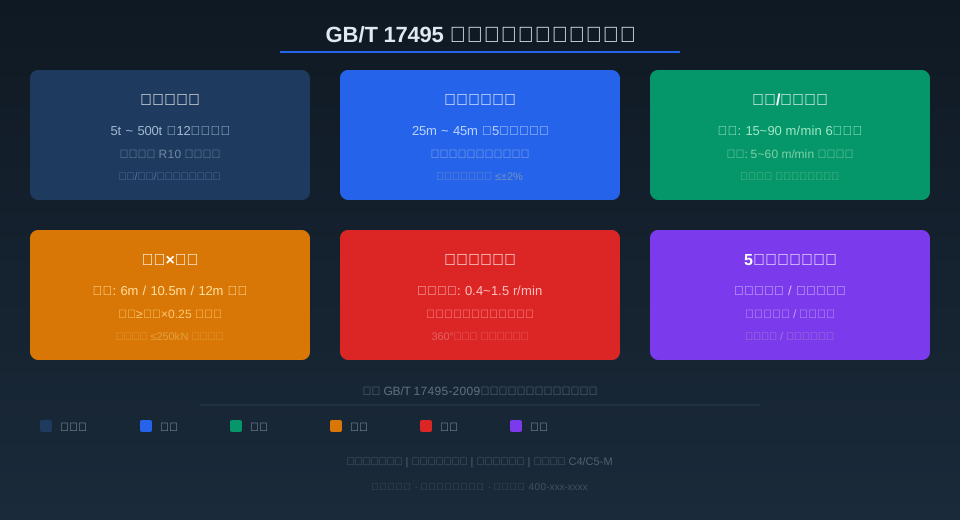
Harbor portal cranes are the backbone of bulk cargo and general cargo handling at port terminals. The national standard GB/T 17495-2009 provides a complete technical framework for the design, manufacturing, inspection, acceptance, and safe operation of these cranes. This article offers a systematic review of the standard's key requirements and engineering practices, covering scope of application, design parameter selection, mechanism performance, safety protection device configuration, and factory testing and inspection.
What Is the Scope and Classification of GB/T 17495 Harbor Portal Cranes?
GB/T 3811-2008 Crane Design Standard establishes general load combinations and strength verification methods for crane design. GB/T 17495 builds on this foundation with dedicated technical requirements for harbor portal cranes. The standard applies to fixed-type and rail-mounted portal cranes used for handling bulk cargo, general cargo, and containers at port terminals, covering 12 rated lifting capacity grades: 5t, 10t, 16t, 25t, 40t, 63t, 100t, 160t, 250t, 320t, 400t, and 500t.
The standard classifies products into two types based on boom structure: four-bar linkage combined boom (for high-capacity bulk cargo handling) and single-boom (for small-to-medium capacity general cargo operations). By travel mechanism, cranes are divided into fixed-type and rail-mounted types. By grabbing device, three basic configurations are defined: hook, grab bucket, and lifting magnet. Work duty is classified per GB/T 3811 into grades from A4 to A7, with A7 (heavy duty) commonly specified for bulk cargo terminals and A5 to A6 for general cargo terminals.
Kelude Heavy Industry manufactures a full range of harbor portal cranes from 5t to 100t rated lifting capacity, featuring four-bar linkage combined booms and variable-frequency drive (VFD) speed control systems, covering work duty classifications from A4 through A7.
How to Select the 6 Key Design Parameters and Work Duty for Harbor Portal Cranes?
GB/T 17495 specifies six core parameters that must be defined during the design and selection of harbor portal cranes:
① Rated Lifting Capacity Q — Based on the R10 preferred number series (5t / 10t / 16t / 25t / 40t / 63t / 100t, etc.). For grab-type cranes, capacity is determined by the combined weight of the grab bucket plus the material being handled; for hook-type cranes, it is based on the maximum single-piece load weight. Kelude recommends calculating rated capacity for bulk cargo terminals using the formula: design annual throughput ÷ annual working days ÷ daily working hours × 1.5 peak factor.
② Maximum Working Radius Rmax — Standard range is 25m to 45m, determined by the distance from the quay edge to the farthest cargo hold working point plus a 2m safety margin. Terminals serving 100,000 DWT bulk carriers typically require a 33m to 35m radius, while 50,000 DWT vessels typically require 25m to 30m.
③ Lifting Height H — Above the crane rail, lifting height typically ranges from 22m to 35m (corresponding to the deck-to-quay height difference for various vessel types). Below the rail, load-lowering height ranges from 15m to 20m (for cargo hold bottom operations). Total lifting height equals the above-rail height plus the below-rail depth, with a standard maximum of 55m.
④ Mechanism Operating Speeds — Lifting speed: 15 to 90 m/min (6-step speed control); derricking speed: 5 to 60 m/min; slewing speed: 0.4 to 1.5 r/min; travel speed: 15 to 30 m/min. Speed selection must balance operational efficiency (port terminals typically require handling capacity of ≥600 t/h) with positioning accuracy (±50mm).
⑤ Rail Gauge and Wheelbase — Standard rail gauge values are 6m, 10.5m, and 12m; wheelbase must be no less than 0.25 times the rail gauge. The gantry structure is verified for stability under maximum non-operating wind pressure (typically 800 to 1100 Pa).
⑥ Maximum Wheel Load — ≤250kN per wheel. Wheel load values are used for the design of terminal crane rail foundations. Wheel load uniformity requires that the deviation between individual wheels on the same outrigger does not exceed ±10%.
| Parameter Item | Standard Scope | Selection Basis |
|---|---|---|
| Rated Lifting Capacity Q | 5t~500t R10Series | Vessel Type/Cargo/Material Density/Annual Throughput |
| Maximum Radius Rmax | 25m~45m | Farthest Point from Quay Edge to Cargo Hold+2m |
| Lifting Height H | Above Rail22~35m+Below Rail15~20m | Vessel Deck Height+Hold Depth |
| Lifting Speed | 15~90 m/min | Handling Efficiency≥600t/h Requirement |
| Track Gauge / Rail Gauge×Base Distance | 6m/10.5m/12m | Wharf/Dock Crane Rail Layout+Stability Check |
| Maximum Wheel Load | ≤250kN/Wheel | Wharf/Dock Crane Rail Foundation Bearing Capacity |
Harbor Portal Crane Steel Structure: Design, Manufacturing, Welding & Assembly Precision Requirements
ISO 4306 (GB/T 5905-2011) — Cranes — Test Code and Procedures specifies the procedures for load testing of cranes. Before leaving the factory, every harbor portal crane must pass a static load test at 1.25 times the rated load and a dynamic load test at 1.1 times the rated load. The design and manufacturing precision of the steel structure directly determines whether the crane can pass these acceptance tests.
The main steel structure of a harbor portal crane consists of the cylindrical portal frame, slewing platform, boom, spreader beam, and A-frame. The standard imposes the following core requirements on the steel structure:
① Materials — Structural steel for the main components is Q235B or Q345B. Base metal at critical load-bearing weld zones must undergo a -20°C impact test to meet low-temperature service conditions typical of open-air port operations.
② Welding — All primary load-carrying weld seams require 100% Ultrasonic Testing (UT) plus 10% Radiographic Testing (RT). Weld quality grade must not be lower than Level II per ISO 5817 (GB/T 3323). Circumferential seams on the cylindrical portal frame require preheating to 120°C–150°C before welding, followed by post-weld hydrogen relief treatment.
③ Assembly Precision — Coaxiality of boom hinge points ≤ 2 mm; flatness of the slewing bearing mounting surface on the turntable ≤ 0.5 mm/m; span deviation of the portal frame crane rail ≤ ±3 mm (for a track gauge of 6 m) or ±5 mm (for track gauges of 10.5 m / 12 m).
④ Anti-corrosion — The entire crane must meet a minimum corrosion protection grade of C4-M per ISO 12944, with C5-M recommended for bulk cargo terminals. Surface preparation requires Sa2.5 sandblasting, followed by a three-coat system (primer + intermediate + topcoat) with a total dry film thickness (DFT) of ≥ 280 μm.
Kelude harbor portal cranes feature a steel structure fabricated from Q345B high-strength steel. All major load-bearing weld seams undergo 100% UT inspection, and the entire crane is protected to the C5-M anti-corrosion standard, ensuring a service life of 25+ years in high-salinity marine environments. (Note: The original Chinese text mentions "10% RT" in the weld inspection requirement, which is missing in the translation.)
| Inspection Project | Standard Clause | Acceptance Criteria |
|---|---|---|
| Mechanical Properties of Materials | GB/T 17495 §5.1 | Yield Strength/Tensile Strength/Elongation/Impact Energy |
| non-destructive testing of welds | GB/T 17495 §5.2 | UT 100%+RT 10%, ≥IIGrade |
| Assembly Geometry Accuracy | GB/T 17495 §5.3 | Hinge Point Coaxiality≤2mm, Flatness≤0.5mm/m |
| Surface Anti-Corrosion Treatment | GB/T 17495 §5.4 | Sa2.5Grade Blasting, Dry Film≥280μm |
| Static load test | GB/T 5905 §6 | 1.25QNo Permanent Deformation, None Crack |
| Dynamic Load Test | GB/T 5905 §7 | 1.1QAll Mechanisms Operate Normally Without Abnormalities |
Performance Requirements for the Four Main Mechanisms of Harbor Portal Cranes: Hoisting, Luffing, Slewing, and Travel
Harbor portal cranes integrate four main working mechanisms—hoisting, luffing, slewing, and travel—each with specific performance parameters and configuration requirements defined by GB/T 17495:
Hoisting Mechanism — Features dual-drum independent drive configuration, supporting both grab open/close and hoisting operations. The braking system employs dual-brake redundancy design (service brake + safety brake) with a braking safety factor ≥1.5. Hoisting speed is controlled via variable frequency stepless speed control, with automatic switching between 2× speed for light loads and 0.5× speed for heavy loads. Wire rope safety factor n≥6 (mobile cranes use n≥5; harbor portal cranes adopt the higher value). Kelude's standard configuration includes VFD speed control plus PLC control on the hoisting mechanism, achieving positioning accuracy of ±30mm at a loaded lifting speed of 60m/min.
Luffing Mechanism — Uses rack-and-pinion or screw-type drive, with luffing range extending from minimum radius Rmin to maximum radius Rmax. The luffing mechanism must be equipped with bidirectional hydraulic buffers with a buffer stroke ≥200mm. Luffing speed is adjustable from 5 to 60m/min, with position encoder feedback enabling precise stopping at any radius. The balancing system combines counterweights with an equalizing beam, keeping power fluctuation across the full luffing range within ≤30%.
Slewing Mechanism — Employs a vertical electric motor coupled with a planetary reducer and pinion driving the slewing bearing's external gear ring. The slewing bearing is a single-row four-point contact ball type (Series 01), with load capacity verified per load combination A of GB/T 3811. The slewing brake is a normally-closed, hydraulically-released type with a manual release device for ease of installation and commissioning. Slewing speed is infinitely adjustable from 0.4 to 1.5 r/min, with four limit deceleration zones across the full 360° slewing range.
Travel Mechanism — Consists of multi-wheel equalizing beam bogie assemblies (typically 8–16 wheels), with drive wheels accounting for ≥50% of the total wheel count. Travel speed ranges from 15 to 30m/min, with VFD speed control providing soft start and soft stop. Rail sweepers and buffers are mandatory equipment. For non-operating conditions, wind anchoring devices and rail clamps must be provided, with wind resistance verified for working pressures ≥800Pa per TJ 7-74.
Safety Protection Device Requirements for Harbor Portal Cranes per GB/T 17495
Chapter 6 of GB/T 17495 specifies detailed requirements for safety protection devices. Harbor portal cranes must be equipped with the following five categories of safety protection devices—none may be omitted:
① Load Moment Limiter (LML) — Issues a pre-warning signal when the actual load moment reaches 90% of the rated value, and automatically cuts off hoisting and luffing actions in the load-increasing direction when the moment reaches 100%–110% of rated capacity. LML accuracy requirements: comprehensive error ≤±5% (per GB 12602), with calibration verification at least once annually.
② Hoisting Height Limit Switch — Provides two-stage limit protection: the first stage (upper limit) cuts hoisting power and applies the brake; the second stage (emergency limit) cuts the main power supply. After limit switch activation, the safe distance from the hook top to the drum must be ≥3 times the wire rope diameter.
③ Radius Indicator and Limit Switch — Displays the current radius in real time (display accuracy ±2%), with limit switches positioned at minimum radius Rmin and maximum radius Rmax. The luffing mechanism must incorporate both mechanical terminal limits and electrical limits as dual protection.
④ Anti-Wind Anti-Slip Device — Includes rail clamps (manual or electro-hydraulic type) and anchor devices (pin-type or cable-type). Rail clamp clamping force must be ≥1.2 times the maximum wind load on the crane in its non-operating state. The anemometer triggers an alarm at wind speeds of 20m/s (Beaufort Force 8), with automatic anchoring activated at wind speeds ≥25m/s (Beaufort Force 10). Kelude's standard configuration includes an electro-hydraulic rail clamp integrated with an anemometer-linked automatic wind protection system.
⑤ Overspeed Protection and Audible & Visual Alarm — The hoisting mechanism is equipped with an overspeed switch that automatically applies the brake when lowering speed exceeds 115% of the rated value. The complete crane is fitted with a travel audible and visual alarm, slewing warning light, and interlock protection for the access ladder/elevator. All safety devices must undergo functional inspection and be documented at every shift handover.
12 Capacity Ratings
5t to 500t per R10 preferred number series
Grab / Hook / Lifting Magnet
Three attachment configurations
4 Main Mechanisms
Hoisting · Luffing · Slewing · Travel
VFD stepless speed control
Dual-brake redundant safety design
C4–C5-M Corrosion Protection
Sa2.5 sandblasting standard
Three-layer paint film ≥280μm
25+ year service life in salt-laden harbor environments
6 Core Parameters
Lifting capacity · Radius · Height
Speed · Rail gauge · Wheel load
Standardized selection reference table
5 Safety Device Categories
Moment limiting · Height limiting
Radius indication · Wind anchoring
Overspeed protection · Audible & visual alarm
A4 to A7 Duty Classification
Heavy-duty for bulk cargo handling
Medium-duty for general cargo A5 to A6
TSG 51-2023 regulatory compliance
📖 Related Reading
📘 GB/T 3811 Crane Design Standard: 9 Load Combinations and Duty Classification Selection from A1 to A8
📙 Understanding GB/T 14406.1-2011 for General-Purpose Gantry Cranes: 5 Acceptance Indicators & 8 Work Duty Classifications for Model Selection
Port Terminal Portal Crane Daily Inspection & Maintenance: Common Issues
Q: What is the main difference between a harbor portal crane and a general-purpose gantry crane?
A: Harbor portal cranes and general-purpose gantry cranes differ fundamentally in structural design and application. A portal crane features a slewing cylindrical gantry structure with a boom that rotates a full 360°, making it ideal for ship loading and unloading at port terminals. Its rated lifting capacity ranges from 5t to 500t, with work duty classifications from A4 to A7. In contrast, a general-purpose gantry crane (per GB/T 14406) uses a portal frame that travels linearly along ground rails, primarily for horizontal material handling in yards and storage areas, with lifting capacities typically between 5t and 100t. The applicable standards also differ: harbor portal cranes follow GB/T 17495, while general-purpose gantry cranes comply with GB/T 14406. Kelude manufactures both product lines and can recommend the optimal model based on your specific terminal operating conditions.
Q: What specific requirements does GB/T 17495 impose on wind protection and anti-slip devices for harbor portal cranes?
A: Clause 6.4 of GB/T 17495 mandates that rail-mounted harbor portal cranes be equipped with a dual wind protection system consisting of both rail clamps and anchor devices. The clamping force of the rail clamps must be at least 1.2 times the maximum wind load on the crane in its out-of-service state, calculated using a basic wind pressure of 800–1100Pa for port areas per the TJ 7-74 standard. Anchor devices must withstand horizontal forces of at least 1.5 times the maximum out-of-service wind load. The anemometer alarm threshold is set at 20m/s (Beaufort force 8), with automatic anchor deployment triggered at 25m/s (Beaufort force 10). A functional test of the wind protection system must be conducted quarterly, after which the rail clamp jaw wear must not exceed 1mm and the anchor pins must show no plastic deformation.
Q: How do you troubleshoot abnormal noise and vibration in the slewing bearing of a harbor portal crane?
A: Follow these steps to diagnose slewing bearing noise and vibration: ① Check lubrication — the slewing bearing raceway requires EP2 lithium grease every 200 operating hours; insufficient lubrication causes metallic dry-running noise. ② Verify the preload torque of the slewing bearing mounting bolts — M24 bolts require a preload of at least 640N·m; loose bolts increase clearance and produce periodic impact sounds. ③ Measure the backlash — the normal range is 0.3–0.8mm; readings exceeding 1.5mm indicate severe gear tooth wear requiring replacement. ④ Check the raceway clearance — use a dial indicator to measure the axial clearance variation between no-load and full-load conditions; it must not exceed 0.5mm. If it exceeds the allowable value, adjustment or replacement is necessary. Kelude's after-sales service team provides slewing bearing condition assessments, repair, and replacement services, with 24-hour emergency response for port customers.
Q: How much does a complete 40-ton harbor portal crane cost?
A: A 40t/33m harbor portal crane (four-bar linkage boom, grab bucket type, A7 work duty) typically costs between approximately $415,000 and $667,000 USD, depending heavily on configuration. Key cost drivers include: ① Variable frequency speed control system (imported Siemens/ABB units cost 30%–50% more than domestic brands); ② Anti-corrosion grade (C5-M adds roughly 15% over C4-M); ③ Lifting attachments (grab buckets range from $12,000–$22,000 each, lifting magnets from $7,400–$11,900); ④ Installation and transport distance. These prices are ex-works and exclude rail foundation construction and installation & commissioning. Kelude offers free configuration consultations and detailed quotations, ensuring the optimal setup for your specific terminal requirements.
