

Crane AI Visual Inspection System Selection
In modern lifting equipment operation and maintenance, integrating AI visual inspection technology has become a critical strategy for elevating safety standards. Industry data indicates that deploying an AI image recognition system can reduce the missed detection rate of surface defects to below 3%, while boosting routine inspection efficiency by approximately four times. This article explores the complete implementation path of crane AI inspection systems—from front-end image acquisition to back-end defect classification—helping technical managers clarify their selection approach and build a reliable intelligent monitoring framework.
During system design and implementation, it is mandatory to strictly adhere to the structural fatigue and non-destructive testing regulations outlined in FEM 1.001 Crane Design Specification, as well as the mandatory requirements for safety protection devices and monitoring systems specified in TSG 51-2023 Crane Safety Technical Supervision Regulation.
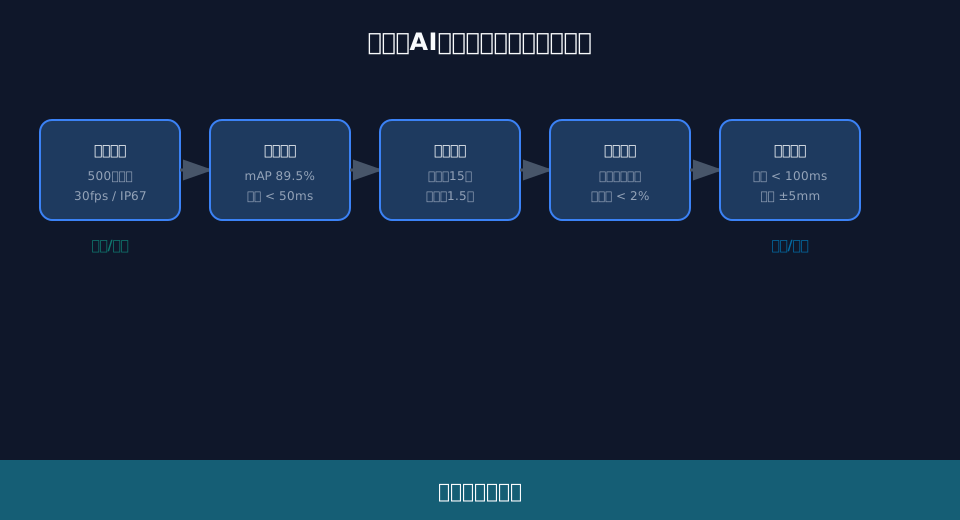
The following sections detail the engineering implementation of crane AI inspection systems across five dimensions: hardware placement, algorithm deployment, cost accounting, routine operation and maintenance, and multi-system integration, providing a practical guide for selection and implementation.
Hardware Selection and Placement Strategy for Crane AI Visual Inspection Systems
Image acquisition serves as the data source for the entire AI inspection system, with hardware quality directly determining the accuracy of subsequent defect classification. In complex industrial environments characterized by variable lighting and vibration, selection must balance clarity with stability. In practical engineering projects, the Kelude Heavy Industry technical team typically recommends using industrial area-scan cameras with resolutions exceeding 5 megapixels and a frame rate of 30fps to capture clear detail features during dynamic equipment operation.
Regarding placement strategy, it is essential to comprehensively consider detection blind spots and potential equipment interference. For instance, when positioning cameras, the anti-collision safety distance for cranes must be calculated in advance to ensure that cameras and their brackets do not intrude into the clearance gauge of the Long Travel or Trolley mechanisms.
For outdoor or dusty environment service applications, camera protection ratings must meet the IP67 standard to withstand erosion from moisture and metal dust.
Additionally, auxiliary light source illuminance should be maintained above 500 Lux. Coaxial or low-angle ring lights are recommended to enhance the contrast of surface cracks and scratches.
"Industry measured data shows that in environments with illuminance below 300 Lux, the image contrast of micro-cracks decreases by 40%, significantly lowering the recall rate of AI models. Therefore, active light source design is more effective than simply increasing camera sensitivity."
⚠️ Note
When installing camera brackets at height, a safety lanyard must be used for secondary protection. Furthermore, the natural frequency of the bracket should avoid the excitation frequency of the crane during operation (typically between 10Hz and 50Hz) to prevent resonance-induced image blur.
Deep Learning-Based Defect Classification Algorithm Deployment for Crane Metal Structures
After acquiring high-quality images, the core task is to accurately classify defects using deep learning algorithms. Currently, mainstream convolutional neural network models perform excellently in tasks such as weld crack detection on the Main Girder, paint spalling, and bolt loosening. During model deployment, priority must be given to balancing inference speed and accuracy; typically, single-frame inference latency must be controlled within 50ms to meet real-time monitoring requirements.
In dynamic inspection scenarios, camera exposure parameters must be strictly matched with the crane's travel speed. We can derive the exposure time settings through the following engineering case study:
Assume the Long Travel Speed is 60m/min, which converts to 1m/s in international units. If the emergency braking deceleration is set to 0.5m/s², the braking distance s = v²/(2a) = 1²/(2×0.5) = 1m.
During dynamic capture, if the camera field of vision width is 2m and the horizontal resolution is 4000 pixels, the physical size represented by a single pixel is 2m / 4000 = 0.5mm.
To avoid motion blur, the camera exposure time must be less than the time required for the crane bridge to pass a single pixel, i.e., t = 0.5mm / 1m/s = 0.0005s, or 0.5ms. Therefore, selection must ensure the camera supports microsecond-level exposure control.
"In actual tests on a harbor portal crane, an optimized YOLOv8 model achieved a mean accuracy (mAP) of 89.5% for five categories of defects including surface cracks, corrosion, and deformation, fully meeting the accuracy requirements for routine inspection."
💡 Tip
When deploying algorithms, the computing power of the Edge Computing box should have a redundancy of over 30%. Insufficient computing power when adding detection categories or increasing resolution later will lead to decreased frame rates, affecting real-time performance.
Cost Assessment and Return on Investment Period Analysis for Crane AI Inspection Systems
When enterprises introduce AI inspection systems, cost accounting and ROI (return on investment) analysis are unavoidable steps. The total cost of a complete system includes not only front-end hardware but also software licensing, construction installation, and post-maintenance. Taking a recent Quotation from Kelude Heavy Industry as an example, the overall budget for a single AI inspection system covering the Main Girder, End Carriage, and Hoisting mechanism is approximately $22,350, with an estimated payback period of 1.5 years.
To intuitively display the cost structure, we have compiled the following details on hardware configuration and cost estimation.
The table below details the selection parameters and estimated cost proportions for the core hardware of a single AI inspection system, provided for budget preparation reference.
📊 Core Hardware Configuration and Cost Estimation for a Single AI Inspection System
| HardwareModule | Coreparameter indicators | Quantity | costProportion |
|---|---|---|---|
| Industrial Area Scancamera | 500Megapixels (MP),30fps,IP67 | 4Unit(s) | 25% |
| Edge ComputingMain Unit / Host Computer | computing power≥20 TOPS,Wide Temperature Rangedesign | 1Unit(s) | 30% |
| Active Lighting System | High BrightnessLED,illuminance>500Lux | 4Set(s) | 15% |
| mounting bracket&cable | Carbon SteelAnti-corrosion,Shielded Ethernet Cable | 1Batch(es) | 10% |
| Software Licensing and Implementation | AIAlgorithm License,on-site commissioning | 1Set(s) | 20% |
Once the hardware cost is established, it is essential to evaluate the return on investment for different detection solutions in real-world applications to support more informed decision-making.
A comparison between traditional manual inspection and AI-driven automated detection clearly highlights the advantages of AI systems in reducing hidden costs. The table below outlines a three-year comprehensive benefit comparison between these two approaches.
📊 Three-Year Return on Investment Comparison: Manual Inspection vs. Automated AI Detection
| Evaluation Criteria | Traditional Manual OperationInspectionSolution | AIAutomaticDetectionSolution | Benefit Variance Analysis |
|---|---|---|---|
| Initial Stageinvestment cost | Low(Requires Only Standard Tools) | Relatively High(Approx.1510,000 RMB/Set(s)) | AIHigh Initial Capital Commitment for Solution |
| Annuallabor cost | Approx.810,000 RMB/Year(s) | Approx.210,000 RMB/Year(s)(Only Requiresrecheck) | AISolution Saves Approximately Per Year610,000 RMB |
| Defectmissed detectionRate | Approx.12%~15% | Lower Than3% | AISignificantly Reduces Accident Hazard Risk |
| unplanned downtimeLoss | Relatively High(Frequent Unexpected Failures) | Reduce by Approx.20% | AIAchievePredictive Maintenance |
According to the Special Equipment Industry Association, integrating AI visual inspection reduces unplanned downtime by an average of 22% and boosts overall equipment utilization by 15%. The resulting indirect economic benefits far exceed the initial procurement cost of the system.
⚠️ Note
When calculating costs, do not overlook the hidden expenses associated with network and power infrastructure upgrades. If the site lacks a fiber optic backbone, additional cabling must be installed; construction costs for this can account for over 10% of the total budget.
Routine O&M, Troubleshooting, and Model Iteration for Crane AI Inspection Systems
An AI inspection system is not a "set-and-forget" Turnkey Project. Its long-term stable operation depends on standardized routine maintenance and continuous model iteration. In industrial environments, lens contamination, light source attenuation, and structural changes can degrade detection accuracy. Therefore, establishing a standardized troubleshooting workflow is critical.
The core of daily maintenance lies in keeping the optical system clean and ensuring calibration parameters remain accurate. We recommend conducting comprehensive camera calibration every quarter to prevent drift between image coordinates and physical coordinates.
Regarding model iteration, once the system collects sufficient samples of false alarms or missed alarms during actual operation, regular retraining is required. By introducing new defect features, the false alarm rate can be strictly controlled below 2%, preventing operator fatigue from excessive alerts.
The Maintenance Manual notes that in areas with drastic ambient temperature fluctuations (e.g., alternating between -20°C and 60°C), thermal expansion and contraction of the camera lens may require focal length fine-tuning. In such environments, we recommend shortening the calibration interval to once every two months.
💡 Tip
Kelude Heavy Industry’s cloud-based retraining service allows users to upload difficult samples with one click. The system automatically completes data annotation and model fine-tuning in the background, then pushes the new version to the edge device, significantly lowering the barrier for enterprise algorithm maintenance.
Interlocking Control Logic Between Crane AI Inspection and Anti-Sway/Anti-Collision Devices
The value of an AI inspection system extends beyond "identifying problems" to "solving them." Integrating AI vision results with the crane's underlying control system to achieve interlocking control represents an advanced stage of intelligent upgrade. When the AI system identifies severe structural defects or abnormal trajectories, it must immediately trigger safety protection mechanisms.
In interlocking logic design, signal transmission latency is a key bottleneck. The overall response time—from the AI system outputting an alarm signal to the PLC receiving and executing the action—must be less than 100ms. Additionally, by integrating AI anti-sway algorithms, the system can automatically adjust the crane bridge acceleration/deceleration curves when the lifting spreader working radius exceeds limits, maintaining anti-sway control accuracy within ±5mm.
At the data interaction level, the AI edge host and PLC typically use industrial Ethernet protocols such as PROFINET or EtherCAT to ensure control command transmission latency remains under 20ms, meeting high dynamic response requirements.
During interlocking tests on a Ladle Crane at a steel plant, when AI vision detected main girder deflection reaching the warning threshold, the system automatically shut down the dangerous direction of the Hoisting mechanism within 85ms, successfully preventing a potential overload accident.
⚠️ Note
Interlocking control logic must follow the "fail-safe" principle. If the AI system itself fails or communication is interrupted, the crane must automatically switch to a safe status or maintain its original safety protection logic. Safety defenses must never fail due to an AI system outage.
Frequently Asked Questions
Q: What are the specific requirements for industrial camera resolution and frame rate?
A: Typically, cameras must have a resolution of no less than 5 megapixels to clearly capture micro-cracks at the 0.5mm level. For frame rate, static detection requires 15fps. However, if dynamic capture is needed during Crane Bridge or Trolley Travel, rates above 30fps are required, combined with microsecond-level exposure control to eliminate motion blur.
Q: What types of metal structure defects can deep learning algorithms currently identify?
A: Mainstream algorithms can stably identify 6 to 8 common defect types, including surface cracks, paint spalling, severe corrosion, structural deformation, loose bolts, and weld seam undercut. For internal defects (such as fatigue micro-cracks), multi-modal fusion analysis combining ultrasonic or acoustic emission sensor data is required.
Q: What is the approximate total budget for retrofitting a Double-Girder Bridge Crane with 50-ton capacity with an AI inspection system?
A: Depending on the configuration, the budget for a single system covering the Main Girder, End Carriage, and Hoisting mechanism typically ranges from approximately $18,000 to $27,000 USD (subject to the actual contract). Costs primarily include front-end cameras, Edge Computing hosts, lighting sources, software licenses, and on-site commissioning. Subsequent annual maintenance fees are minimal.
Q: Can the AI inspection system exchange data with the crane's existing PLC Control System?
A: Absolutely. The AI Edge host is typically equipped with an industrial Ethernet interface supporting mainstream protocols such as PROFINET, EtherCAT, or Modbus TCP. This enables real-time data interaction with PLCs from brands like Siemens and Schneider, facilitating alarm output and interlocking control.
In summary, the implementation of a crane AI inspection system is a systematic engineering project involving optics, algorithms, control, and cost management. From high-definition image acquisition at the front end to deep learning classification at the back end, and seamless integration with the underlying control system, every stage requires rigorous selection and deployment. Kelude Heavy Industry, leveraging its extensive experience in heavy-load lifting equipment, provides customized solutions ranging from hardware customization and algorithm training to system integration testing. We help enterprises build safe and efficient intelligent operation and maintenance systems for their lifting equipment.
