

Retrofit or Replace? Crane Automation Retrofit Decision Logic
📋 Key Summary
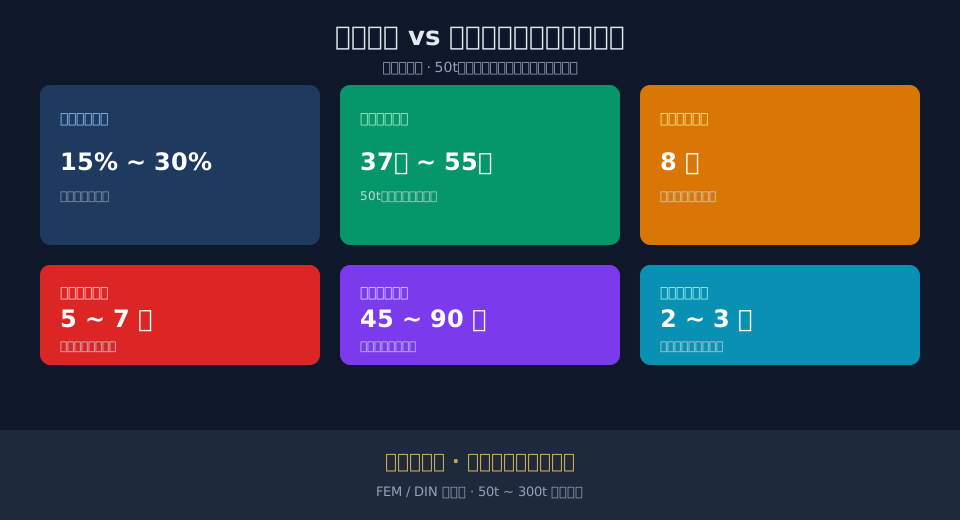
Should you retrofit an aging crane with a VFD or replace it outright? Start with three numbers: a VFD and automation retrofit typically costs only 15%–30% of a new crane's purchase price; a conventional replacement for a 50-ton overhead crane runs in the range of roughly ¥370,000–¥550,000 (about $55,000–$81,800), while high-end customization to European standards is subject to the actual contract; and the retrofit only pays off if the steel structure has more than 8 years of remaining life. This article breaks down the decision logic across three dimensions: investment, service life, and downtime cost.
In the fall of 2025, the equipment manager at a steel structure plant in Changzhou, Jiangsu, faced a dilemma. The 50-ton overhead crane in his workshop had been in service for 12 years. Its old control cabinet, built on relays and contactors, occasionally let the load slip during hoisting, and the contactor contacts had to be replaced two or three times a year. Yet the main girder showed no visible deformation. Two suppliers submitted quotes: one for a full variable frequency drive retrofit, the other for a brand-new crane.
The retrofit quote came in at about ¥100,000 (roughly $14,900); the replacement quote at about ¥420,000 (roughly $62,500). The manager's instinct was to save where he could and go with the retrofit. But after completing an assessment, engineers at Kelude Heavy Industry reached a different conclusion: the retrofit cost isn't just that ¥100,000 figure — first you have to determine how much "life" this crane has left.
A VFD Retrofit Fixes the Control System; a New Crane Resets the Steel Structure's Life
Many people treat "retrofit or replace" as a question of price. In reality, it's two separate questions: a retrofit addresses shortcomings in the control system, while a replacement resets the crane's entire service-life clock. The two act on completely different parts of a crane — which is exactly why comparing quotes alone leads to the wrong conclusion.
A VFD retrofit follows a path that goes from shallow to deep, layer by layer. At the shallowest level, relay control is replaced with variable frequency speed control, turning the start and stop of the hoisting mechanism and the bridge and trolley travel from on/off switching into stepless motion — this layer solves impact and load slipping. The second layer adds a Programmable logic controller (PLC), consolidating the wiring logic of dozens of intermediate relays into a single program — this layer solves the difficulty of fault diagnosis. The third layer completes the safety protection devices, including overload protection, limit switches, and door interlocks — this layer solves compliance. The deepest layer connects to positioning and dispatching systems, transitioning toward semi-unmanned and unmanned operation — this layer solves labor and efficiency.
A VFD and PLC retrofit isn't just a matter of swapping in a frequency inverter. The control cabinet's Protection Rating (IP), grounding continuity, and overcurrent protection settings must all be verified at the same time — this is the foundation of any electrical retrofit. As for whole-machine parameters such as work duty and load spectrum, you have to go back to FEM 1.001 Crane Design Standard to check them: under the A-class work duty system, a crane designed to A6 level has its hoisting mechanism selection based on that work duty from the start. A retrofit only changes the method of execution — it doesn't change the design basis.
Replacement is entirely different. It simultaneously resets three service-life clocks — the metal structure, the working mechanisms, and the electrical system — and a new crane starts fresh with a design life of approximately 20 years under the design specification. So the real comparison between retrofitting and replacing isn't which quote is cheaper, but whether "the 70% you save" is worth more than "the extra decade-plus of life you gain."
Five Decision Dimensions: Investment, Life, Accuracy, Energy, and Downtime
Only by placing retrofit and replacement side by side in the same parameter matrix do the differences become clear. When Kelude Heavy Industry conducts a retrofit assessment, it never quotes just a retrofit price — it first lays out the following five dimensions, item by item.
On investment, a retrofit typically costs only 15%–30% of the new crane price, putting far less pressure on cash flow; replacement is a one-time, full-value outlay. On service life, a retrofit does not reset the structure's life — how far it can go depends on how much margin the metal structure has left; replacement starts the 20-year clock over. On accuracy, a VFD with encoder-based closed loop can bring an old crane's positioning to within roughly ±5 mm, while a new crane's mechanical accuracy typically reaches ±3 mm — a gap that widens in high-precision operating conditions.
On energy consumption, variable frequency speed control delivers a measured energy-saving effect of 20%–30%, and the hoisting mechanism no longer wastes energy during lowering and braking. On downtime, an on-site retrofit typically restores production within 5–7 days, whereas a full replacement involves a 45–90 day production scheduling and delivery time — a decisive factor for workshops that can't afford to stop. Only when all five dimensions are weighed together do you get the complete picture for your decision.
| Decision Dimension | variable frequency drive retrofit | Full Crane Replacement | Order-of-Magnitude Reference | Decision Weight | Decision Signal |
|---|---|---|---|---|---|
| One-Time Investment | of Full Crane Price15%~30% | Full Purchase | Retrofit10×10,000 vs Full Crane Replacement40Order of ×10,000 | High | Priority Retrofit if Cash Flow Tight |
| remaining life | No Reset,ViewstructureRemaining Margin | Per20Yeardesign lifeNo Reset | structureRemaining Margin≥8Retrofit Possible per Year | High | Must Replace if Margin Insufficient |
| Positioning Accuracy | Variable Frequency Drive (VFD)+Encoder±5mmOrder of ×10,000 | New Crane±3mmOrder of ×10,000 | Affected bymechanism wearandCrane RailImpact | Medium | HighAccuracyoperating conditionPriority Replacement |
| Operationenergy consumption | Variable Frequency Drive (VFD)Electricity Savings20%~30% | New Crane Baselineenergy consumption | Hoisting / LiftingBrakingEnergy Recovery | Medium | Priority Retrofit if Electricity Cost Sensitive |
| downtime | 5~7Day | 45~90Daydelivery time | SiteRetrofit vs Full Craneproduction scheduling | High | Priority Retrofit if Production Cannot Stop |
Retrofit or Replace? Check Structural Remaining Life First, Then Duty Match, Then Life Cycle Cost
The order of decisions matters. Kelude Heavy Industry recommends breaking the retrofit-or-replace question into three sequential steps: assess the structure first, then evaluate duty match, and finally run the numbers — rather than jumping straight to comparing quotations.
Step 1: Assess the remaining life of the metal structure. Start with non-destructive testing and a Remaining Life Assessment. If main girder deflection exceeds limits, critical weld seams show fatigue cracks, or the metal structure has less than 8 years of remaining life, the retrofit path should be closed immediately. The structural "root" is no longer sound — upgrading the control system on top of it is like building on a crumbling foundation.
Step 2: Evaluate duty match. Check whether the old crane's Work Duty classification, Lifting Capacity, and Span still align with current process requirements. If production capacity has been upgraded and the required Lifting Capacity now exceeds the original design, a retrofit cannot close that parameter gap — replacement is the right call.
Step 3: Run the full life cycle cost comparison. Project the energy savings and efficiency gains over 8–10 years after retrofit, combine them with the one-time investment, and place that total on the same timeline as the life cycle cost of a new crane. Factor in downtime cost before making the final decision.
There is also a compliance cost that is easy to overlook. Under TSG 51-2023 Crane Safety Technical Supervision Regulation, major retrofits of lifting appliances require notification and inspection procedures, and periodic inspection after completion must be carried out according to the new condition. This administrative and time cost should be factored into the decision from the start — not discovered after the retrofit is finished.
📋
Adequate structural margin
No significant fatigue cracks found in main girder and end carriage NDT
📋
Mechanisms sound, control cabinet aging
Faults concentrated in relays and contactors
📋
Production cannot tolerate long downtime
Retrofit 5–7 days vs. new crane delivery of several months
📋
Tight cash flow constraints
Retrofit investment is only 15%–30% of replacement cost
📋
Duty match still acceptable
Lifting Capacity, Span, and Work Duty still meet process needs
📋
Electricity cost is a major expense
VFD retrofit can cut energy consumption by 20%–30%
📋
No high-accuracy positioning required
Existing crane rail and mechanism accuracy is sufficient
📋
Passed periodic inspection
Structural safety judged fit for continued service
The more of these eight signals apply, the more a retrofit pays off. Conversely, if structural margin or duty match shows a red flag, it is time to switch decisively to replacement. When Kelude Heavy Industry prepares proposals for customers, it typically provides both retrofit and replacement comparisons side by side — so the decision rests on data, not gut feeling.
| costItem | variable frequency drive retrofit | Full Crane Replacement | Difference Description |
|---|---|---|---|
| One-Time Investment | Approximately10Order of ×10,000 CNY | Approximately42Order of ×10,000 CNY | RetrofitApproximately One-Quarter of Replacement |
| Annual Averagemaintenance | OldmechanismmaintenanceRising Year by Year | Near Zero in Early Yearsmaintenance | Before Replacement5Yearmaintenance costLow |
| Annual Averageenergy consumption | Variable Frequency Drive (VFD)Electricity Savings Afterward20%~30% | Per New Crane Baselineenergy consumption | RetrofitRecovered Year by Year Through Electricity Cost Savings |
| Expected Service Life | Additional Service8~10Year | Per20Yeardesign life | Replacement Service Life Significantly Longer |
📖 Related reading: Crane costs should be calculated over 20 years: life cycle cost comparison of imported vs. domestic cranes | Why European Standard Cranes cost more: the technical cost behind FEM and DIN standards | Maintenance cost differences and selection basis: three-in-one gearbox vs. split-type gearbox
FAQ
Q: How many times more expensive is a full crane replacement compared to a VFD retrofit?
A: A retrofit typically costs 15%–30% of the original crane purchase price. For a 50 t crane, a retrofit runs around $14,900, while a replacement runs around $59,500 — a difference of 3 to 4 times. However, a retrofit does not reset the service life of the metal structure, so another overhaul decision may be needed in 8–10 years. A new crane, by contrast, starts with a 20-year design life. The two options operate on entirely different time scales.
Q: How do I determine whether the metal structure of an old crane is still safe to use?
A: Three results matter most: whether main girder deflection exceeds the specified limit, whether non-destructive testing of critical welds reveals any fatigue cracks, and whether the Remaining Life Assessment shows more than 8 years of service life left. Only when all three meet the standard should a retrofit be recommended. If any one fails, replacement is the right call — structural safety is the bottom line for the entire decision.
Q: How much does a complete VFD retrofit cost for a 50 t overhead crane?
A: The industry-typical range is around $14,900. The exact figure depends on whether hoisting, long travel, and cross travel are all converted to variable frequency drive, and whether the PLC and safety protection devices are upgraded at the same time. For Kelude Heavy Industry's high-end customization projects, pricing is subject to the actual contract — the scope of the retrofit and the choice of Frequency Inverter brand both affect the final quotation.
Q: After a retrofit, how many more years can the crane run — will it need replacing again in a couple of years?
A: The remaining life of the metal structure is the key variable. If the structural assessment shows more than 8 years of remaining life, the crane can reliably run another 8–10 years after a retrofit. If the assessment shows only 3–5 years left, the retrofit math doesn't work out — direct replacement is the better value. That's why understanding the structural service life before deciding matters far more than comparing quotations.
