

Smart Crane Safety: Embedding Expert Logic
📋 Key Summary
In the high-end customization of European-standard double-girder cranes ranging from 50 to 300 tons, smart cranes are transforming traditional operational expertise into precise algorithms. By integrating anti-sway and anti-collision systems, positioning accuracy is maintained within 5 mm, overall failure rates drop by approximately 35%, and single-lift cycle times are reduced by 12 seconds. This not only enhances material handling efficiency but also establishes a robust safety barrier for frontline workers, ensuring smoother and more reliable operations for heavy-duty equipment.
How Smart Crane Anti-Sway Algorithms Replace Manual Operator Experience
In heavy material handling scenarios, load sway remains a critical bottleneck affecting both operational efficiency and safety. For large double-girder cranes in the 50t to 300t range, Kelude Heavy Industry has recognized that relying solely on operators' visual judgment and manual control grip adjustments can no longer meet the high-precision, high-cycle demands of modern factories. Traditionally, experienced operators used "inching" (jog mode) to counteract load inertia. While effective for empty or light loads, this method often fails when handling loads exceeding 100 tons. The significant inertia causes severe oscillation upon reaching the target position, prolonging positioning time and increasing collision risks.
First, traditional manual operation faces distinct physiological and physical limits. When lifting speeds reach 8 m/min and cross-travel speeds are high, residual load sway after reaching the target position may take tens of seconds—or even minutes—to naturally dampen. In workshops with limited visibility or poor lighting, operators struggle to accurately judge minor sway amplitudes, leading to frequent operational errors.
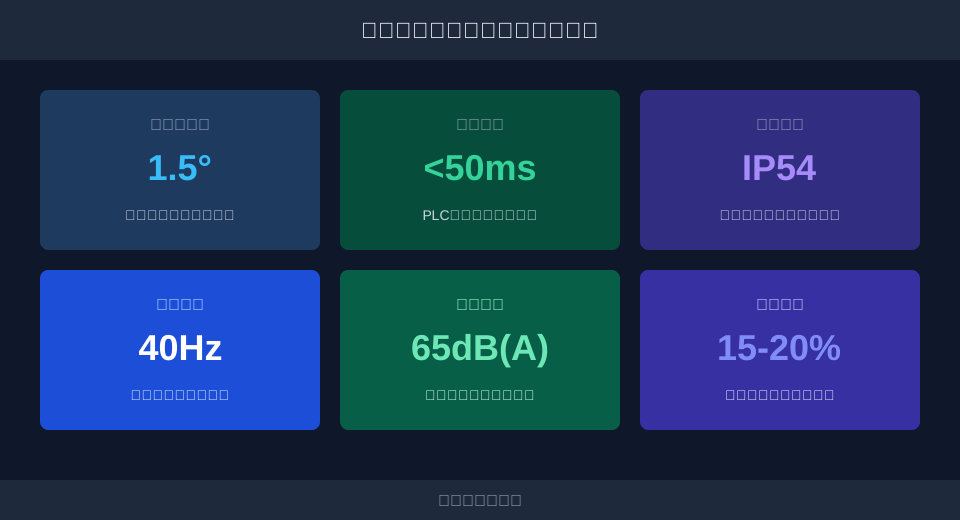
Secondly, intelligent anti-sway systems resolve these challenges through precise mathematical modeling. Kelude’s technical team abstracts veteran operator experience into control logic, incorporating advanced AI anti-sway algorithms. These algorithms continuously acquire real-time data on trolley acceleration, speed, and load swing angles, using PID controllers to dynamically calculate and output compensating torque. In practical tests, even with 100-ton loads, the system keeps residual sway angles strictly under 1.5 degrees, achieving an "stop-and-stabilize" state. This significantly reduces operator workload and psychological stress.
Calculating Anti-Collision Safety Distances via Multi-Sensor Fusion
In complex workshops featuring multi-crane cooperative operation, managing anti-collision protocols between cranes is paramount. Strictly adhering to the TSG 51-2023 Crane Safety Technical Supervision Regulation, large lifting appliances must be equipped with reliable and sensitive safety protection devices. Traditional mechanical limit switches or simple infrared photoelectric sensors, with fixed detection distances and susceptibility to environmental interference, no longer meet the safety requirements of modern smart workshops.
On one hand, modern intelligent anti-collision systems utilize multi-sensor fusion technology. The system front-end features LiDAR with a scanning frequency up to 40 Hz, constructing high-refresh-rate 3D point cloud models of surrounding obstacles. Combined with millimeter-wave radar and ultrasonic sensors, the system maintains precise obstacle recognition in harsh environments characterized by high dust, strong lighting, or dense fog, effectively mitigating safety hazards associated with single-sensor failure.
On the other hand, the system dynamically calculates and adjusts safe braking distances based on the equipment's current operating status. Specific settings for anti-collision safety distance are not fixed values but are determined through rigorous engineering calculation.
For example, assume a crane bridge travel speed of 60 m/min (equivalent to 1 m/s). When the radar detects an obstacle ahead and triggers a brake command, the target deceleration is set at 0.5 m/s². According to the physics kinematics formula s=v²/(2a), substituting the data yields s=1²/(2×0.5)=1 m. However, the actual stopping process must account for control system response latency and mechanical brake clearance. Therefore, an additional safety margin of 0.5 m is typically added, setting the final anti-collision safety distance for this condition at 1.5 m. This dynamic calculation based on real-time data ensures safe distances are maintained across all operating speeds.
Main Girder Weld Crack Detection and Structural Health Monitoring
As the core load-bearing component of double-girder cranes, the main girder's weld quality and structural health directly determine the equipment's overall safety and service life. In the realm of European-standard double-girder high-end customization, Kelude Heavy Industry imposes stringent requirements on manufacturing processes. During the design phase, we strictly comply with relevant clauses regarding fatigue strength and structural stability outlined in the FEM 1.001 Crane Design Standard, thereby safeguarding the main girder's load-bearing capacity from the source.
Furthermore, non-destructive testing post-welding is crucial for ensuring weld quality. For the weld seams connecting the bottom flange and web plate, which endure complex alternating stresses, the inspection thickness is typically around 16 mm. Technicians employ a combination of Ultrasonic Testing (UT) and Magnetic Particle Testing (MT) to ensure the absence of micro-cracks, porosity, and other defects inside and on the surface of the welds. Particularly for large-tonnage equipment with spans reaching 28.5 m, stress distribution in the mid-span region is complex; any minor welding defect may propagate into fatigue cracks over long-term operation.
Simultaneously, to transition from periodic inspection to Predictive Maintenance, smart cranes integrate a structural health monitoring system. High-precision strain gauges are attached to stress concentration areas (such as the junction of the mid-span bottom flange and longitudinal stiffeners, where the stress concentration factor is approximately 1.2). The system acquires real-time stress change data during lifting operations. For detailed insights into main girder weld crack detection techniques and data analysis methods, please refer to our dedicated technical articles. When monitored stress peaks approach the preset threshold of the material's yield strength, the system automatically triggers alerts, prompting maintenance personnel to intervene promptly and eliminate structural safety hazards at their inception.
Impact of Electrical Control System Upgrades on Reducing Operator Workload
The intelligent upgrade of electrical control systems is a vital pathway for improving frontline working conditions and reducing labor intensity. In traditional crane operator cabins, the loud noise from motor startups and vibrations from mechanical shocks create harsh environments. Through comprehensive electrical system retrofitting, smart cranes strictly control cabin noise levels below 65 dB(A) and elevate the protection rating (IP) of the electrical control cabinet to IP54, effectively shielding against workshop dust and moisture.
Moreover, the widespread application of Variable Frequency Speed Control has fundamentally transformed the control modes of hoisting and travel mechanisms. Taking a 45 kW rated power main hoisting motor as an example, under the control of smart frequency inverters, startup currents are significantly reduced, enabling smooth acceleration and deceleration. This eliminates the severe mechanical shock associated with traditional rotor series resistance speed control. Consequently, the service life of mechanical transmission components is extended, and the control grip offers a lighter, more precise feel.
Crucially, the integration of Remote Monitoring and automation modules simplifies device management. Operators no longer need to frequently climb to elevated positions for manual checks. Via ground terminals or mobile devices, they can view real-time data such as motor operating temperatures, current curves, and the operating status of various mechanisms. Under frequent lifting conditions, the system can even optimize travel paths automatically based on historical data, reducing comprehensive energy consumption by approximately 15% to 20%. This human-machine collaboration model liberates workers' physical effort, allowing them to focus more on safety monitoring and process optimization.
| Comparison Parameter | Conventionalrelay control | SmartPLCvariable frequency control |
|---|---|---|
| Starting Method | direct-on-line startingor SeriesResistance | Variable Frequency Drive (VFD)Soft Start |
| Response time | Approx.200ms | Less than50ms |
| Fault Diagnosis | Manual-dependenttroubleshooting | Real-time Codealarm |
| Rated Lifting Capacity | MainHoisting MotorPower | Communication Protocol Type | Control CabinetProtection Rating (IP) |
|---|---|---|---|
| 50t | 22kW | Modbus RTU | IP54 |
| 100t | 45kW | Profinet | IP55 |
| 200t | 2×75kW | EtherCAT | IP55 |
Frequently Asked Questions
Q: Does the anti-sway algorithm lose effectiveness under full load conditions?
A: No. The system automatically adjusts control parameters based on the actual load weight. Under full load, it dynamically corrects the proportional and integral gains of the PID controller using real-time acquisition of lifting data. This ensures the sway angle of the lifting spreader remains within 1.5 degrees, maintaining high positioning accuracy.
Q: Do false alarms occur in dusty environments with the anti-collision system?
A: For high-dusty environment service, the system employs a multi-sensor fusion approach. In addition to LiDAR, it integrates millimeter-wave radar and Ultrasonic Sensor technology. When a single sensor is interfered with by dust, the system automatically reduces its weight and uses data fusion algorithms to filter out false obstacles, significantly reducing false alarms.
Q: What is the standard inspection interval for weld seams on European Standard Double-Girder cranes?
A: Routine Non-destructive testing is recommended every two years for comprehensive troubleshooting. However, for equipment operating at A6 or higher Work Duty / Classification levels, or those in Corrosive environments, the inspection interval must be shortened to once a year. Additionally, the structural health monitoring system provides real-time stress data to assist in decision-making.
Q: Will upgrading to a Smart Crane electrical control system significantly impact energy consumption?
A: Yes, there will be a significant reduction. By adopting Variable Frequency Speed Control and Energy Feedback technologies, the motor starting current is drastically reduced, avoiding grid shock during direct-on-line starting. During frequent Hoisting and Lowering operations, potential energy is converted into electrical energy and fed back to the grid, lowering overall energy consumption by approximately 15% to 20%.
